TL;DR
Mistral is emphasizing sovereignty, open weights, and full-stack control to serve regulated European enterprises. While it may lag in reasoning benchmarks, its strategic niche could secure a durable position in the AI world.
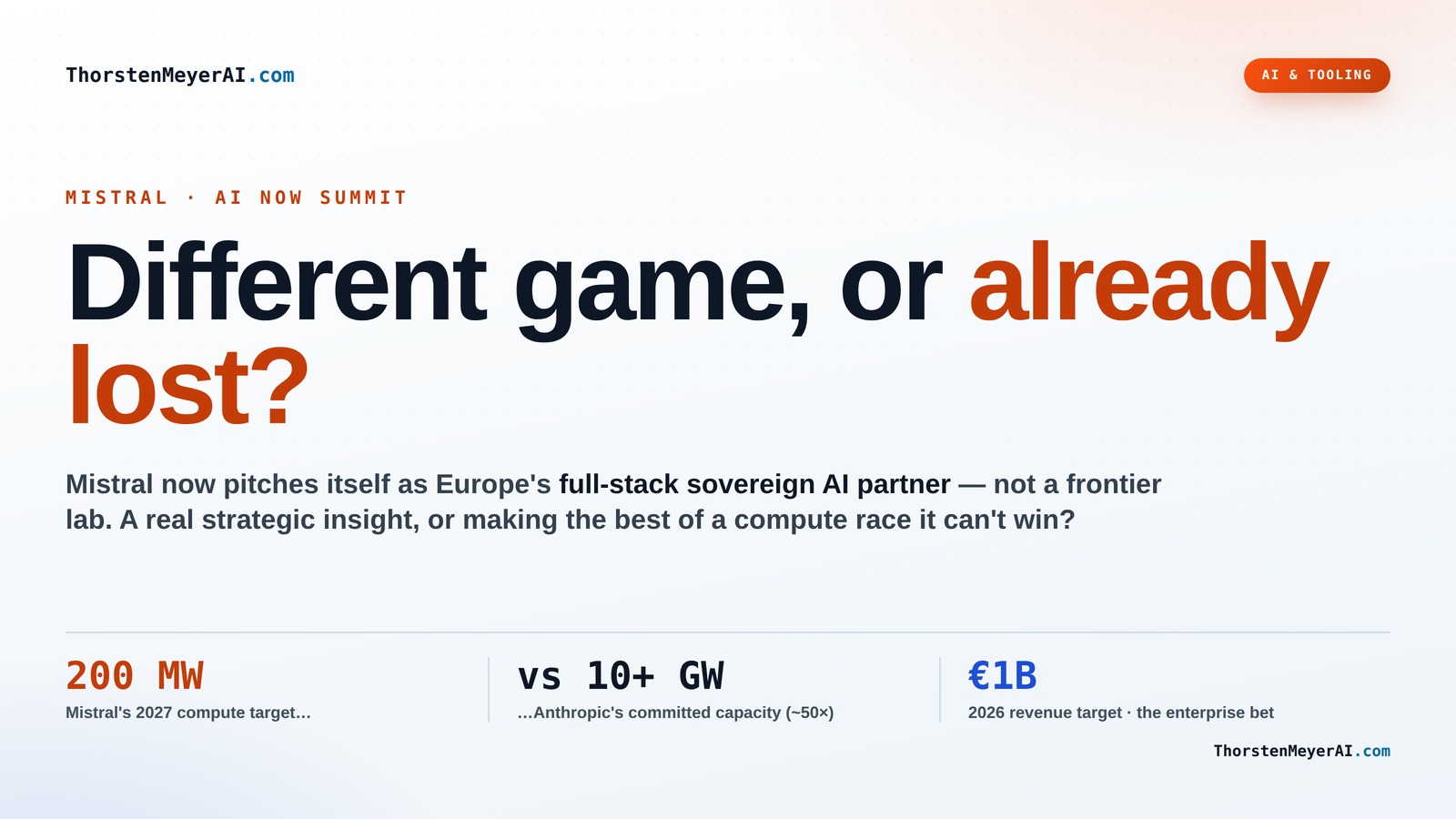
Different game, or already lost?
Mistral now pitches itself as Europe’s full-stack AI provider — compute, models, platform, consultancy — not a frontier-model lab. Is that a real strategic insight, or making the best of a race it can’t win? Both readings fit the same facts.
From model lab to full-stack provider
The clearest signal from the summit wasn’t a model — it was a posture. Heavy on enterprise logos and partnerships (ASML, BNP Paribas, Alexa+), light on new-model announcements. That absence is exactly what skeptics seized on.
Compute
40MW Paris DC + Sweden build · 200MW target by 2027
Models
Open & custom · efficient · you own and run them
Platform
Forge for custom models · Vibe for Work agent
Consultancy
Sales teams, integrators, EU provenance & support
enterprise AI platform software
As an affiliate, we earn on qualifying purchases.
As an affiliate, we earn on qualifying purchases.
Small & focused, or large & general?
Mistral bets on specialized small models. The claim isn’t that they win a reasoning leaderboard — they don’t. It’s that on the metrics that matter in production agent systems, a purpose-built small model wins. Flip the metric to see the case reverse.
Small specialized vs large general — by what you measure
In token-heavy agentic apps making hundreds of calls, speed/energy/cost compound. Toggle the metric.
full-stack AI development tools
As an affiliate, we earn on qualifying purchases.
As an affiliate, we earn on qualifying purchases.
Narrow models doing real work
Each is one model doing one thing efficiently — the tangible version of the strategy. Strong on their own terms; the open question is whether the bundle beats a free Chinese open-weight download.
On-prem KYC compliance
Mistral models run inside the bank’s walls for know-your-customer checks. Sensitive financial data never leaves. (BNP was Mistral’s first customer, 2023.)
Voxtral multilingual voice
A focused voice model powering Alexa+ across Europe — speed and efficiency over raw size.
Robostral industrial robotics
Plus a “physics AI” push (via the Emmi acquisition) into aerospace, automotive & semiconductor design and simulation.
Document AI / OCR at scale
Large-scale text extraction — the unglamorous, high-volume enterprise work small models excel at.
AI model deployment hardware
As an affiliate, we earn on qualifying purchases.
As an affiliate, we earn on qualifying purchases.
The strategy is downstream of the compute gap
Once you see the raw numbers, “why is Mistral behind?” answers itself — and the specialized-small-model strategy starts looking partly like a smart adaptation to a binding constraint, not a pure philosophical choice.
Compute & capital · Mistral vs a frontier leader, this same week
Not a knock — it’s the constraint that forces the efficiency-first, sovereignty-wedge strategy. Adapting intelligently to your position is what good strategy is.
European enterprise AI solutions
As an affiliate, we earn on qualifying purchases.
As an affiliate, we earn on qualifying purchases.
“I want them to win, but I’m worried”
That ambivalence is the most accurate read of where Mistral sits. The enterprise pivot gets read two opposite ways — and both deserve airing.
On-prem, real sales teams, the Koyeb deployment acquisition, EU provenance — exactly what regulated enterprises want, and stickier than consumer mindshare. Targeting €1B revenue in 2026 with 1,000 staff, up from 15 people and one customer in 2023. US closed-API labs structurally can’t match the sovereignty axis.
“Software consultancy with a data center,” not a foundation-model moat. Enterprise B2B is where European startups go when they can’t win consumer or world-scale SaaS. Why pay Mistral on-prem when you could run Qwen free? One paying Le Chat Pro user said the quality gap with frontier labs is now hard to ignore.
Key Takeaways
- Mistral’s move to full-stack, European-focused AI signals a shift from model size to control and sovereignty as key assets.
- On-prem models serve regulated industries best, but face competition from free open-weight models—Mistral’s support and provenance aim to justify their premium.
- Small, purpose-built models excel in deployment efficiency, but they won’t replace giants in reasoning-heavy tasks.
- Mistral’s revenue and client base reveal a strategic focus on Europe’s sovereignty-driven market, not just technological leadership.
- Deciding between AI solutions now hinges more on control, compliance, and support than raw model performance.
Why Mistral’s Full-Stack Play Changes the Rules
Mistral isn’t just building models anymore. It’s positioning itself as a complete AI provider—compute, models, platform, and support. CEO Arthur Mensch’s words about transforming electrons into tokens aren’t just poetic—they signal a shift from model lab to full-stack enterprise.
By owning everything from data centers in Europe to the models themselves, Mistral targets regulated industries that demand control and transparency. For example, their 40MW data center near Paris, with plans for 200MW by 2027, aims to give European companies infrastructure independence.
This approach stands out because, unlike OpenAI or Anthropic, which sell API access, Mistral offers self-hosted models tuned for compliance and local control—something European regulators and banks crave.

Are On-Prem Models the Future or Just a Niche?
Mistral’s main pitch: on-premises AI for Europe’s regulated sectors. Major clients like BNP Paribas run Mistral models inside their own data centers to keep sensitive info private. That’s a game-changer—regulations like GDPR make this a non-negotiable for many.
But here’s the catch: why pay Mistral when open models like Qwen are free? The answer lies in support, customization, and European provenance. For industries that need compliance and traceability, paying for a trusted local vendor can outweigh free options.

However, skeptics argue this is a niche play—since open weights are improving fast, cheaper, and more flexible. The open question remains: can Mistral justify its premium in a world where open models get better every quarter?
Small, Fast, Focused Models: The Secret Sauce?
Mistral champions small, purpose-built models over giant general-purpose ones. They argue that for real-world applications—like voice assistants or document processing—speed, cost, and energy efficiency matter more than raw reasoning power.
Think of a 7B model powering Amazon’s Alexa+ in Europe or a tiny OCR model used by the European Patent Office. These models do one thing exceptionally well, at a fraction of the cost and latency of large models.
But here’s the debate: can small models really replace the giant, reasoning-focused models that dominate benchmarks? Or are they just a practical solution for specific industries? The truth is, both are right—small models excel in deployment, but giant models still lead in general reasoning.

The Real Win: Sovereignty or Model Power?
The core question is whether Mistral is winning because of its sovereignty focus or because it’s technically behind. Some discussions on cryptogramplatform.com suggest Mistral’s models lag behind in reasoning and medium-context tasks. On one hand, they align perfectly with Europe’s push for independence from US cloud giants [3][4]. Their open weights, like Mistral 7B and Mixtral 8x7B, appeal to organizations wary of data leaks and proprietary lock-in.
On the other hand, some Hacker News discussions suggest Mistral’s models lag behind in reasoning and medium-context tasks, which many see as the true battleground for AI’s future [1].
This creates a tension: is Mistral’s strategy a bold move to carve out a niche, or a sign that they’re already falling behind in the race for AI supremacy? For more insights, see thelibertyportfolio.com.

What Mistral’s Revenue and Customer Base Say About Its Real Strengths
Nearly 60% of Mistral’s revenue now comes from Europe, indicating a strong regional focus [3]. Its early clients—like BNP Paribas and Abanca—are regulated firms that need control, not just raw AI power.
This revenue pattern suggests Mistral’s real edge isn’t beating Google on reasoning—it's serving a niche that demands sovereignty, compliance, and open models.
For enterprise buyers, this means evaluating not just model quality but also control, support, and legal compliance. Mistral’s growth shows that a focused, sovereignty-first approach can pay off, especially in regulated markets.

Is Mistral Playing a Different Game or Just Falling Behind?
The big question: is Mistral innovating with a unique strategy, or is it just trying to stay relevant in a game they’re losing? Their emphasis on sovereignty, open weights, and full-stack control signals a different approach—one that aligns with European values and regulation.
But skeptics point out that Mistral may be behind on reasoning benchmarks and large-model capabilities, which are the real metrics for AI dominance [1].
Both views have merit. The optimistic take sees Mistral as building a resilient, regulation-friendly niche. The skeptical view worries they’re playing catch-up in a game where size and reasoning still rule.

What Should You Really Care About When Choosing AI?
When evaluating AI options, don’t just chase the biggest model or the fastest API. Think about what matters most—control, compliance, transparency, and support—especially if you’re in a regulated industry.
Mistral’s approach highlights that sovereignty and open weights can be worth paying for if they fit your needs. The question is: are you willing to trade a bit of reasoning power for control and peace of mind?
In the end, it’s about aligning your AI choice with your risk appetite, regulatory environment, and long-term strategy.