📊 Full opportunity report: The City That Watches Itself: The Living Digital Twin, and the God’s-Eye View We’re Building on ThorstenMeyerAI.com — validation score, market gap, and execution plan.
TL;DR
Cities are creating real-time, dynamic digital replicas using sensors, radar, and AI, enabling better planning and management. However, these systems also pose significant surveillance risks. The development is ongoing, with key technical and sovereignty issues still unresolved.
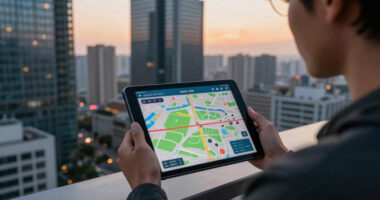
Urban centers worldwide are increasingly adopting dynamic digital twins—virtual, real-time replicas of cities powered by integrated sensors, satellite data, and advanced AI—marking a significant shift in urban management and surveillance.
These digital twins combine data from IoT sensors, wide-area motion imagery (WAMI), all-weather radar, satellite imagery, and other sources to create a continuously updated, three-dimensional virtual model of a city. Cities like Singapore, Helsinki, and Las Vegas are already using such systems for planning, traffic management, and infrastructure maintenance.
The latest breakthrough involves frontier AI models capable of understanding heterogeneous data, recognizing patterns, and enabling natural language queries. This allows city officials to ask complex questions like, ‘Show me all vehicles that visited these addresses last month,’ effectively turning the twin into an oracle.
However, the technology’s rapid development raises concerns about surveillance, data sovereignty, and privacy. Critics warn that these systems could become invasive tools, capable of detailed monitoring of citizens and infrastructure, with potential misuse if not properly regulated.
The city that watches itself: the living digital twin, and the god’s-eye view we’re building
Soon most cities will exist twice — once in concrete, once as a live data model you can rewind, simulate, and question in plain language. Persistent sensing + frontier AI turn the planner’s digital twin into an oracle. The most useful thing we’ve built — and the most powerful surveillance instrument. Both at once.
- Plan better — cities & rural: traffic, zoning, energy, land use
- Emergency response — route crews, one live picture, ~50% faster
- Disaster resilience — simulate, track live, assess damage in hours
- Mass surveillance — track everyone, retroactively, forever
- Pattern-of-life — AI links movements, infers associations
- Social control — no warrant, no suspicion (cf. Baltimore, 2021 ruling)
We’re building a city that watches itself, remembers everything, and can be asked anything. The technology won’t choose between saving lives and ending privacy — we will, through the rules we write now, while the twin is still under construction and the defaults haven’t yet hardened into permanence. WAMI and the living twin open our lives to a view from the heavens that, from the dawn of civilization until a heartbeat ago, was reserved for gods and stars. The question is no longer whether we can see everything — it’s who gets to look, and who watches the watchers.
Implications of Autonomous City Monitoring Systems
The development of live digital twins integrated with AI signifies a major shift in urban governance, enabling more efficient planning, resource allocation, and disaster response. Yet, it also introduces risks related to privacy violations, surveillance overreach, and reliance on foreign AI models, which could compromise national security and sovereignty.
As these systems become more sophisticated, the balance between utility and privacy will be critical. Cities could benefit from shorter planning cycles and fewer infrastructure errors, but the potential for misuse or cyberattacks remains a serious concern.

Smart Cities For Dummies
As an affiliate, we earn on qualifying purchases.
As an affiliate, we earn on qualifying purchases.
Technological Foundations and Recent Advances
The concept of digital twins for cities is not new; Singapore’s Virtual Singapore, launched after 2012, was among the first large-scale implementations. It models every building, road, and utility in three dimensions, with live overlays and underground mapping. Other cities have followed, using these models for urban planning and operational efficiency.
The recent leap comes from the integration of wide-area motion imagery (WAMI), which captures real-time movement of vehicles and pedestrians across entire urban areas, and frontier AI capable of processing vast, heterogeneous data streams. This combination turns static maps into living, queryable entities.
Until recently, the main obstacle was data comprehension; sensors and storage had existed for years, but AI lacked the capacity to interpret the flood of information meaningfully. Now, models like GPT-5.6 can fuse data, recognize patterns, and understand scenes, enabling natural language interaction with city data.
“We are witnessing the emergence of cities as ‘shared operational brains,’ capable of predictive management and detailed surveillance.”
— Thorsten Meyer, AI researcher

3DMakerpro LiDAR Spatial Scanner Raven, Handheld Personal 3D LiDAR Scanner with 12MP Camera, Up to 100m Scan Range & 4K Imaging, 150,000 Points/sec
ALL-IN-ONE STANDALONE SCANNING: Ditch the smartphone. Powered by a robust 8-core processor and a crisp 3.9” AMOLED touchscreen,…
As an affiliate, we earn on qualifying purchases.
As an affiliate, we earn on qualifying purchases.
Key Challenges and Risks Still Unresolved
Several critical issues remain unresolved, including data sovereignty, privacy concerns, and the potential for foreign-controlled AI systems to become vulnerabilities. It is unclear how widespread regulation will be or how cities will safeguard against misuse and cyber threats.
Additionally, the long-term implications of relying on frontier AI models—whose development is often controlled by private or foreign entities—are still uncertain, raising questions about technological sovereignty.

AGPtek Digital Satellite Signal Finder Meter for Dish Network Directv FTA with Compass and Audio Tone – Blue
High Quality Component: and professional design; Designed with a compass for easier and quicker tuning. Powered by the…
As an affiliate, we earn on qualifying purchases.
As an affiliate, we earn on qualifying purchases.
Next Steps in Policy, Technology, and Security
Future developments will likely include tighter regulations around data privacy and AI use, efforts to develop domestic AI models for city management, and enhanced cybersecurity measures. Cities will also need to establish standards for transparency and accountability in these systems.
Research and pilot programs are expected to expand, testing how these digital twins can be integrated into broader urban resilience and smart city initiatives. Monitoring how these systems evolve and are governed will be critical in the coming years.

Towers: The Rising
As an affiliate, we earn on qualifying purchases.
As an affiliate, we earn on qualifying purchases.
Key Questions
What is a digital twin in the context of cities?
A digital twin is a virtual, real-time replica of a city, integrating sensor data, satellite imagery, and AI to simulate and analyze urban systems for planning and management.
How does AI enhance city digital twins?
AI enables the twin to understand complex data, recognize patterns, answer natural language questions, and simulate scenarios, transforming it into an oracle-like tool.
What are the main risks associated with these systems?
Risks include privacy violations, surveillance overreach, dependence on foreign AI, and potential cybersecurity threats that could compromise infrastructure or civil liberties.
Will this technology replace traditional urban planning?
While digital twins can improve planning accuracy and efficiency, they are intended to supplement—not replace—human decision-making, with oversight and regulation critical to prevent misuse.
How might city residents be affected by these systems?
Residents could benefit from improved services and infrastructure but also face increased surveillance and data collection, raising privacy concerns that need addressing through policy.
Source: ThorstenMeyerAI.com