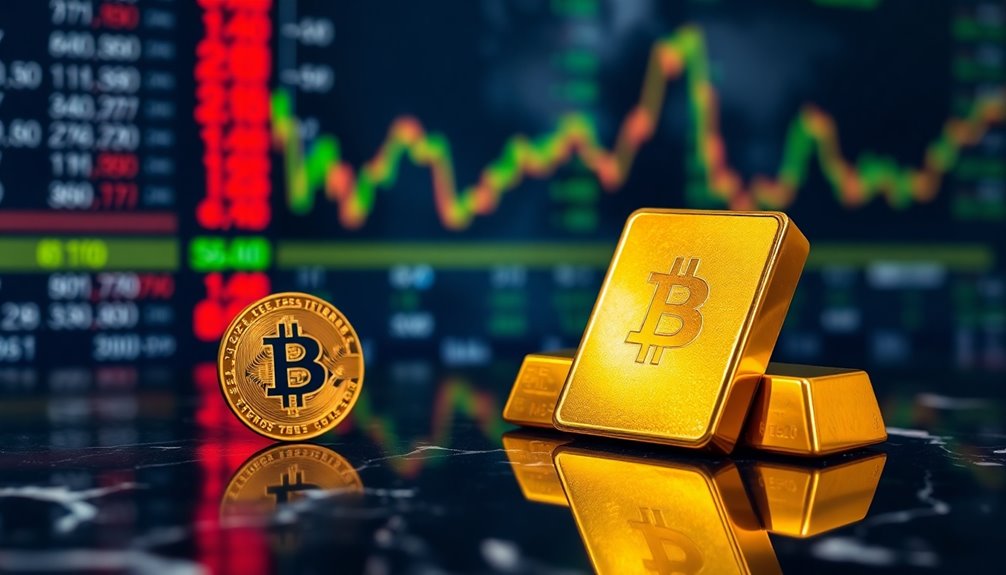

As Trump's trade war escalates, you're probably noticing a shift in investment trends. Gold's appeal as a safe haven is growing, especially with economic uncertainty looming. Meanwhile, Bitcoin's volatility leaves many questioning its reliability. This transition highlights not just market preferences but also a deeper concern about stability in these turbulent times. What does this mean for the future of cryptocurrencies and traditional assets alike?
As trade tensions between the U.S. and China escalate, you've likely noticed gold emerging as the safe haven of choice for investors seeking stability. With gold prices reaching a record high of $2,886.62 per ounce, it's clear that many people are turning to this precious metal amid growing economic uncertainty. The ongoing trade war has prompted investors to look for reliable assets, and gold's historical role as a hedge against inflation and geopolitical unrest makes it particularly appealing right now. Additionally, Gold IRAs provide a means for investors to protect their retirement savings while benefiting from gold's stability.
The fear of economic downturns, especially due to potential inflationary pressures from tariffs, has intensified gold's allure. As the U.S. and China navigate their trade disputes, the volatility in the market only strengthens gold's position. While you might've heard about Bitcoin's decline during this time, it's evident that gold is garnering more trust as a safe haven. Bitcoin's performance has diverged sharply from gold's upward trajectory, reinforcing the idea that traditional safe-haven assets remain a preferred choice during turbulent times.
Moreover, central bank actions, especially the People's Bank of China's increased gold holdings, further support the metal's value. Such moves signal confidence in gold, encouraging more investors to follow suit.
You've likely noticed that while gold shines bright, other precious metals, like silver and platinum, have shown mixed performances, highlighting gold's unique standing in the current climate.
The dollar index also plays a significant role in gold's appeal. A weaker dollar often makes commodities cheaper for foreign investors, thereby boosting gold prices. As market volatility persists, gold's stability makes it an attractive option compared to other assets, especially industrial metals like copper, which are heavily influenced by trade policies.
Economic indicators, such as recent job market data and Federal Reserve actions on interest rates, contribute to the dynamics affecting gold's value. Lower-than-expected job creation may hint at potential rate cuts, which could further drive gold prices upward.
With inflation concerns rising due to tariffs, gold continues to shine as a reliable hedge. As you navigate this complex landscape, it's clear that fears of a global economic slowdown are driving demand for safe-haven assets like gold.
As diplomatic efforts between the U.S. and China unfold, you can expect gold to maintain its status as the preferred choice for investors seeking stability in uncertain times.

Prestige ORO Premium Gypsum-Bonded Investment Powder – Smooth, Bubble-Free Castings for Gold, Silver, Brass & Bronze – 5 lb
PREMIUM QUALITY INVESTMENT: Gypsum-bonded powder for flawless castings of alloys up to 22K, including yellow & white gold,…
As an affiliate, we earn on qualifying purchases.
As an affiliate, we earn on qualifying purchases.

How to Invest in Gold and Precious Metals in 2026: How to Lock In Wealth, Hedge Against Inflation, and Invest in Precious Metals During Uncertain Times (Mastering Wealth in America Series)
As an affiliate, we earn on qualifying purchases.
As an affiliate, we earn on qualifying purchases.

1986 – Present (Random Year) American Gold Eagle 1/10th oz Bullion Coin with Certificate of Authenticity $5 Seller Uncirculated
✔️Each coin contains 1/10 oz of gold.
As an affiliate, we earn on qualifying purchases.
As an affiliate, we earn on qualifying purchases.
![Apple Watch Series 11 [GPS + Cellular 42mm] Smartwatch with Gold Titanium Case with Gold Milanese Loop. Sleep Score, Fitness Tracker, Health Monitoring, Always-On Display, Water Resistant](https://m.media-amazon.com/images/I/51sY3J8BEEL._SL500_.jpg)
Apple Watch Series 11 [GPS + Cellular 42mm] Smartwatch with Gold Titanium Case with Gold Milanese Loop. Sleep Score, Fitness Tracker, Health Monitoring, Always-On Display, Water Resistant
HYPERTENSION NOTIFICATIONS — Apple Watch Series 11 can spot signs of chronic high blood pressure and notify you…
As an affiliate, we earn on qualifying purchases.
As an affiliate, we earn on qualifying purchases.