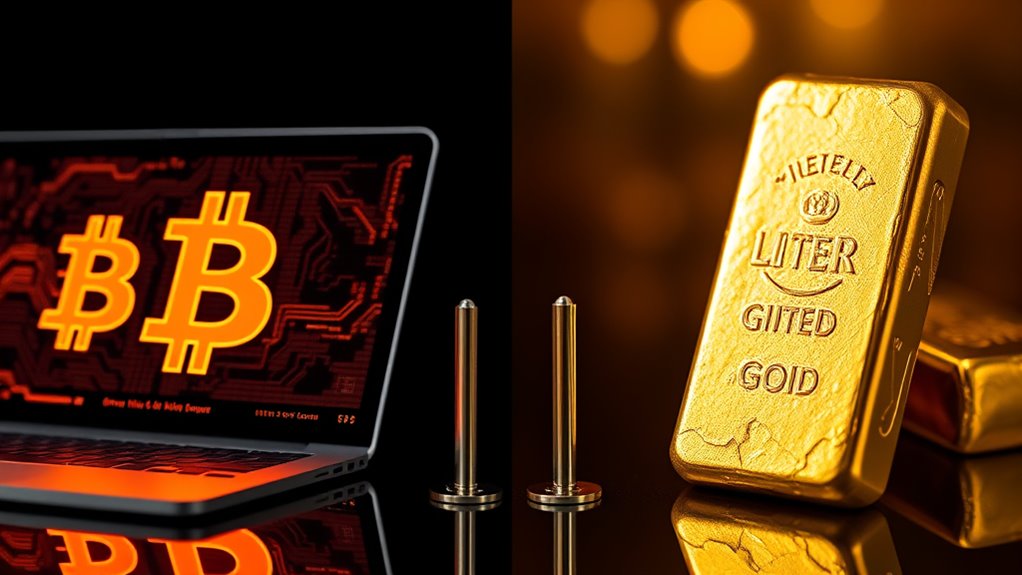

In 2025, choosing between Bitcoin and gold as a safe haven depends on your risk tolerance and outlook. Gold offers stability with its physical presence and long-standing value, making it a reliable hedge during economic uncertainty. Bitcoin, however, provides potential for high returns, driven by digital innovation and market dynamics, but it comes with higher volatility and regulatory risks. To understand which aligns best with your goals, exploring their differences in detail can provide valuable insights.
Key Takeaways
- Gold’s physical stability and established history make it a resilient safe haven during economic uncertainty.
- Bitcoin’s digital nature enables rapid, borderless transfers but introduces cybersecurity and regulatory risks.
- Regulatory developments in 2025 could influence Bitcoin’s volatility while gold remains comparatively stable.
- Investors may favor gold for long-term stability, while Bitcoin appeals to high-risk, high-reward strategies.
- Both assets serve as diversification tools, but gold’s intrinsic value often offers greater reassurance in turbulent times.
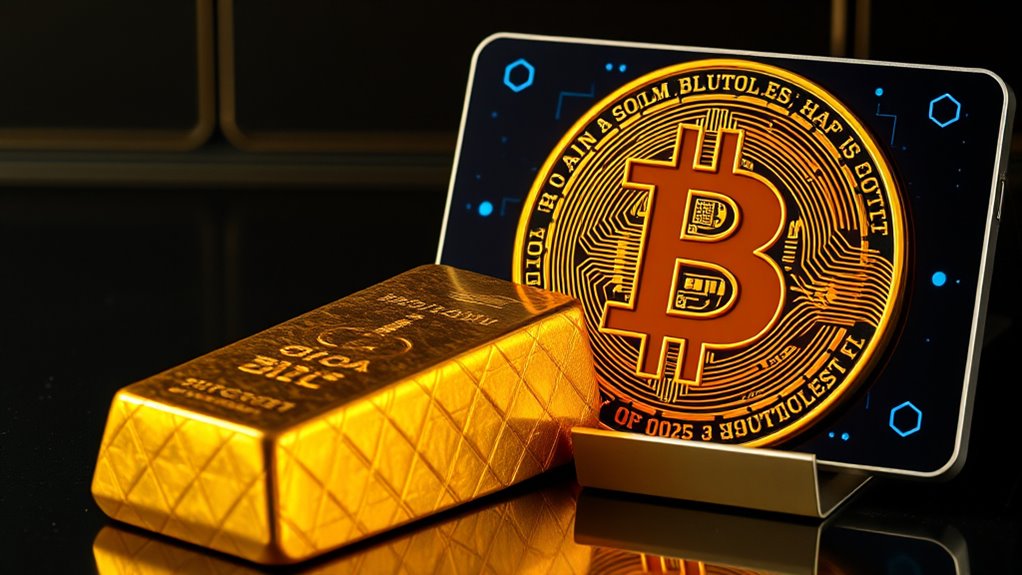
When comparing Bitcoin and gold as investments, it’s essential to understand their unique characteristics and roles in the financial landscape. Both are often viewed as safe havens during times of economic uncertainty, but they operate within different frameworks. Gold has a long-standing history as a tangible asset, valued for its intrinsic worth and physical properties. Its valuation relies heavily on the concept of precious metal valuation, which considers factors like rarity, demand, and mining costs. Gold’s stability is rooted in its physical nature, making it less susceptible to technological disruptions but still influenced by market sentiment and macroeconomic trends. In contrast, Bitcoin exists purely in digital form, and its value is driven by market dynamics, user adoption, and technological developments. Because it’s a relatively new asset, its valuation can be highly volatile, often reflecting investor sentiment more than tangible metrics. Additionally, the regulatory landscape for cryptocurrencies is rapidly evolving, impacting their perceived safety and legitimacy among investors. When you consider investing in either, understanding cryptocurrency regulation becomes vital. Cryptocurrency regulation is evolving rapidly across different jurisdictions, which can markedly impact Bitcoin’s price and accessibility. Governments and regulators are increasingly scrutinizing digital currencies, aiming to establish frameworks that prevent fraud, money laundering, and tax evasion. These regulatory changes can introduce volatility, yet they also lend legitimacy to Bitcoin as an asset class, potentially attracting more institutional investors. Gold, on the other hand, is less affected by immediate regulatory shifts, though its valuation can be influenced by policies affecting mining, trade tariffs, or monetary policy decisions. Gold’s status as a traditional asset means it is more resilient to regulatory uncertainty, making it a safer option for conservative investors seeking stability.
Bitcoin’s value is driven by market dynamics and adoption, while gold’s stability relies on physical properties and intrinsic worth.
In comparing these two assets, you should also consider their liquidity and ease of transfer. Gold has a well-developed global market, but physical storage and insurance can add costs and complexity. Bitcoin offers near-instantaneous transfers across borders, with liquidity often depending on the exchange or platform you use. However, the digital nature of Bitcoin makes it vulnerable to cybersecurity threats and exchange failures, which can impair liquidity temporarily. Despite this, Bitcoin’s transparency and the ease of trading on numerous digital platforms give it an edge in fast transactions. Understanding the infrastructure supporting each asset—such as cryptocurrency exchanges and physical storage options—can greatly influence your investment decisions.
Ultimately, whether you see Bitcoin or gold as a safer haven depends on your risk tolerance, investment goals, and belief in the stability of their respective valuation methods. Gold’s enduring physical presence and established valuation methods provide a sense of security for many, while Bitcoin’s innovative technology and potential for high returns attract those willing to accept higher volatility and regulatory risks. Both assets serve as important tools in diversifying your portfolio, especially in uncertain times, but understanding their fundamental differences will guide you toward a more informed decision.

IROLD 24k Gold Bar .9999 Fine with Assay Certificate – 1 OZ
Pure 24K: Crafted from .9999 fine gold for maximum purity and value.
As an affiliate, we earn on qualifying purchases.
As an affiliate, we earn on qualifying purchases.
Frequently Asked Questions
How Will Regulatory Changes Impact Bitcoin and Gold in 2025?
Regulatory uncertainty will markedly influence both Bitcoin and gold in 2025. You might see stricter market regulation, which could limit Bitcoin’s use or increase its compliance costs, affecting its value. Gold, on the other hand, could benefit if regulations favor traditional assets, boosting investor confidence. Overall, evolving regulations will shape your investment decisions, making it essential to stay informed about policy changes that could either hinder or help these assets’ stability.
What Are the Environmental Impacts of Bitcoin Mining Versus Gold Extraction?
You should consider that Bitcoin mining’s environmental footprint is mainly due to high energy consumption, leading to significant carbon emissions, while gold extraction causes resource depletion through invasive mining practices and habitat destruction. Both activities impact the environment, but Bitcoin’s footprint stems from electricity use, often from fossil fuels, whereas gold extraction directly depletes natural resources and damages ecosystems. Understanding these impacts helps you evaluate their sustainability and environmental responsibility.
Can Bitcoin Replace Traditional Gold as a Long-Term Store of Value?
You might see Bitcoin as digital gold, potentially replacing traditional gold as a long-term store of value. Its crypto dominance grows as more people trust its decentralized nature and limited supply. Unlike gold, Bitcoin offers easier transfer and storage, making it appealing for future investments. However, its volatility still raises questions. If it stabilizes, Bitcoin could definitely become a preferred safe haven in the evolving financial landscape.
How Do Liquidity and Market Accessibility Compare Between Bitcoin and Gold?
You’ll find that Bitcoin offers higher liquidity and market accessibility than gold, thanks to its 24/7 trading hours and digital platform. Bitcoin’s market depth fluctuates but generally allows quick buying or selling without significant price impact. Gold, on the other hand, has limited trading hours and less instant liquidity, making it less accessible for rapid transactions. This ease of access makes Bitcoin attractive for short-term and global traders.
What Technological Advancements Could Influence Bitcoin’s Security and Usability?
Imagine your digital wallet as a fortress, shielded by quantum resistance that thwarts even the most advanced computers. New biometric security measures—like fingerprint or retina scans—make accessing your bitcoin safer and more intuitive. These technological advancements will strengthen bitcoin’s security and usability, ensuring your assets stay protected from future threats while making transactions faster and more seamless. You’ll feel confident knowing cutting-edge tech guards your investments.

Trezor Model One – The Original Cryptocurrency Hardware Wallet, Bitcoin Security, Store & Manage 1000's of Coins&Tokens, Easy-to-Use Interface, Quick & Simple Setup (Black)
All-in-one hardware wallet for easy crypto security, storage & use
As an affiliate, we earn on qualifying purchases.
As an affiliate, we earn on qualifying purchases.
Conclusion
As you navigate the shifting landscape of 2025, remember that both Bitcoin and gold act like quiet anchors amid swirling tides. Gold offers a steady glow, softly guiding you through uncertain waters, while Bitcoin sparks like a distant star, shimmering with promise. Trust your instincts to find the subtle balance, knowing that in the dance of safety, sometimes the calmest current leads you home. Ultimately, your choice shapes the voyage ahead.

KYODOLED Fireproof Document Box with Key Lock, Large Safe Storage Box for Valuables, Fire Resistance Security Chest, Lock Box for Passport, Cash, Tablet 12.9'' x 10.7'' x 4.2'' Black
FIREPROOF INSULATION: KYODOLED fireproof storage safe box is made of sturdy double cold rolled steel construction and is…
As an affiliate, we earn on qualifying purchases.
As an affiliate, we earn on qualifying purchases.
Trezor Model One – The Original Cryptocurrency Hardware Wallet, Bitcoin Security, Store & Manage 1000's of Coins&Tokens, Easy-to-Use Interface, Quick & Simple Setup (Black)
All-in-one hardware wallet for easy crypto security, storage & use
As an affiliate, we earn on qualifying purchases.
As an affiliate, we earn on qualifying purchases.