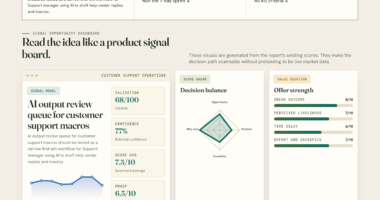
📊 Full opportunity report: Software-Defined Warfare: How Ukraine’s Delta Turned The Battlefield Into A Shared, Real-Time Map on ThorstenMeyerAI.com — validation score, market gap, and execution plan.
TL;DR
Ukraine has deployed Delta, a cloud-based, browser-accessible battlefield management system that fuses real-time intelligence from diverse sources. This innovation exemplifies software-defined warfare, shifting advantage from hardware to data and software. Its deployment aims to enhance battlefield coordination and resilience.
Ukraine has officially deployed Delta, a cloud-native, browser-based battlefield management system, designed to fuse real-time intelligence from diverse sources and enhance frontline coordination. This development marks a significant shift in military technology, emphasizing software and data over traditional hardware platforms, and aims to improve Ukraine’s operational resilience and battlefield awareness amid ongoing conflict.
Delta was developed through a collaboration between Ukraine’s Defense Ministry, the NGO Aerorozvidka, and the Ministry of Digital Transformation. It integrates inputs from drones, satellite imagery, sensor networks, and allied intelligence, providing a shared, real-time operational picture accessible via standard devices like phones and laptops. The system’s backend is hosted in a cloud environment outside Ukraine to protect against missile and cyber threats, ensuring continuous operation even under attack.
During recent military operations, Ukraine’s Defense Ministry claimed Delta helped identify approximately 1,500 enemy targets daily, though these figures are self-reported and cannot be independently verified. The system shortens the decision cycle by linking reconnaissance directly to operational responses, embodying the concept of software-defined warfare.
Software-defined warfare: how Ukraine’s Delta turned the battlefield into a shared, real-time map
A soldier opens a browser and sees the fused war — drones, satellites, sensors and vetted reports on one live map. The backend is a cloud deliberately hosted abroad so a missile can’t take it down. The clearest case yet of treating warfare as software.
Optical sensors go blind in cloud & dark; an all-weather SAR radar layer — the kind VigilSAR produces — slots into a picture like this as one resilient, sovereign input. vigilsar.com · And note the paradox: to survive missiles & cyberattack, Ukraine hosted its crown-jewel cloud outside its own borders — trading physical sovereignty for operational survivability. Resilience through distribution.
Delta’s lasting lesson isn’t a piece of software — it’s a model of how to build: commodity clients, cloud backend, open standards, relentless iteration, fusion over hardware, and resilience through distribution. It’s why a wartime NGO out-shipped procurement bureaucracies on a fraction of the budget. The platform mattered less than the picture — and the picture is software. Own the fusion layer, own the sovereign feeds into it, and get it to the edge.
Implications of Ukraine’s Software-Defined Battlefield
This development signals a strategic shift where advantage increasingly depends on data, software, and rapid iteration rather than traditional hardware platforms. Delta’s approach enhances battlefield agility, resilience, and inclusivity by enabling frontline troops to access comprehensive situational awareness via common web interfaces. It demonstrates a new organizational model in military technology, emphasizing interoperability, rapid development, and cloud-hosted resilience, which could influence future defense strategies globally.cloud-based battlefield management software
As an affiliate, we earn on qualifying purchases.
As an affiliate, we earn on qualifying purchases.
Background of Ukraine’s Digital Military Innovation
Since 2017, NATO-inspired initiatives have encouraged Ukraine to break away from siloed, hardware-dependent military IT systems. The collaboration between NGOs, government agencies, and defense innovation units has fostered a startup-like pace of software development and deployment. Delta builds on this foundation, representing a move toward more flexible, interoperable, and resilient battlefield management tools that prioritize data fusion and rapid decision-making. Its deployment in 2024 reflects Ukraine’s broader strategy to leverage digital transformation for military advantage in the ongoing conflict with Russia.“Delta is a game-changer—bringing a shared, real-time operational picture directly to the frontline, accessible on any device.”
— Mykhailo Fedorov, Ukraine’s Minister of Digital Transformation

Mind Mapping Secrets – FreeMind Basics: Using Free Software to Create your Mind Maps (Strategies for Success – Mind Maps)
As an affiliate, we earn on qualifying purchases.
As an affiliate, we earn on qualifying purchases.
Unverified Claims and System Limitations
Many of Delta’s operational claims, such as the number of targets identified daily, are self-reported by Ukrainian officials and lack independent verification. Details about the system’s integration with drone operations and its full capabilities remain classified or undisclosed for security reasons. It is also unclear how resilient the cloud-hosted system is against sophisticated cyberattacks or missile strikes targeting its infrastructure.

Police Drone & Pilot Detection Kit– Handheld Drone Detection & Tracking Tool | Real-Time Alerts for Law Enforcement, Event Security & Emergency Response | Portable Airspace Awareness Device
- Real-Time Drone Detection: Detects drones via remote ID signals instantly
- Portable & Compact Design: Handheld, lightweight, and easy to carry
- Immediate Threat Alerts: Provides instant notifications for quick response
As an affiliate, we earn on qualifying purchases.
As an affiliate, we earn on qualifying purchases.
Next Steps for Delta’s Deployment and Evaluation
Ukraine plans to expand Delta’s deployment across more frontline units and integrate additional sensors and intelligence sources. Independent assessments and potential international collaboration could provide clearer evaluations of its effectiveness. Monitoring how Delta adapts to evolving threats and whether other countries adopt similar cloud-native, software-driven battlefield systems will be key in the coming months.

Satellite Remote Sensing for Archaeology
As an affiliate, we earn on qualifying purchases.
As an affiliate, we earn on qualifying purchases.
Key Questions
What is the core function of Ukraine’s Delta system?
Delta fuses real-time intelligence from drones, satellites, sensors, and allied sources to create a shared, live battlefield picture accessible via standard devices, aiding command and coordination.
How does Delta differ from traditional military systems?
Unlike legacy systems that rely on proprietary hardware and siloed data, Delta runs on cloud infrastructure and uses commodity devices, emphasizing software and data sharing for faster decision-making.
Is the system completely secure and resilient?
While hosting the system outside Ukraine enhances resilience against missile and cyberattacks, the full security profile and vulnerability to sophisticated threats are not publicly confirmed.
What are the potential global implications of Delta’s deployment?
Delta exemplifies a shift toward software-defined warfare, potentially influencing military modernization strategies worldwide, especially regarding interoperability, rapid development, and resilience.
Will other countries adopt similar systems?
Many militaries are studying Ukraine’s approach; adoption depends on technological, strategic, and security considerations, but the model’s success could inspire broader implementation.
Source: ThorstenMeyerAI.com