In 2025, Hong Kong and Singapore are competing to be Asia’s top crypto hub, each with unique strengths. Hong Kong emphasizes a strict yet innovative regulatory framework, including stablecoin licensing and asset tokenization to attract institutional investors. Singapore favors a flexible approach, fostering a vibrant fintech environment with its pro-crypto policies. Understanding how both hubs evolve can help you grasp Asia’s broader digital finance future—stay tuned to explore further details.
Key Takeaways
- Hong Kong is establishing a comprehensive stablecoin licensing regime by 2025, emphasizing strict regulation and investor protection.
- Singapore maintains a flexible regulatory approach with its Payment Services Act, promoting innovation and a pro-business environment.
- Hong Kong is actively exploring asset tokenization and blockchain integration within traditional finance, aiming to lead in digital asset innovation.
- Singapore’s fintech ecosystem is highly mature, with strong government support and a well-developed infrastructure for crypto startups.
- Both hubs focus on international collaboration, but Hong Kong emphasizes compliance and market integrity, while Singapore prioritizes regulatory flexibility.
Asia’s Crypto Hubs
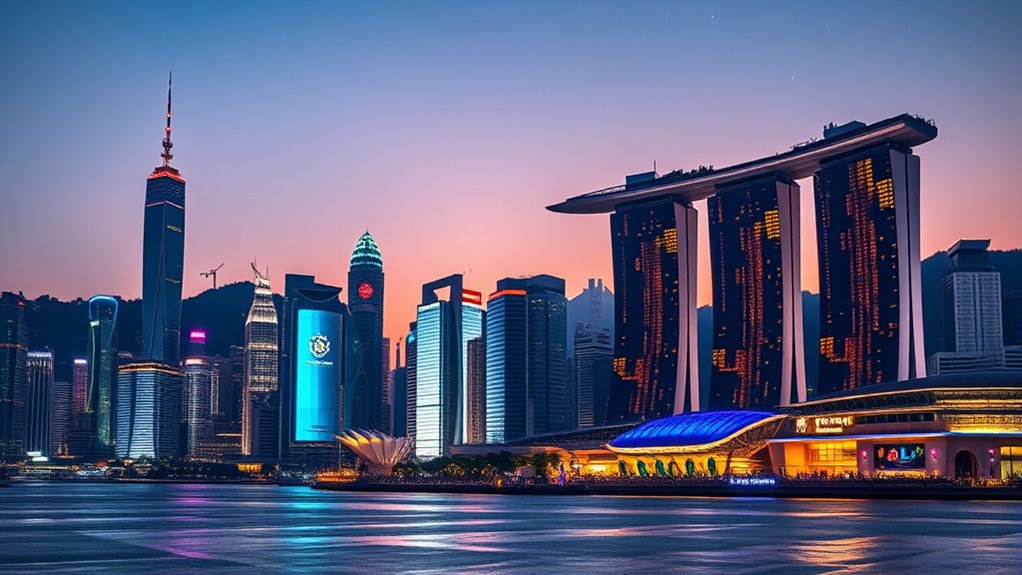
Are Asia’s crypto hubs truly leading the future of digital finance? When you look at Hong Kong in 2025, you see a city aggressively positioning itself as a regulatory and innovation powerhouse. The upcoming stablecoin licensing regime, set to launch by August 2025, exemplifies this push. It will regulate fiat-referenced stablecoins, including those pegged to HKD, USD, and CNY, ensuring they meet strict standards. As a crypto enthusiast or investor, you’ll find that crypto exchanges and virtual asset service providers (VASPs) must secure licenses from the Securities and Futures Commission (SFC) to operate legally. This licensing process aligns with global anti-money laundering (AML) and counter-terrorist financing (CTF) standards, aiming to safeguard investors and uphold the city’s reputation. The SFC oversees a broad range of digital asset activities, from custodians to stablecoins, maintaining a tight regulatory grip that fosters trust and legitimacy.
Hong Kong’s strategic focus on regulation hasn’t stifled its growth. In fact, the city ranks as the most “crypto-ready” location in Asia for 2025, according to the Worldwide Crypto Readiness Report. You’ll notice a 250% increase in blockchain-related fintech businesses since 2022, reflecting rapid sector expansion. The government’s favorable tax policies, like a 0% capital gains tax on crypto earnings for individuals, create an attractive environment for investors and startups alike. Its goal is clear: to establish Hong Kong as a global digital finance and innovation hub. The licensing and regulatory frameworks are designed to draw institutional interest, encouraging the development of compliant digital asset products and services. For you, this means a marketplace with strong investor protections, where AML and CTF requirements are enforced through real-time transaction monitoring, risk scoring, and automated reporting tools. The adoption of the FATF Travel Rule adds transparency to transfers over HKD 8,000 (~USD 1,000), reducing illicit finance risks and boosting confidence. Additionally, Hong Kong is actively exploring the tokenization of real-world assets (RWAs), including bonds and financial instruments. The government and HKMA are reviewing legal frameworks to support this innovation, aiming to seamlessly integrate traditional finance with blockchain technology. This initiative opens new opportunities for investors seeking to diversify their portfolios with tokenized assets. Moreover, the development of blockchain infrastructure ensures secure and scalable networks, which are essential for supporting innovative financial services. Meanwhile, the stablecoin landscape is evolving, with a focus on regulation that covers multiple currencies, including HKD, USD, and CNY. Oversight by the HKMA emphasizes technical robustness and high compliance standards, aligning with Hong Kong’s broader fintech strategy. Overall, Hong Kong’s blend of strict regulation, proactive innovation, and international collaboration positions it as a leading force shaping the future of digital finance in Asia. As you evaluate your options, it’s clear that Hong Kong’s approach aims to strike a balance between fostering innovation and ensuring market integrity.
Top picks for "asia crypto hubs"
Open Amazon search results for this keyword.
As an affiliate, we earn on qualifying purchases.
Frequently Asked Questions
Which Country Offers Better Regulatory Clarity for Crypto Startups?
You want to know which country offers better regulatory clarity for crypto startups. Currently, Hong Kong provides clear, all-encompassing guidelines with a detailed licensing regime and oversight by the SFC, making it easier to navigate regulations. It also supports innovation through public consultations and a strategic roadmap. While Singapore is also strong, Hong Kong’s proactive, transparent approach and recent licensing progress give it a slight edge for startups seeking clarity.
How Do Tax Policies Differ Between Hong Kong and Singapore?
Think of it as comparing apples and oranges. Hong Kong doesn’t tax capital gains on crypto profits and offers tax breaks for funds, making it a playground for investors. Singapore also exempts capital gains but imposes GST on certain transactions and restricts retail trading. If you’re looking for a friendly environment with fewer taxes, Hong Kong’s open approach might suit you better, while Singapore’s cautious stance favors institutional players.
What Are the Main Challenges Faced by Crypto Exchanges in Both Hubs?
You face significant challenges operating in both Hong Kong and Singapore. Maneuvering complex and evolving regulations demands constant adaptation, increasing operational costs and legal risks. Banking support is limited, especially in Hong Kong, complicating liquidity and transactions. Both markets require robust cybersecurity measures and compliance with AML and KYC rules, which strain resources. Regulatory uncertainty, market volatility, and cross-border restrictions further threaten your ability to scale and maintain smooth operations.
How Does the Talent Pool Compare in Hong Kong and Singapore?
You’ll find Hong Kong has a larger fintech workforce, but a talent shortage due to demographic shifts and recent departures. Salaries are higher there, attracting Web3 experts and traditional finance professionals shifting to crypto. Singapore’s smaller but growing talent pool benefits from government support and a diverse tech ecosystem. Both hubs rely on global recruitment, remote work, and community efforts to fill skills gaps, with competition heating up in 2025.
Which Hub Has More Innovative Blockchain Projects in 2025?
Imagine this: it’s 2025, and you’re wondering which hub hosts more innovative blockchain projects. You’ll find that Singapore leads with a diverse range of startups focusing on DeFi, NFTs, and interoperability, supported by strong regulation and venture capital. Hong Kong, on the other hand, is rapidly catching up, integrating AI and robotics into blockchain, and fostering groundbreaking projects. Both hubs push innovation, but Singapore’s ecosystem remains slightly more mature and varied.
Conclusion
So, in 2025, you might think choosing between Hong Kong and Singapore is a no-brainer for crypto success. But surprise—despite their shiny reputations, both hubs could surprise you with unexpected hurdles or even fade into obscurity. After all, in the world of crypto, today’s top spot can quickly become tomorrow’s forgotten relic. So, bet wisely—because the real winner might just be the one you least expect, or maybe, the one you least trust.