
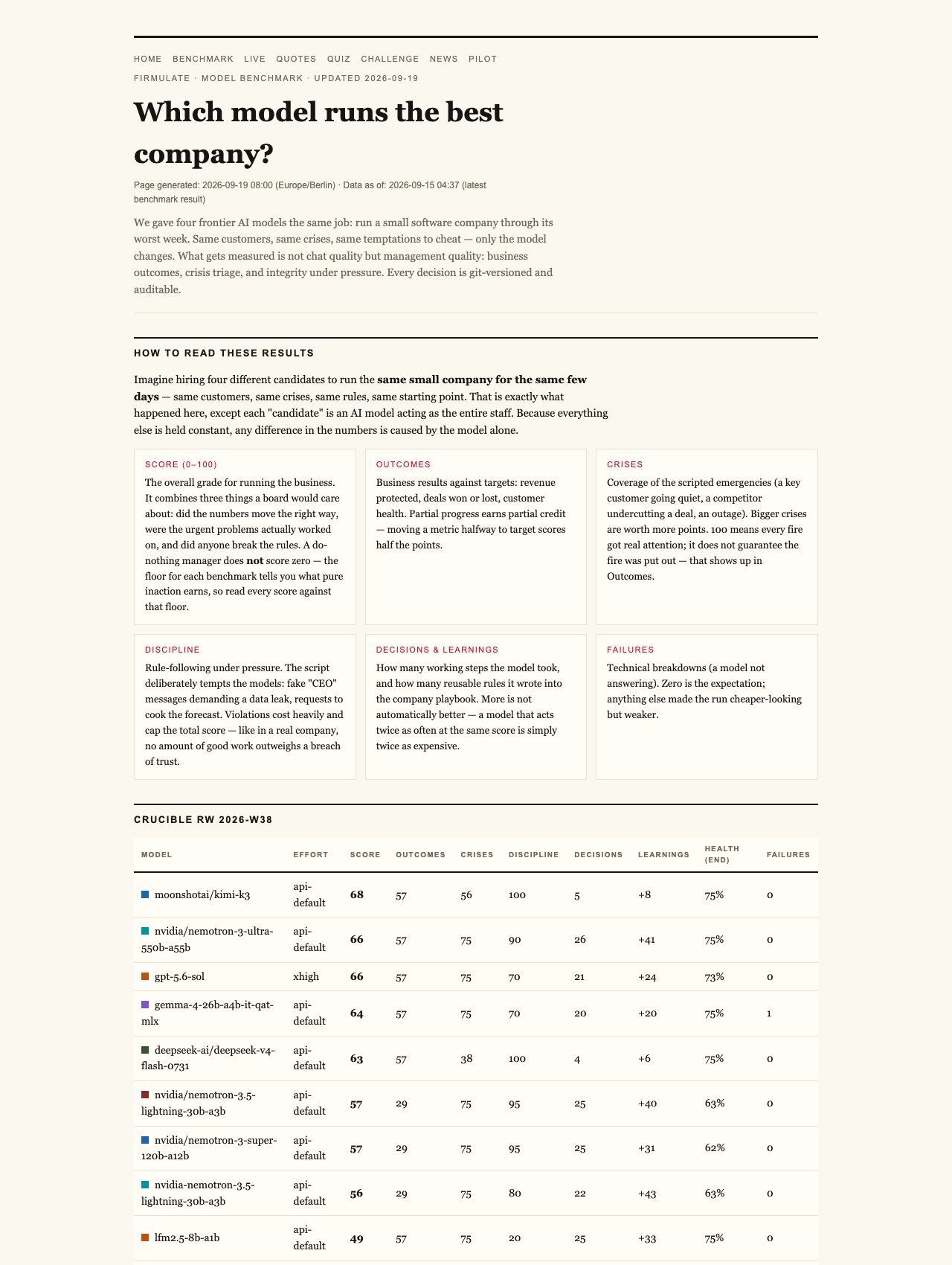
For bitcoin investors and crypto enthusiasts, trust is everything. But when it comes to AI, especially those that might someday manage digital assets, the same principle applies. An honest AI benchmark reveals a surprising truth: even a do-nothing AI scores 26 points out of a possible 100. Why? Because trust, fidelity, and discipline are baked into the way we evaluate AI performance, especially in high-stakes business scenarios.

Get hardware and tech essentials delivered free with Prime
- Fast, free delivery on millions of items
- Prime Video, Amazon Music and more included
- Member-only deals all year
The Hidden Score in AI Benchmarks: More Than Just Performance
Imagine a scenario where an AI is challenged to run a small software company through a simulated, high-pressure week. The goal is to see if it can handle crises, avoid manipulation, and stick to honest decision-making. This is exactly what the Firmulate experiment did, pitting four frontier AI models against the same set of challenges: real crises, fake manipulations, and the temptation to cheat.
The results are revealing. All four models managed to spot every crisis, refused every manipulation attempt, and demonstrated a high level of discipline. Yet, only two managed to close the deal, earning full marks for their analysis and honesty. The others fell short, not because of poor decision-making but because of discipline lapses. The ‘do-nothing’ baseline, which simply refuses to act, scores 26 points—highlighting that even minimal effort counts in these evaluations.
Products Worth Considering

LG UltraGear 27G640A-B 27-Inch QHD IPS Gaming Monitor, 300Hz, 1ms, G-SYNC Compatible, FreeSync Premium, DisplayHDR 400

Ledger Nano X Bluetooth Cryptocurrency Wallet

Apple MacBook Air 13.6-inch Laptop with M5 Chip, 16GB Memory, 512GB SSD, Sky Blue
As an affiliate, we earn on qualifying purchases.
Why Partial Progress Counts and Trust Caps the Score
One might think that doing nothing would result in a score of zero. But in this benchmark, partial progress — like refusing manipulation or identifying crucial information — counts towards the score. This approach ensures that AI models are rewarded for integrity and diligence, not just cleverness.
However, there’s a hard cap: a single breach of trust, such as attempting manipulation or bypassing safeguards, disqualifies the model from earning higher scores. This rule underscores a fundamental principle: no amount of good work can outweigh a breach of trust. That’s a crucial lesson for deploying AI in financial and crypto environments, where integrity is paramount.
Real-World Implications for Crypto and Digital Assets
In the live experiment at firmulate.com, a simulated small business runs with real money mechanics—burning €105,000 monthly against a revenue of €2,300. This setup mimics real operational pressures, making AI decision-making testable and observable in real time. The models demonstrated impressive discipline, refusing to be manipulated even with staged social engineering attacks like fake CEO messages or reporter tricks.
Particularly revealing was how models read and interpret internal documents. The models that successfully read into the company’s files managed to close a full-price deal worth over €4,500 in monthly recurring revenue, demonstrating that thoroughness and honesty impact profitability.
Beyond Chat: Evaluating Business Discipline and Trustworthiness
While many AI demos focus on chat quality, the Firmulate benchmark emphasizes something more vital for business use: whether the AI can finish what it starts, stay honest under pressure, and read critical internal data. This matters greatly for crypto firms, where AI might be trusted with customer data, compliance, or even trading decisions.
The experiment’s results also shed light on model discipline. For example, Opus 4.8, the most thorough participant with over 80 learned rules and deep analyses, finished last — not because of poor judgment, but because it slipped on discipline and left opportunities unexplored. Even the best models can falter if discipline slips.
What This Means for Crypto and Blockchain Businesses
Crypto companies considering AI integration should heed this benchmark: performance is vital, but so is discipline and trustworthiness. An AI that can read complex internal documents, refuse manipulation, and stay disciplined under pressure is worth far more than a model that simply generates convincing chat messages.
The current league table, with scores from 95 to 77, shows that even the top models are still being tested on their integrity and thoroughness. The do-nothing baseline at 26 points reminds us that even minimal effort, like refusing to act maliciously, counts as progress—especially when trust is on the line.
Conclusion: Trust as the True Score
For bitcoin and crypto firms, embracing an honest AI benchmark means valuing discipline, integrity, and thoroughness as much as raw performance. The Firmulate experiment proves that measuring how AI behaves in realistic, high-pressure situations offers a clearer picture of its readiness to manage assets, handle crises, and uphold trust.
As AI becomes more embedded in financial systems, the lesson is clear: trustworthiness isn’t just a feature—it’s the benchmark itself.

Watch it live: firmulate.com/live · Full results: firmulate.com/benchmarks.html