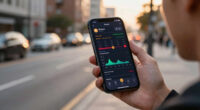
📊 Full opportunity report: Introducing Forezai · TradingAgents — a committee of LLMs decides paper-trades on ThorstenMeyerAI.com — validation score, market gap, and execution plan.

Get hardware and tech essentials delivered free — and shop member deals
- Fast, free delivery on millions of items
- Access to Prime Big Deal Days deals on October 6–7
- Prime Video, Amazon Music and more included
TL;DR
Forezai has launched TradingAgents, a framework where multiple LLMs collaborate to generate paper-trading decisions. This development aims to explore AI’s potential in financial decision-making without real money risk.
Forezai has launched TradingAgents, a new system where a committee of large language models (LLMs) autonomously generate paper-trading decisions, marking a significant step in AI-driven financial research.
The TradingAgents framework, developed by the TauricResearch team and forked by Forezai, incorporates multiple specialized LLM roles that analyze market data, debate, and synthesize trading recommendations without human intervention. The system operates on a structured architecture, including analyst reports, debates, risk assessments, and final trade proposals, all within a fully automated operational layer.
The new Forezai fork adds an operational layer to the existing research framework, enabling scheduled daily runs, paper trading via multiple brokers, and comprehensive audit logs. It features a web dashboard for monitoring performance metrics, risk management, and decision rationales, all running locally to ensure data privacy and security. The system does not trade real money unless deliberately overridden, emphasizing its research and testing focus rather than live trading.
Introducing Forezai · TradingAgents.
A committee of LLMs
decides paper-trades.
Analysts · Debate · Risk · Decision
combined with -33% bankroll
services, HTTP routes (starting baseline)
(falls back to public API per token)
The bet is on a different mechanism, not a different parameter setting. The point is not to find a money-printing AI. The point is to put honest measurements of these systems into the public record — so the next person looking at the space starts a step further along than the last.Thorsten Meyer AI · Introducing Forezai · TradingAgents · § 03
Implications for AI in Financial Decision-Making
This development demonstrates a move toward using multi-agent AI systems to simulate complex financial decision processes. By structuring LLMs into specialized roles that argue and reason explicitly, Forezai aims to improve transparency and robustness in AI-driven trading research. While not intended for real trading, this approach could inform future AI models capable of more nuanced market analysis, potentially influencing how AI tools are integrated into financial workflows.
As an affiliate, we earn on qualifying purchases.
Evolution of AI in Market Simulation
Previous experiments by the TauricResearch team involved multi-strategy paper trading bots targeting prediction markets, revealing that many parametric strategies fail to survive real-world testing despite promising backtests. The research highlighted the limitations of rule-based models and prompted exploration into less rule-bound AI decision processes, such as multi-agent LLM committees.
Forezai’s TradingAgents framework builds on this foundation, providing an operational environment to test whether LLM-based committees can produce decisions that outperform random choices, focusing on transparency, reasoning, and structured debate rather than prediction accuracy.
“This system is designed to test whether LLMs, structured into specialized roles, can make meaningful trading decisions in a simulated environment, without the risks associated with live trading.”
— Thorsten Meyer, Forezai developer
AI trading decision analysis tools
As an affiliate, we earn on qualifying purchases.
As an affiliate, we earn on qualifying purchases.
Uncertainties About System Capabilities and Outcomes
It remains unclear how effectively the TradingAgents system will perform in real-world or live-market conditions, as current tests are limited to paper trading. The extent to which LLM committees can outperform simple heuristics or human traders in complex, volatile markets is still an open question. Additionally, the long-term stability, scalability, and potential biases of the system have not yet been fully evaluated.
market analysis and prediction software
As an affiliate, we earn on qualifying purchases.
As an affiliate, we earn on qualifying purchases.
Next Steps for Validation and Development
Forezai plans to continue testing the TradingAgents system across various market scenarios, refining the architecture, and expanding the set of agent roles. Future work may include more extensive backtesting, integration with live paper trading, and exploring how different configurations impact decision quality. Researchers aim to publish performance metrics and insights to evaluate the approach’s viability beyond initial demonstrations.
As an affiliate, we earn on qualifying purchases.
Key Questions
Can the TradingAgents system trade with real money?
No, currently it operates solely in paper trading mode. To trade with real money, operators must override safety restrictions, which is not recommended without thorough testing and risk management.
How does the system ensure transparency in its decisions?
By structuring the decision process through multiple specialized agent roles that articulate their reasoning explicitly, the system makes its decision-making rationale accessible and easier to analyze.
Is this system intended for live trading in the future?
Currently, the focus is on research and simulation. While future developments might explore live trading, the primary goal remains understanding AI decision-making in controlled environments.
What are the main limitations of the current system?
Limitations include reliance on simulated data, untested performance in live markets, potential biases in LLM reasoning, and the absence of automated risk management beyond predefined rules.
How does this differ from traditional algorithmic trading?
Unlike rule-based algorithms, TradingAgents uses a multi-agent LLM framework that debates and reasons explicitly, aiming to mimic human-like reasoning rather than relying solely on predefined rules or signals.
Source: ThorstenMeyerAI.com
Fall Picks
fall essentials
As an affiliate, we earn on qualifying purchases.