📊 Full opportunity report: Getting Started With An Empty Trust Tracker For Estate Planning on IdeaNavigator AI — validation score, market gap, and execution plan.

Get hardware and tech essentials delivered free with Prime
- Fast, free delivery on millions of items
- Prime Video, Amazon Music and more included
- Member-only deals all year
TL;DR
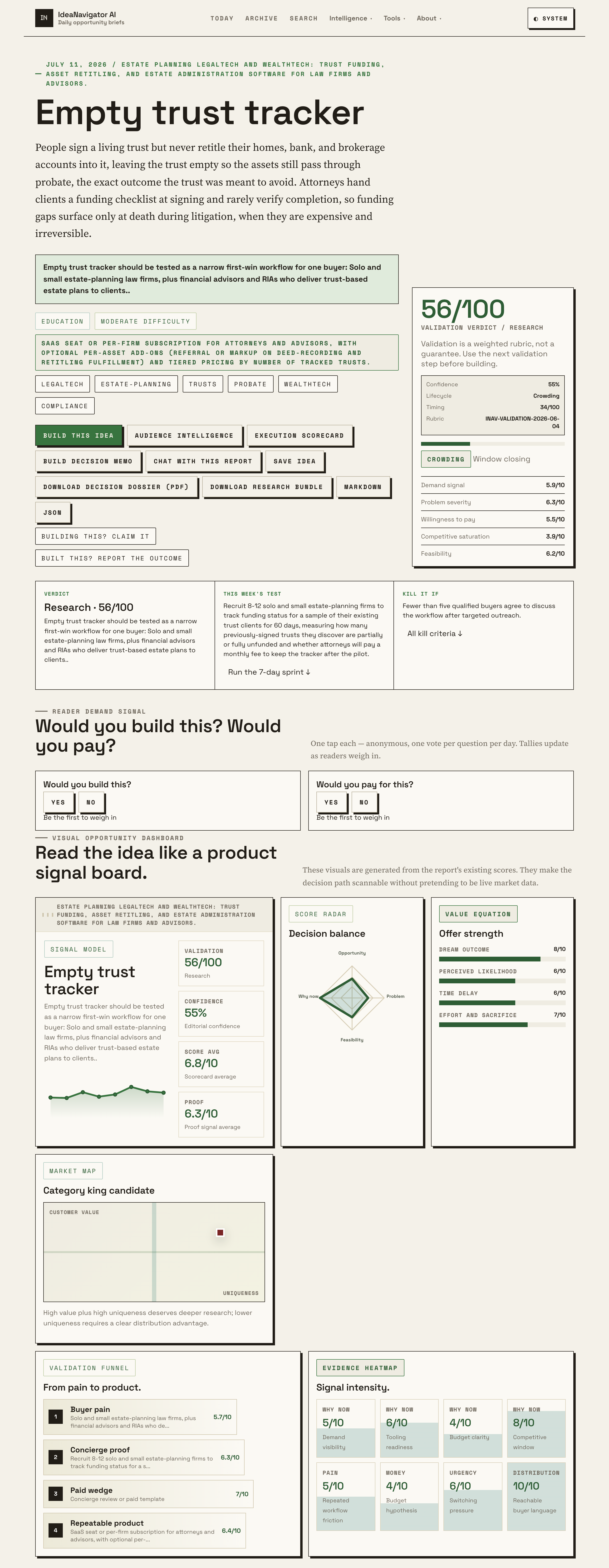
A proposal outlines a trust-funding tracker for small estate-planning firms and financial advisers to monitor whether clients move assets into living trusts. Its suggested 60-day pilot has not been reported as underway, and there are no results showing how many trusts are unfunded or whether firms will pay for the service.
The proposed tool would let a firm create a funding checklist for each trust, covering assets such as real estate, bank and brokerage accounts, business interests and beneficiary designations. Each item could be marked pending, in progress or confirmed funded, with documents such as a recorded deed or a statement showing retitled ownership attached as proof.
Automated reminders would prompt clients to complete outstanding steps. A firm dashboard would show the percentage of each trust funded and the status of the firm’s broader caseload. The suggested business model is a firm or seat subscription, potentially tiered by the number of trusts tracked, with optional fees or referrals for deed recording and other asset-transfer services.
The proposed validation would recruit 8 to 12 solo and small firms to review a sample of existing trust clients over 60 days. The measures would include how many signed trusts are found to be partly or fully unfunded and whether participating attorneys would pay a monthly fee to continue using the tracker. Those are planned measures, not findings.
Where Trust Plans Can Fall Short
A living trust can only help manage assets placed in it. The proposal focuses on the gap between signing a trust and completing the separate work of changing ownership or account arrangements. If an asset remains outside the trust, the intended estate-planning outcome may not apply to that asset.
For firms and advisers, a status tracker could make follow-up more visible after signing and give staff a way to identify incomplete tasks while a client can still act. The suggested dashboard would make funding gaps easier to spot across multiple clients. Whether that would reduce probate disputes, save costs or improve client outcomes has not been established by pilot evidence in the material provided.
The proposal also points to a possible commercial opening alongside existing document-drafting tools and paid deed services. A subscription tracker might address follow-up work those tools do not cover, but the market demand, willingness to pay and cost of verifying documents remain untested.
The Work After Trust Signing
The proposal describes trust funding as a manual, fragmented process. Attorneys may give clients a checklist when signing, but the proposal says completion is often not verified. It argues that missed transfers can remain unnoticed until a death or later dispute, when correction may be difficult or impossible.
IdeaNavigator AI says estate-planning adoption and digital tools are growing in 2026, while about 11% of Americans hold a trust. The material does not provide a survey citation, date range or definition for that estimate, so it should be treated as a stated figure rather than a verified measure here. It also cites deed-funding services priced from $250, but gives no provider or pricing breakdown.
The suggested customers are solo and small estate-planning firms, as well as financial advisers and registered investment advisers that include trust-based plans in client services. The proposed tracker would sit alongside legal documents and asset-transfer services; it is not described as performing the legal or financial transfers itself.
Pilot Evidence Is Still Missing
It is not clear whether any firms have agreed to participate, whether a tracker has been built, or whether the proposed 60-day pilot has begun. There are no reported counts of unfunded trusts, client completion rates, subscription commitments or measured effects on probate outcomes.
The proposal also leaves open how firms would verify attached documents, how often records would need updating, and how sensitive financial and property information would be stored and accessed. It does not specify pricing, integrations with law-firm or adviser systems, or how responsibility would be divided when a transfer is delayed or a record is incomplete.
The estimate that roughly 11% of Americans hold a trust and the reference to deed services starting at $250 are not accompanied by supporting citations or definitions in the proposal. Their underlying time periods and comparison bases are therefore unclear.
A 60-Day Firm Pilot
The next proposed step is to recruit 8 to 12 solo and small firms and track a sample of existing trust clients for 60 days. The pilot would record the share of trusts found partly or fully unfunded and ask whether firms would pay a monthly fee to keep using the tracker.
No timetable for recruitment, launch date, pricing decision or public results is given. Until those details are reported, the tracker remains a product concept with a suggested validation plan, rather than a demonstrated service.
Source: IdeaNavigator AI
Key Questions
What is an empty trust tracker?
It is a proposed tool for recording whether a client’s assets have been transferred into a living trust, with statuses, supporting documents and reminders.
Who is the proposed tracker for?
The proposal identifies solo and small estate-planning law firms, financial advisers and registered investment advisers that provide trust-based estate plans.
Has the tracker been tested?
No test results are provided. IdeaNavigator AI proposes a 60-day pilot with 8 to 12 firms, but does not report that the pilot has started.
How might the service make money?
The proposed model is a firm or seat subscription, potentially tiered by the number of trusts tracked, with optional fees or referrals for asset-transfer services.
Source: IdeaNavigator AI
Halloween Picks
halloween
As an affiliate, we earn on qualifying purchases.