
📊 Full opportunity report: Newly Inherited Wealth? Check Your Advisor’s Work on IdeaNavigator AI — validation score, market gap, and execution plan.

Get hardware and tech essentials delivered free with Prime
- Fast, free delivery on millions of items
- Prime Video, Amazon Music and more included
- Member-only deals all year
TL;DR
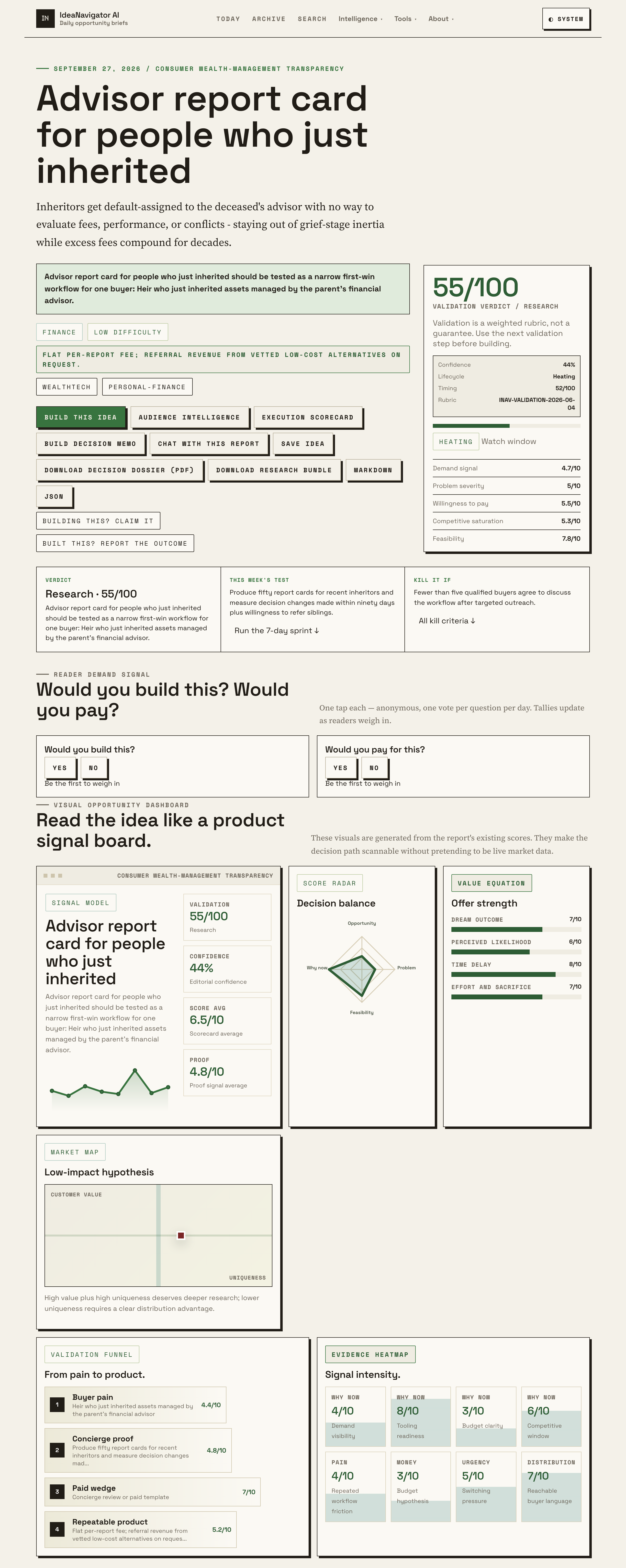
IdeaNavigator AI outlined a proposed report card to help people who inherit assets review the financial advisor who managed them for a parent. The concept would analyze fees, regulatory disclosures and alternatives, but no operating product, test results or customer outcomes are reported.
IdeaNavigator AI has outlined a proposed advisor report card for people who inherit assets managed by a parent’s financial advisor, describing a paid service that would analyze account statements, fees and regulatory disclosures. The material presents the service as an idea to test, not a launched product, and provides no results showing whether heirs have used it or changed advisors after receiving a review.
The proposed service is aimed at a specific situation: an heir inherits assets that remain with the deceased parent’s advisor. IdeaNavigator AI says the heir may stay with that advisor by default, without an easy way to assess fees, investment performance or potential conflicts of interest. The description frames grief and administrative inertia as factors that could delay a review; it does not provide research or customer data quantifying how often that happens.
The suggested first version would let a user enter an advisor’s name and upload account statements. It would then combine regulatory history and disclosed conflicts with an estimate of all-in fees drawn from the statements, compare those costs with alternatives, and provide stay, negotiate or switch guidance, including scripts for contacting the advisor. No technical specifications, sample report, validation method for the fee calculations or evidence of a working service are included.
IdeaNavigator AI proposes charging a flat fee for each report and earning referral revenue if users request introductions to vetted, lower-cost alternatives. The plan does not state the proposed report price, identify referral partners or explain how alternatives would be vetted. It also suggests testing the concept with 50 recent inheritors, tracking decisions made within 90 days and whether participants would refer siblings. The material does not say that this test has begun.
A Review at the Transfer Point
If built and tested, the service would put a structured review in front of heirs at a moment when financial accounts may pass to them along with the existing advisor relationship. Fees and conflicts can be difficult to interpret across account documents, so a clear accounting could help a new owner ask informed questions before deciding whether to keep an advisor, negotiate costs or seek another option. The proposal’s potential value depends on whether its analysis is accurate, understandable and useful for real decisions.
The idea also raises practical questions about incentives. A business that charges for a report while receiving referral revenue could have reason to steer users toward particular alternatives. The plan mentions vetted providers but does not describe vetting standards, referral payments or safeguards for presenting options. Those details would matter to heirs evaluating whether the recommendations are independent.
For readers considering a similar review now, the proposal is not evidence that any particular advisor has charged excessive fees or acted improperly. It describes a possible way to examine an individual relationship. Investment outcomes vary, and investments carry a risk of loss; a fee comparison alone cannot establish which advisor or strategy is suitable for a person’s circumstances.
From Inheritance to Advisor Review
The proposal situates the idea within the transfer of wealth to heirs over the coming decade, which it characterizes as involving trillions of dollars. It does not provide a specific estimate, timeframe calculation or citation for that figure. Its narrower focus is the handoff of assets that remain under the management of a parent’s advisor, rather than estate planning or wealth management generally.
The suggested workflow relies on two kinds of information: public regulatory and fee disclosures, and the heir’s own account statements. IdeaNavigator AI argues that public data and large language model document parsing could make parts of an advisor evaluation automatable. The material does not explain what sources would be checked, how disclosures would be matched to a specific advisor, or how software outputs would be reviewed for errors.
The concept is at the validation stage as described: produce 50 reports for recent inheritors, then measure whether users make a decision within 90 days and whether they refer siblings. Those are proposed measures, not reported findings. No launch date, product name, company operating the service or completed pilot is given.
Product and Testing Status
It is not clear whether a report card has been developed, whether any heirs have tried it, or whether the proposed 50-person validation study has started. There are no reported results on decision changes, user willingness to pay, accuracy of fee extraction or referrals.
The proposal also leaves open how it would define performance benchmarks and compare advisors with alternatives, including how it would account for differences in investment risk, services and client circumstances. It does not specify how recommendation quality would be checked, how sensitive statements would be stored or protected, or how referral revenue would be disclosed. Until those points are addressed, the described stay, negotiate or switch guidance remains a planned feature rather than a demonstrated outcome.
The Proposed 90-Day Test
The next step in the plan is to produce report cards for 50 recent inheritors and track whether they change an advisor-related decision within 90 days. The proposal also calls for measuring whether participants would refer siblings, a signal of potential word-of-mouth interest. No timeline or completed test findings are provided, so there is no public evidence yet on uptake or impact.
If the test proceeds, useful details for judging the results would include how participants are recruited, what counts as a decision change, whether users pay for reports, and how fee calculations and referrals are handled. Any eventual results would need to distinguish between heirs who were already considering a change and those whose decisions followed the report.
Source: IdeaNavigator AI
Key Questions
Is the advisor report card available now?
The material describes a proposed service and a validation plan. It does not say that a product is available or that testing has begun.
What would the proposed report review?
It would combine an advisor’s regulatory history and disclosed conflicts with fee information extracted from the heir’s account statements, then compare the relationship with alternatives.
Would it tell heirs to switch advisors?
The proposed report would offer stay, negotiate or switch guidance. No evidence is provided that these recommendations have been tested or that switching is appropriate for any particular heir.
How would the service make money?
IdeaNavigator AI proposes a flat fee per report and referral revenue when users request introductions to lower-cost alternatives. The proposed prices, partners and vetting standards are not specified.
What evidence would show whether the idea works?
The proposed test would create reports for 50 recent inheritors and track decisions within 90 days and sibling referrals. No results or test schedule are reported.
Source: IdeaNavigator AI
Halloween Picks
halloween
As an affiliate, we earn on qualifying purchases.