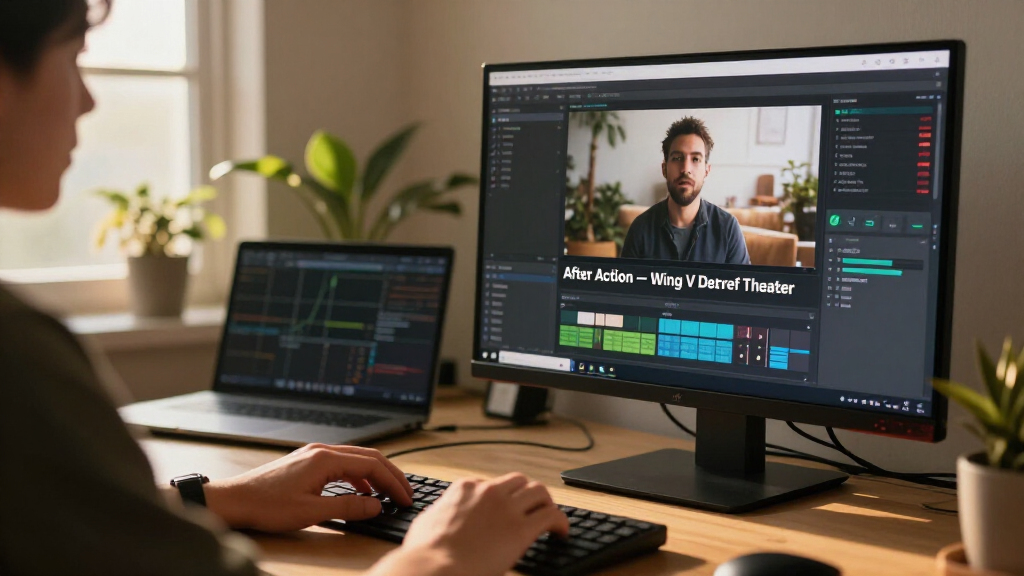

🔍 Read the full analysis: Inside The AI-Powered Credits Of “After Action — Wing V Debrief Theater” on ThorstenMeyerAI.com

Get hardware and tech essentials delivered free — and shop member deals
- Fast, free delivery on millions of items
- Access to Prime Big Deal Days deals on October 6–7
- Prime Video, Amazon Music and more included
TL;DR
After Action — Wing V Debrief Theater is a fictional, AI-built web exhibition that presents 24 website experiences as productions in a continuous, interactive credits roll. Its design combines code-generated sand-table scenes with a locally stored poster image, and includes controls for pausing, navigation and reduced motion.
After Action — Wing V Debrief Theater, the original analysis, is a live, AI-built web exhibition that presents 24 fictional web experiences as a cinematic closing-credit roll, rather than as a conventional gallery. The project is explicitly a fictional design piece, not a real company or an account of military activity; its main development is a browser-based format that makes the credits themselves the exhibit.
The exhibition’s central feature is a continuous, navigable credit roll interrupted at intervals by miniature sand-table scenes. The credits name the 24 Wing V rooms as productions, with department labels and links to individual experiences. Visitors can pause the roll or jump between chapters using controls synchronized with a time display, locator line and chapter label.
The motion is driven by JavaScript timing and a continuous track transform, according to the project description, rather than a CSS marquee. Names moving through the roll are removed from keyboard focus; a separate, stationary linked register provides an alternative route through the same material. The animation runs while the theater is visible and playing, pauses when the browser tab is hidden, and offers manual scrolling for visitors who prefer reduced motion.
After every eight productions, the credit sequence gives way to CSS-built dioramas. Tilted terrain, contour gradients and raised markers suggest scenes including a shield formation, a catapult’s arc and two keys moving toward a shared lock. An intersection observer activates each scene as it enters view. The project says its visual effects are largely generated in code, but the theater’s hero area uses a locally stored still image: the intended ambient video was unavailable in the described build.
Credits Become the Exhibition
The design makes a practical argument about how a portfolio or collection can be experienced: instead of asking visitors to scan a grid and choose a project, it places each work in a shared sequence. The rolling credits provide the main navigation, while chapter controls and the linked register offer ways to move through the collection without waiting for every title to pass.
That approach also makes accessibility part of the format rather than an afterthought. A stationary index serves visitors who do not use the animated roll, and reduced-motion support replaces continuous movement with manual scrolling. The project’s pause behavior and focus handling address specific issues that can arise when animated text is also being used as navigation.
The military language and sand-table imagery are presented as theatrical motifs, not as reporting about combat or actual operations. That distinction matters because the piece borrows the vocabulary of a debrief theater while describing itself as a fictional design exercise. Its stated emphasis is on interaction design and presentation, not on depicting harm.
As an affiliate, we earn on qualifying purchases.
A Fictional Wing V Finale
The source identifies After Action as room 125 of a planned 175-room series and describes it as a finale for the fictional Wing V collection. Its premise is a nearly empty cinema where the closing credits become the exhibit. The individual websites are framed as productions in a shared fictional universe, with the gallery format replaced by a final reel.
The art direction combines cinema black, projector white, sand amber and credit gold. Compressed display lettering evokes film titles, while monospace text is used for labels and controls. Letterbox bars, registration marks, simulated grain and a projected beam frame the page as a screening space. The brief also specifies a plain-text index, local assets and no external requests, although the source description does not independently document every implementation detail.
The supplied material includes the original creative brief and describes the resulting site as live. It attributes the brief to Claude Fable 5 and says it was executed by the FABLE/175 pipeline. Those labels explain how the work is presented; the material does not provide independent verification of the AI tools, development process or performance claims.
““The credits are not a scrolling text illusion or a CSS marquee.””
— The exhibition’s description
As an affiliate, we earn on qualifying purchases.
What the Build Description Leaves Open
The source describes the site’s intended behavior and reports that it is live, but it does not include independent testing of the exhibition across devices, screen readers or browsers. Claims about smooth playback, performance and responsive behavior should therefore be understood as design specifications or descriptions, not as independently verified results.
The material also does not identify the 24 experiences’ authors or explain how much of each site was generated with AI. It names a brief author and a production pipeline, but offers no account of the tools, human contributions or review process. The unavailable ambient video is the one implementation limitation stated directly; the source says a local still image is used instead.
As an affiliate, we earn on qualifying purchases.
The Theater’s Next Viewing
The described exhibition is available to view at the project link, where visitors can follow the credits, use the chapter controls or consult the stationary register. The source does not announce a release schedule, planned revisions or another milestone. Any further changes to the theater, including a replacement for the unavailable video, are not specified.
For readers evaluating the work, the next useful step is to compare the live experience with the described features: whether navigation remains usable without motion, how the roll behaves at different screen sizes and whether the index covers all 24 linked rooms. Those are questions for direct testing, not results established by the supplied material.
As an affiliate, we earn on qualifying purchases.
Key Questions
What is After Action — Wing V Debrief Theater?
It is a fictional, AI-built web exhibition that presents 24 Wing V website experiences as productions in a cinematic end-credit sequence. It is not a real company or an account of military activity.
How does the credits roll work?
The project description says JavaScript tracks elapsed time and moves one continuous track. Chapter controls let visitors pause or jump between sections, with the time display and locator updated to match.
What are the sand-table scenes made from?
The miniature scenes are described as CSS-built dioramas, using perspective, layered terrain effects and markers. The hero area differs: the intended ambient video was unavailable, so the build uses a locally stored still image with visual effects.
Can visitors use the exhibition without the moving credits?
The description says a stationary linked register offers another way through the material and that reduced-motion users can choose manual scrolling. It also says the moving names are taken out of keyboard focus.
Has the site’s accessibility and performance been independently verified?
No independent testing is included in the supplied material. Its statements about accessibility behavior and performance describe the project’s implementation or goals, but do not establish test results.
Source: ThorstenMeyerAI.com
Fall Picks
fall essentials
As an affiliate, we earn on qualifying purchases.