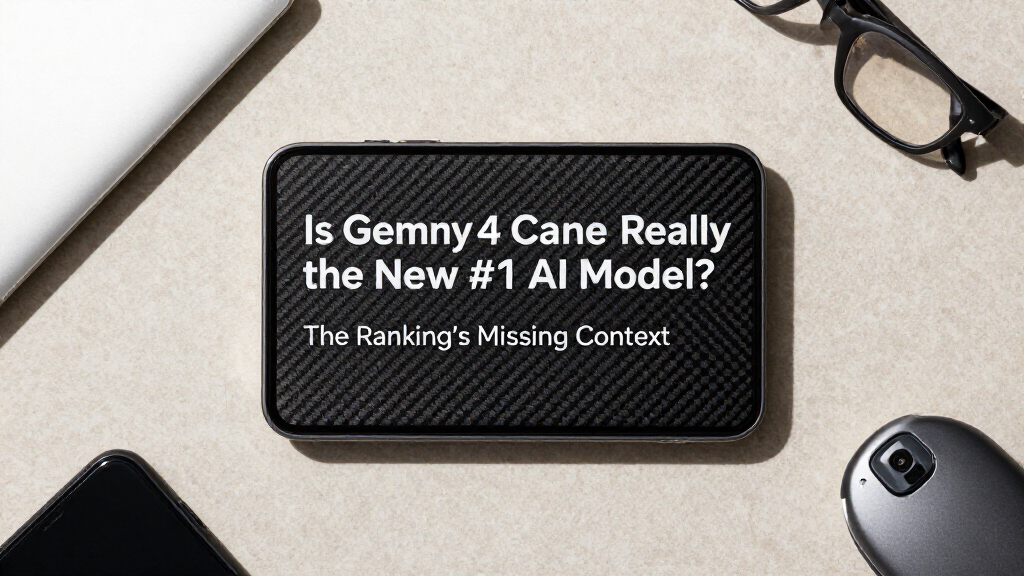

🔍 Read the full analysis: Is Gemini 4 Carbon Really The New #1 AI Model? The Ranking’s Missing Context on ThorstenMeyerAI.com

Get hardware and tech essentials delivered free with Prime
- Fast, free delivery on millions of items
- Prime Video, Amazon Music and more included
- Member-only deals all year
TL;DR
Artificial Analysis’s Intelligence Index v5 ranks Google’s Gemini 4 Carbon first with 59 points, one ahead of Claude Opus 5.5 and two ahead of GPT-6 Astra. The result is specific to nine weighted tests: Carbon leads four and trails rivals on five, and Google has not yet made it publicly available.
Google’s Gemini 4 Carbon ranks first in Artificial Analysis’s rebuilt Intelligence Index v5, scoring 59 points—one ahead of Claude Opus 5.5 and two ahead of GPT-6 Astra. The ranking measures performance across nine selected tests, not every use of AI, and Carbon is not yet publicly available.
The index, launched on October 27, gives equal weight to four categories: knowledge work, coding, science and general tasks. Carbon takes first place in four of the nine tests, including hard reasoning and knowledge questions, science workflows conducted in a terminal, business workflows, and a test that penalizes incorrect answers. It loses the other five, according to the supplied benchmark results.
Its strongest result on the knowledge-and-reasoning exam HLE-Diamond is 69%, compared with 68% for Claude Opus 5.5. On Terminal-Bench-Science it scores 65%, against 63% for GPT-6 Astra. In AutomationBench-AA, which assesses workflows across software tools, Carbon edges its predecessor, Gemini 4 Argon.
The top-line score does not mean Carbon leads every category. Claude Sonnet 5.5 and Claude Opus 5.5 score higher on office-style knowledge work; Claude Opus 5.5 also leads on the index’s real-world coding test. GPT-6 Astra is ahead on a physics research test, Kimi K3.1 Pro on terminal tasks, and Meta’s Muse Wonder Full on document reasoning, according to the source’s account of the results.
Infographic 01 · What the #1 is made of
Number one overall. First in four of nine tests.
The Intelligence Index is a decathlon score: nine tests, one number. Carbon wins on reasoning, science and careful knowledge, and trails on office work and coding.
The nine tests behind the score
Carbon at its highest setting (high) against the best model on each test.
| Test | Weight | Carbon | Leader or runner-up |
|---|---|---|---|
| HLE-Diamond Hard reasoning + knowledge questions | Weight 10% | Carbon 69% | Carbon leads Next: Claude Opus 5.5, 68% |
| Terminal-Bench-Science Science research work in a terminal | Weight 15% | Carbon 65% | Carbon leads Next: GPT-6 Astra, 63% |
| AA-Omniscience v1.1 Knowledge, wrong answers penalized | Weight 15% | Carbon 54 | Carbon leads Next: Claude Opus 5.5, 48 |
| AutomationBench-AA Business workflows across apps | Weight 5% | Carbon 78% | Carbon leads Next: Gemini 4 Argon, 78% |
| AA-Briefcase Office-style knowledge work | Weight 15% | Carbon 1,609 Elo | Behind Claude Sonnet 5.5, 1,812 |
| FrontierCode 2.0 Code a maintainer would merge | Weight 15% | Carbon 41% | Behind Claude Opus 5.5, 46% |
| CritPt v2 (hard) Research-level physics | Weight 10% | Carbon 63% | Behind GPT-6 Astra, 71% |
| Terminal-Bench 4.0 Agentic terminal tasks | Weight 10% | Carbon 65% | Behind Kimi K3.1 Pro, 67% |
| GDP.pdf Reasoning over documents | Weight 5% | Carbon 28% | Behind Muse Wonder Full, 33% |
The surprise in the knowledge test
- Accuracy: Claude Fable 5.1 68%, Claude Opus 5.5 66%, GPT-6.1 Sol and GPT-6 Astra 62%, Carbon 58%
- Hallucination rate: Carbon 11%, Claude Opus 5.5 and GPT-6 Astra about 50%
- Carbon wins because it rarely bluffs, not because it knows the most
Read the weights
- Each of the four blocks counts 25%: knowledge work, coding, science, general
- Carbon trails in two of the four heaviest tests (15% each): office-style work and real-world code
- Hallucination rate = wrong answers among all questions not answered correctly
Source: Artificial Analysis, 28 Oct 2026; Index v5 announcement, 27 Oct 2026; Artificial Analysis model data, retrieved 29 Oct 2026. Scores rounded as in the article; Carbon tested at high, other models at their highest tested setting.
Powered by Thorsten Meyer AI
A Narrow Lead With Practical Trade-Offs
The ranking matters because benchmark leaders can influence which models companies test or adopt, but the result is not a universal verdict. Index v5 combines a particular set of tasks and model settings into one score. A business that mainly needs code generation, office work or document analysis may find a competitor performs better on the work it actually does.
Cost and access also affect the comparison. The source reports an estimated $7.76 per index task for Carbon at standard prices: about 23% below Claude Opus 5.5 at $10.04, but above GPT-6 Astra at $6.24 and well above GPT-6.1 Sol at $1.27. These figures are estimates for the index workload, not a universal price for using each model. The source says Google’s introductory API rates are $2 per million input tokens and $10 per million output tokens, later rising to $4 and $20.
For users, the immediate effect is limited: Carbon is not open to the public. For organizations, the results support comparing models on representative tasks and measuring the cost per completed task, rather than choosing on leaderboard position alone. Model outputs can still be wrong, and testing does not remove the need to check consequential work.
Products Worth Considering

Apple MacBook Pro 16.2-inch with M5 Pro, 18-core CPU, 20-core GPU, 64GB Memory, 1TB SSD, Space Black

Apple MacBook Pro 14-inch (2021) – M1 Pro Chip, 10-Core CPU, 16-Core GPU, 16GB RAM, 1TB SSD, Space Gray
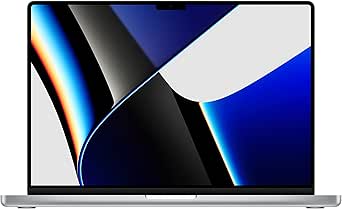
Apple MacBook Pro 16-inch with M1 Pro, 10-core CPU, 16-core GPU, 16GB RAM, 1TB SSD, Silver
As an affiliate, we earn on qualifying purchases.
How The Nine-Test Score Works
Artificial Analysis describes the index as a combined score from nine evaluations grouped into four equally weighted blocks. Knowledge work and coding each account for 25% of the total, as do science and general tasks. Within those blocks, individual tests have different weights: for example, FrontierCode 2.0 accounts for 15% and Terminal-Bench 4.0 for 10% of the index.
The source says 60% of v5 uses private test sets or held-out answers, intended to reduce the effect of models having seen test questions during training. Many evaluations involve longer agent-style tasks, such as working in a terminal, producing reports or fixing code. This can offer a different measure from short chat prompts, while also making runs more expensive.
Artificial Analysis’s reported scores place Gemini 4 Carbon at 59, Claude Opus 5.5 at 58, GPT-6 Astra at 57, GPT-6.1 Sol at 55 and Gemini 4 Argon at 50. Those figures apply to the models and settings tested; a different benchmark mix or task weighting could produce a different order.
“The lead: Gemini 4 Carbon (high reasoning) scores 59 on the Artificial Analysis Intelligence Index v5.”
— Thorsten Meyer, source report
Availability And Benchmark Limits
Public release timing remains unknown. The source says Google is initially providing Carbon to a subset of cyber defenders, followed by trusted partners and then developers, businesses and consumers, without giving dates for those stages. It is also unclear when the reported API pricing will take effect for different users or how costs will vary with actual workloads.
The supplied material does not provide the full methodology, run-to-run variation or detailed results for all nine tests. It also gives only a partial account of some categories and does not establish how well the scores predict performance on any particular company’s tasks. The one-point gap between Carbon and Claude Opus 5.5 should be read as the index’s result, not proof that Carbon is better for every user or workload.
Google’s Staged Rollout
Google’s stated plan is to provide Carbon first to a subset of cyber defenders, then trusted partners, followed by developers, businesses and consumers. No timetable was included in the source material. Further access details and independent evaluations on additional workloads could clarify whether the benchmark lead translates into practical advantages outside the index.
Until broader access is available, buyers and developers cannot directly assess Carbon against their own tasks. Once they can, the useful comparison will include accuracy, completion rates, latency and total cost—not just a single overall ranking.
Key Questions
Is Gemini 4 Carbon the best AI model overall?
Artificial Analysis ranks it first on its Intelligence Index v5, with 59 points. That result covers nine tests and does not establish that Carbon is best for every task or user.
How close is the lead?
Carbon scores one point ahead of Claude Opus 5.5 and two ahead of GPT-6 Astra in the reported index results.
Can the public use Gemini 4 Carbon now?
No public availability date is given in the source. Google is reported to be starting with a subset of cyber defenders and expanding access in later stages.
Does Carbon lead on coding and office work?
No. The source reports that Claude models lead the index’s office-style work and real-world coding tests. Carbon’s overall first place comes from its combined results across all nine tests.
What does the reported $7.76 cost mean?
It is the source’s estimate of Carbon’s cost for an index task at standard prices, not a guaranteed cost for every prompt or business workload. Actual spending depends on usage and task requirements.
Source: ThorstenMeyerAI.com