🔍 Read the full analysis: A Look At 14 AI Workflow Automation Software Options For 2027 on ThorstenMeyerAI.com

Get hardware and tech essentials delivered free with Prime
- Fast, free delivery on millions of items
- Prime Video, Amazon Music and more included
- Member-only deals all year
TL;DR
ThorstenMeyerAI.com presents 14 AI workflow automation options, grouping them for business users, developers and enterprise teams. The guide emphasizes matching technical demands, integrations, security and cost to a team’s needs, but the supplied material does not provide a complete list or verify that the resources have been updated for 2027.
ThorstenMeyerAI.com has published a guide to 14 AI workflow automation options for readers choosing tools or instructional resources for business, developer and enterprise use. The guide’s central message is that selection should follow a team’s technical capacity and workflow needs. However, the supplied source material does not identify all 14 options or establish that they were newly updated for 2027.
ThorstenMeyerAI.com recommends The No-Code AI Automation Playbook for business users seeking to create workflows without programming, describing it as a bridge between Zapier, Make and n8n, a topic also covered in these AI automation software guides. For developers seeking greater control over custom agents, the guide points to n8n AI Automation and its Python integration. These are the publisher’s recommendations, not independently verified rankings.
The guide also names Agentic Coding with Claude Code, Agentic AI for DevOps, AI-Powered Automation for Small Business and Microsoft Power Automate. It associates the first two with developer-oriented autonomous agents, the small-business resource with starting on simpler, high-impact tasks, and Power Automate with organizations already using Microsoft products. These descriptions reflect the guide’s characterizations.
According to the supplied guide material, its assessment considered practical applicability and technical accessibility, including whether resources offer steps toward working workflows. The guide also tells buyers to check integration coverage, API constraints, pricing at higher volumes, data handling, compliance and ongoing maintenance, considerations explored in this guide to comparing AI automation software. The available material does not provide the other names in the advertised 14 or evidence for comparative scores.
The 14 picks
- 1
 Agentic AI for DevOps Engineers: Building Autonomous CI/CD, Infrastructure, a…View on Amazon →
- 2
 Workflow Automation with Microsoft Power AutomateView on Amazon →
- 3
 Claude AI for Smart Automation: No-Code Strategies to Build Intelligent Workf…View on Amazon →
- 4
 The No-BS Guide to AI Agents & Automation: Build AI Workflows, Automate Your…View on Amazon →
- 5
 AI Agents: From Theory to Operations — A Practical Guide to Business Automati…View on Amazon →
- 6
 50 AI Workflows for Engineers: From Debugging to System Design, Code Review &…View on Amazon →
- 7
 AI-Powered Automation and Workflows for Small Business OwnersView on Amazon →
- 8
 Practical Autonomous Workflow Automation: Build AI Agents and Automate Real-W…View on Amazon →
- 9
 Hands-On AI Workflow Automation: A Beginner-Friendly Roadmap to Eliminating R…View on Amazon →
- 10
 The No-Code AI Automation Playbook: Build Practical AI Workflows with Zapier,…View on Amazon →
- 11
 AI for Everyday Automation: 7 AI Workflows to Save Hours at Work Every WeekView on Amazon →
- 12
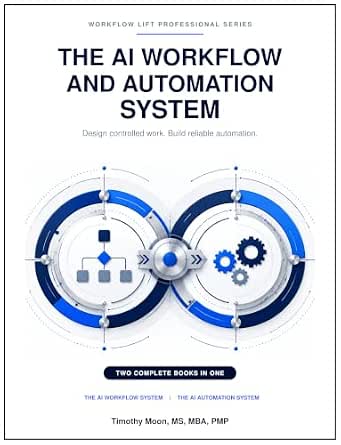 AI Workflow and Automation System – Workflow Lift Professional SeriesView on Amazon →
- 13
 n8n AI Automation: Build Smarter Workflows, Agents, and Intelligent Systems w…View on Amazon →
- 14
 Agentic Coding with Claude Code (5-in-1): A Practical Developer’s Handbook fo…View on Amazon →
Matching Automation to Team Capacity
The guide’s main practical point is that the same platform will not suit every team. It presents no-code tools as a way to lower the barrier to routine automations, while describing code-first frameworks as offering engineers more room to build custom logic. The guide cautions that choosing a tool beyond a team’s skills can leave projects unfinished, while a restrictive tool may frustrate users with more complex needs.
The source also highlights operational costs beyond setup. It says workflows can fail when an application changes its API and that task-based pricing may rise with usage. Because automations can move sensitive information between services, the guide advises buyers to check data retention, access controls and compliance terms. The supplied material raises these concerns but does not provide a product-by-product audit of costs, security or reliability.
Products Worth Considering

LG UltraGear 32GS60QC-B 32-Inch Curved QHD Gaming Monitor

Logitech MX Master 4 Ergonomic Wireless Mouse with Haptic Feedback, Graphite

Logitech MX Mechanical Wireless Illuminated Keyboard, Tactile Quiet, Graphite
As an affiliate, we earn on qualifying purchases.
The Guide’s Selection Framework
ThorstenMeyerAI.com divides the options into broad user groups: business users seeking no-code approaches, developers wanting configurable frameworks, and enterprise teams dealing with complex cloud environments. The guide says its selection approach favored actionable instructions and resources aligned with particular user profiles. The supplied text does not include a complete methodology, scoring table or underlying test results.
The guide describes Zapier and Make as accessible starting points, while noting that branching logic can become cumbersome as workflows grow. It presents n8n and Python-based approaches as more flexible but more technically demanding. For larger organizations, it says Power Automate may fit teams already embedded in Microsoft’s ecosystem. These are general assessments from the guide; actual suitability depends on an organization’s applications, policies and implementation.
Missing Picks and Verification
The supplied material from ThorstenMeyerAI.com does not name all 14 options, despite the guide’s title. It also provides no publication date, product version numbers, pricing figures, benchmark results or direct quotations from users or vendors. The material therefore does not clarify whether “for 2027” refers to a recent review, a forward-looking roundup or a title that has not been updated.
The source refers to books and other instructional resources alongside software platforms, leaving the scope of the 14 picks unclear. Its “best overall” label for a no-code playbook represents the publisher’s judgment; the supplied material does not show comparative testing that would independently substantiate it. The guide advises buyers to verify current integrations, security documentation and pricing with providers.
What Buyers Should Check
ThorstenMeyerAI.com advises readers to compare the full list against their own requirements. Before committing, teams can test the needed connectors and API behavior, map a representative workflow, and check how errors are reported and recovered. The guide also recommends estimating costs at higher usage levels and reviewing data-processing and access-control terms, particularly for sensitive information.
The supplied source does not announce a follow-up review or a timeline for updated picks. Because the complete list and its publication details are not available in the material provided, it remains unclear which products the guide covers beyond those named. The guide’s advice is to account for changing integrations and ongoing maintenance; it does not guarantee future performance or suitability.
Key Questions
What is the guide’s main recommendation?
ThorstenMeyerAI.com recommends The No-Code AI Automation Playbook for business users who want to build workflows without coding. That is the publisher’s assessment, not an independently verified ranking.
Which options does it point developers toward?
The guide names n8n AI Automation for developers seeking control over custom agents and also cites Agentic Coding with Claude Code and Agentic AI for DevOps. The supplied material does not compare their capabilities in detail.
Does the source list all 14 options?
No. The supplied text names only some of the resources, so the complete set of 14 picks cannot be confirmed from this material.
What should teams check before choosing an automation platform?
The guide advises checking technical fit, required integrations, API limits, projected costs, security controls, data handling and maintenance needs. It recommends matching the platform to the team’s actual skills and workflow requirements.
Source: ThorstenMeyerAI.com