
Modern health AI tools now can accurately forecast disease susceptibility for over 1,000 conditions by combining genetic, clinical, and real-world data. They analyze electronic health records, genetic profiles, and environmental information to identify early warning signs. These tools help you get personalized insights, enabling earlier detection and proactive management of health risks. If you want to discover how these innovations could impact your health journey, there’s more to explore ahead.
Key Takeaways
- Advanced AI algorithms analyze diverse health data to accurately predict disease risk for over 1,000 individuals.
- Integration of genetic, clinical, and environmental data enhances early susceptibility detection.
- Neural network models continuously update risk assessments as new information becomes available.
- AI-driven tools enable proactive interventions, reducing disease progression and improving outcomes.
- Secure data handling ensures privacy while facilitating large-scale disease susceptibility forecasting.
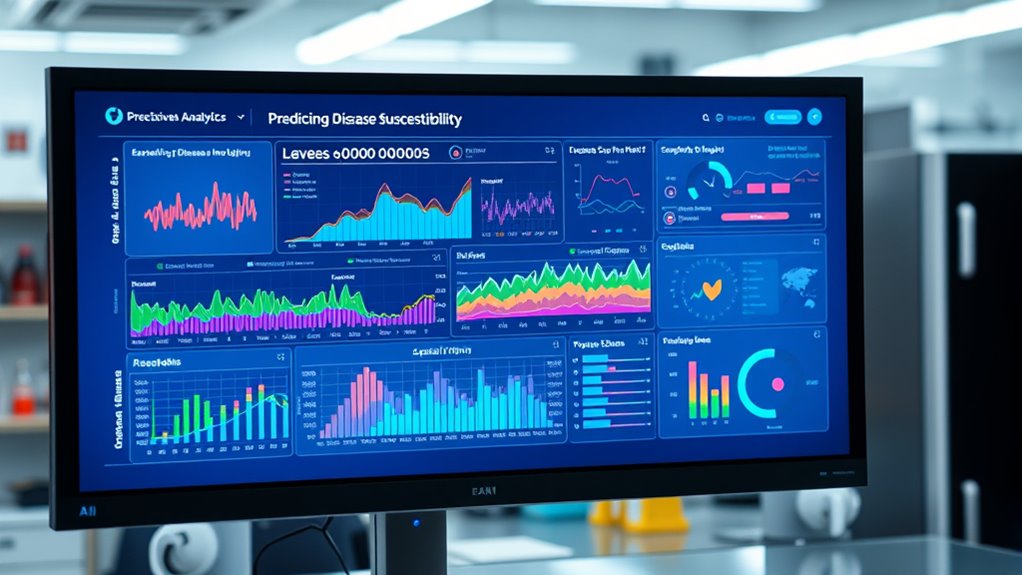
Health AI tools are transforming how we predict, detect, and manage diseases by harnessing advanced algorithms that analyze vast amounts of patient data. These tools blend classical statistical methods with modern AI techniques to create accurate disease risk models. By tapping into real-world clinical datasets like electronic health records (EHRs) and claims databases, they can autonomously evaluate all aspects of your health information — diagnoses, medications, labs, and more — to select the most relevant predictor variables. This process enables the development of sophisticated neural network models that forecast your individual disease risks with remarkable precision. One of the most impressive aspects of these AI-based systems is their ability to learn and adapt over time. As new patient data is collected, the algorithms rerun to update predictions, ensuring they reflect the latest health trends. This continuous refinement helps in identifying early signs of disease, often before symptoms even appear, which is crucial for timely intervention. For example, in autoimmune disease prediction, AI models analyze genetic expression data to improve accuracy. They identify gene and trait associations linked to autoimmune conditions, uncovering 26% more novel connections than previous methods. This means you could be flagged as at risk earlier, allowing healthcare providers to intervene proactively rather than reactively. Additionally, EXPRESSO, the new AI algorithm, demonstrates how integrating genetic, epigenetic, and 3D genomic data can significantly enhance disease prediction capabilities beyond traditional models. AI also plays a vital role in infectious disease management through early warning systems. These systems process enormous datasets, including medical records, social media activity, news reports, and environmental data. They look for unusual patterns or anomalies that could signal an emerging outbreak, such as spikes in symptom-related online searches or social media mentions. These signals enable public health officials to respond faster, often before official reports confirm an outbreak. By revealing complex correlations across diverse data streams, AI can forecast outbreaks, helping you and your community stay safer. In clinical settings, AI-driven predictive models assist in managing disease severity and progression. For example, during the COVID-19 pandemic, severity algorithms evaluate patient lab results and demographics to predict risks like ventilator need or organ damage. Healthcare providers use these insights to prioritize care and make better-informed decisions. Similar models support managing chronic diseases like liver cirrhosis by predicting disease progression, enabling early treatment adjustments that can prevent severe outcomes. The ability to foresee disease trajectories helps you receive personalized care that’s timely and effective. Furthermore, AI contributes significantly to predicting long-term risks for chronic conditions such as cancer, heart disease, and diabetes. By analyzing data from EHRs, genetic profiles, and wearable sensors, these models identify early warning signs and risk factors. This proactive approach allows you to take preventive measures, whether through lifestyle changes or medication, ultimately improving your health outcomes. Studies consistently show that AI-based predictions outperform traditional methods, providing a clearer picture of your disease susceptibility and helping you stay ahead of potential health issues. Moreover, the use of AI security solutions ensures that sensitive health data is protected, allowing for the safe and effective implementation of these predictive tools.
Frequently Asked Questions
How Accurate Are the AI Predictions for Individual Disease Risk?
Your AI predictions for individual disease risk are quite accurate, with AUC scores ranging from about 0.66 to 0.95 depending on the disease and model. For common conditions like cardiovascular disease, accuracy can reach over 95%. However, the precision varies based on data quality and disease complexity. Incorporating genetics and lifestyle data generally improves prediction, but some models still need further validation across diverse populations.
Can the AI Tool Predict Rare or Emerging Diseases?
Yes, the AI tool can predict rare or emerging diseases. It analyzes limited data, identifies hidden patterns, and detects early signs that might otherwise go unnoticed. By examining electronic health records and clinical notes, AI helps flag patients at risk before symptoms fully develop. This proactive approach enables earlier diagnosis and targeted treatments, ultimately improving outcomes for patients with rare or emerging conditions.
What Data Sources Does the AI Use to Assess Susceptibility?
Did you know AI models analyze over 100 million patient records? They use diverse data sources like electronic health records, including demographics, diagnoses, labs, and critical signs. They also incorporate genomic data, revealing genetic risks. Real-time sensor data from wearables provides ongoing health insights. Imaging scans and diagnostic tests further enhance predictions. Combining these sources allows AI to assess susceptibility accurately and adapt to evolving health trends for personalized risk assessments.
How Is Patient Privacy Protected During AI Analysis?
You protect patient privacy during AI analysis by ensuring data is de-identified or anonymized, removing personal identifiers to minimize risks. You use encryption to secure data at rest and in transit, and implement strict access controls and regular audits. You may also utilize federated learning, which trains models without sharing raw data. Clear communication and obtaining informed consent from patients further reinforce privacy protections, building trust and compliance.
Will the Tool Be Accessible to All Healthcare Providers Globally?
You might face barriers to accessing this AI tool globally, especially in low-resource areas with limited infrastructure or internet connectivity. However, efforts like cloud-based platforms, open-source models, and international partnerships aim to expand availability. Training programs and adaptable designs help improve usability across diverse settings. While challenges remain, these initiatives work toward making such tools accessible to all healthcare providers worldwide.
Conclusion
This new health AI tool is like a crystal ball, giving you a glimpse into your future health risks. It empowers you to take control and make informed decisions, much like having a trusted map on a journey. With its ability to forecast disease susceptibility for over a thousand conditions, you’re better equipped to stay ahead of potential health issues. Embrace this technology and turn uncertainty into confidence—your health’s best ally in steering the road ahead.