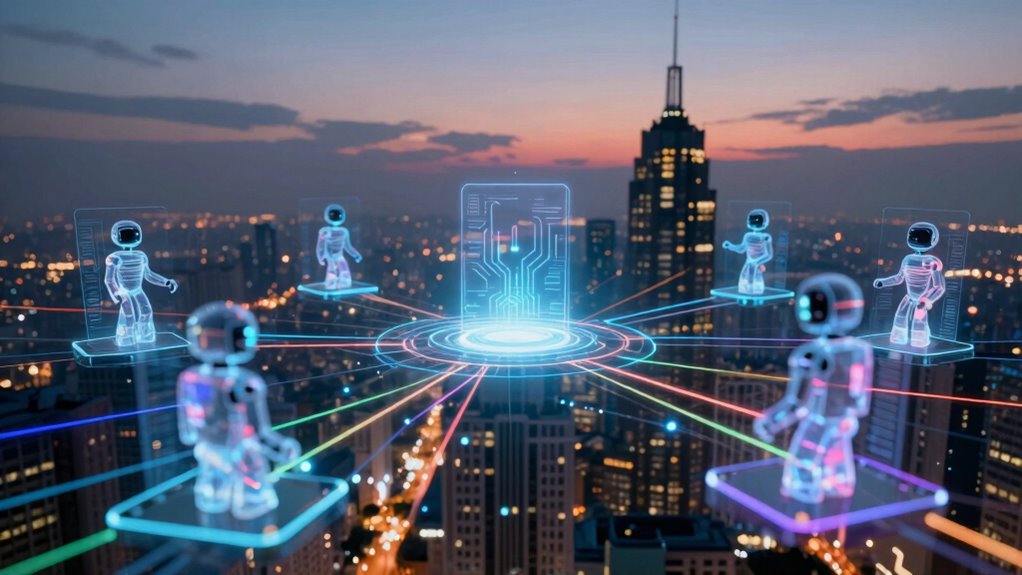

To make AI agents on blockchain truly effective, you need reliable, real-time data validation. Currently, blockchain ensures data integrity after entry but doesn’t verify the accuracy before it’s used. Without trustworthy data, AI decisions can be flawed or manipulated. Improving validation methods will boost confidence in decentralized governance and autonomous decisions. If you want to understand how developing stronger validation solutions can transform AI on blockchain, keep exploring this topic further.
Key Takeaways
- Reliable, real-time data validation mechanisms are still lacking for AI agents on blockchain.
- Current validation solutions, like oracles, do not fully ensure data accuracy before entry.
- Trustworthy data is essential for AI decision-making, yet verification remains a major challenge.
- Without robust validation, AI agents risk making decisions based on flawed or manipulated data.
- Developing dependable, real-time validation methods is crucial for advancing AI on blockchain.

While AI agents on blockchain have made significant strides in decentralizing decision-making and enhancing transparency, they still lack a crucial element: reliable, real-time data validation. Without this, their ability to make accurate, trustworthy decisions remains limited. Blockchain’s inherent transparency and security are excellent for maintaining a record of actions, but the quality of data fed into AI systems is paramount. If the data isn’t verified in real time, the AI’s outputs can be flawed or manipulated, undermining the entire purpose of decentralization.
Decentralized governance relies on the premise that no single authority controls the system, but rather a network of participants collectively make decisions. For AI agents to function effectively within this framework, they need access to validated, trustworthy data. If the data comes from unverified sources, biases, inaccuracies, or malicious inputs can skew decisions, damaging the system’s integrity. This is especially critical when considering data sovereignty, which emphasizes that users should control their data and determine how it’s used. Without dependable validation, users can’t confidently assert control, and the system risks becoming vulnerable to external interference.
You might think that blockchain’s transparency solves these issues, but it doesn’t fully address real-time data validation. While blockchain ensures data integrity once recorded, it doesn’t inherently guarantee the data’s accuracy before it’s entered. That’s where the challenge lies. Effective mechanisms for real-time validation, such as oracle networks, are emerging but aren’t yet universally reliable or thorough enough to serve all AI applications on the blockchain. Until such systems are robust, AI agents remain susceptible to feeding on unverified data, which can compromise their decision-making processes. Improving data validation mechanisms is essential for building more trustworthy AI on blockchain.
For you, this means that despite the impressive advances, AI on blockchain still needs a dependable way to verify data as it flows into the system. Achieving this will strengthen decentralized governance models and uphold data sovereignty by making sure users’ data remains trustworthy and under their control. As new solutions develop, you’ll see AI agents become more capable of making autonomous decisions based on real, validated information—bringing us closer to truly autonomous, transparent, and user-controlled blockchain ecosystems. Until then, the missing piece remains the ability to validate data in real time, a challenge that’s essential for unlocking the full potential of AI on blockchain. Recognizing the importance of digital content formats and innovative validation methods will be key in overcoming this hurdle.

AI Audit Intelligence: Audit efficiency strategies | AI-powered assurance | AI audit innovations | Blockchain auditing tools | Predictive audit models | Prescriptive audit insights
As an affiliate, we earn on qualifying purchases.
As an affiliate, we earn on qualifying purchases.
Frequently Asked Questions
How Do AI Agents on Blockchain Ensure Data Privacy?
You guarantee data privacy for AI agents on blockchain by implementing robust privacy protocols, which restrict access to sensitive information. Data encryption protects data both in transit and at rest, preventing unauthorized viewing. These privacy protocols, combined with encryption techniques, make certain that only authorized parties can access the necessary data, keeping user information secure and maintaining trust in the system.
What Are the Biggest Security Risks for These AI Agents?
You should be wary of behavioral vulnerabilities that can be exploited by malicious actors, compromising AI agents’ integrity. Consensus attacks pose a serious threat, potentially disrupting the blockchain’s stability and trustworthiness. These risks could lead to data breaches or manipulation, undermining your confidence in the system. Staying vigilant and implementing robust security measures is vital to protecting these AI agents from hidden dangers lurking beneath the surface.
How Scalable Are Current Blockchain-Based AI Agents?
You find that current blockchain-based AI agents face scalability challenges, mainly due to token governance and consensus mechanisms. These systems can slow down transaction speeds and limit the number of AI interactions simultaneously. As token governance involves complex voting processes and consensus mechanisms require extensive validation, you might notice delays and throughput issues. Improving these areas is key to making blockchain AI agents more scalable and efficient for widespread adoption.
Can AI Agents on Blockchain Learn and Adapt Autonomously?
AI agents on blockchain can’t fully learn and adapt autonomously yet because they lack advanced mechanisms for decentralized decision-making. You’d need robust distributed consensus protocols to guarantee the agents’ updates are trustworthy, along with effective token economics to incentivize ongoing learning. Without these, autonomous adaptation remains limited, as the system can’t reliably validate or reward new behaviors, hindering the AI agents’ ability to evolve independently.
What Are the Legal Implications of Using AI on Blockchain?
Think of AI on blockchain as a car without clear traffic rules—without proper legal frameworks, you risk collisions. Using AI agents raises questions about intellectual property rights, especially if they generate proprietary data. Regulatory compliance becomes tricky when laws vary across jurisdictions. You must guarantee your AI respects these legal boundaries, or you could face lawsuits, fines, or loss of trust. Staying informed helps you navigate this complex legal landscape confidently.

Chainlink Link Crypto Logo Blockchain Oracle Network T-Shirt
- Bold Chainlink (LINK) Logo Design: Features a clean, bold Chainlink logo
- Perfect for Crypto Enthusiasts: Ideal for blockchain developers and DeFi users
- Comfortable Classic Fit: Lightweight with double-needle sleeve and hem
As an affiliate, we earn on qualifying purchases.
As an affiliate, we earn on qualifying purchases.
Conclusion
Imagine building a mighty ship without a compass—you might sail, but you won’t find true direction. AI agents on blockchain are powerful, but without that missing piece, they’re like ships adrift at sea. Until they have this essential element, their full potential remains out of reach. Keep watch, for when that compass is found, they’ll navigate new horizons, transforming the digital ocean into a domain of endless possibilities.
decentralized data verification devices
As an affiliate, we earn on qualifying purchases.
As an affiliate, we earn on qualifying purchases.

Decision and Game Theory for Security: 14th International Conference, GameSec 2023, Avignon, France, October 18–20, 2023, Proceedings (Lecture Notes in Computer Science Book 14167)
As an affiliate, we earn on qualifying purchases.
As an affiliate, we earn on qualifying purchases.