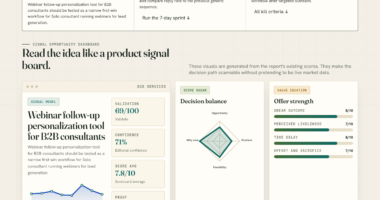

📊 Full opportunity report: Phase 1 synthesis. What the four sectors crystallize. on ThorstenMeyerAI.com — validation score, market gap, and execution plan.
TL;DR
Phase 1 research confirms four structurally distinct displacement patterns across key sectors, revealing heterogeneity in AI-driven labor shifts. This foundational finding guides upcoming policy responses.
Empirical research in Phase 1 has confirmed four distinct displacement patterns across sectors, establishing a foundational understanding of how AI impacts labor differently depending on sectoral characteristics. This confirms the structural heterogeneity of AI-driven labor shifts, providing a critical basis for subsequent policy responses.
The research, conducted across four sectors—software engineering, professional services, customer service + BPO, and creative industries—demonstrates that each sector exhibits unique displacement patterns shaped by their specific structural profiles. These patterns include cohort-bifurcation in software engineering, sub-sector heterogeneity in professional services, operational-scale displacement in BPO, and the ‘middle squeeze’ in creative industries.
Key empirical signatures include a significant displacement of junior cohorts in software engineering, fragmentation of displacement effects within professional sub-sectors, operational-scale shifts in BPO, and a narrowing of middle-tier roles in creative industries. These findings confirm that AI-driven labor displacement is not a monolithic phenomenon but a family of structurally distinct patterns aligned with sectoral traits.
The research also identifies five attribution factors that influence displacement, such as sector-specific automation potential and operational scale, and confirms four interpretations of the transition, notably that effects arrive slowly and heterogeneously across sectors. These insights form the empirical backbone of Phase 1 and will inform policy responses in Phase 2.
Phase 1 synthesis.
What the four
sectors crystallize.
Four sector forensics shipped · four distinct displacement patterns · five attribution factors · four-interpretations confirmation · pipeline horizons 2027-2035+. The empirical-evidence foundation Phase 1 produces — and the structural bridge to Phase 2 (jurisdictional policy responses · July-August 2026).
This is Atlas Essay 06 — the integrative synthesis closing Phase 1’s empirical-evidence sector-forensic foundation before Phase 2 begins. Phase 1 has produced an empirical-evidence foundation that is structurally complete — and the cross-sector integrative finding is that “AI-driven labor displacement” is not a single phenomenon but a family of structurally distinct patterns whose axes are determined by sectoral characteristics. Pattern 1 cohort-bifurcation (Essay 02 · software engineering · career-stage axis). Pattern 2 sub-sector heterogeneity (Essay 03 · professional services · industry-vertical axis). Pattern 3 operational-scale displacement (Essay 04 · BPO · geographic+operational axis). Pattern 4 creative-skill-spectrum bifurcation (Essay 05 · creative industries · creative-skill-spectrum axis). Interpretation 2 from Essay 01 — transition arriving slowly with heterogeneous effects — is empirically dominant across all four sectors. The heterogeneity itself is the structural signature, not a deviation from it.
Four patterns. Four axes.
Phase 1’s four sector forensics produce empirical evidence for four structurally distinct displacement patterns operating across four structurally distinct axes determined by sectoral characteristics. This is what Phase 1 contributes to the post-labor economics discourse — the analytical-discipline framework that holds multiple patterns simultaneously.
axis
axis
operational axis
spectrum axis
Five factors. Sector-specific rigor.
The analytical-decomposition crystallization Phase 1 produces. Five attribution factors identified across four sectors — three universal plus two sector-specific. The Atlas framework operates on sector-specific attribution rigor rather than universal-displacement-driver claims.
services
Four interpretations. Phase 1 confirmation.
Essay 01 introduced four structural interpretations the framework holds simultaneously. Phase 1’s four sector forensics empirically test which interpretation each sector privileges. The cross-sector pattern crystallizes which interpretations are dominant in which sectoral contexts.
sectors
specific
sector
only
Four horizons. 2027-2035+.
The temporal-integration crystallization Phase 1 produces. Pipeline problems across the four sectors operate on different horizons — but they share the structural mechanism of cohort-bifurcation second-order effects. The forward-looking landscape Phase 4 will integrate.
horizon
concentration
horizon
compression
Bridge to Phase 2. July 2026.
The structural-discipline crystallization Phase 1 produces. Phase 1’s empirical-evidence foundation is structurally complete. Phase 2 begins July-August 2026 with the jurisdictional policy-response analysis operationally aligned with the August 2 EU AI Act enforcement window.
EU AI Act window
full closing bracket
Phase 1’s four sector forensics produce empirical evidence for four structurally distinct displacement patterns operating across four structurally distinct axes determined by sectoral characteristics. “AI-driven labor displacement” is not a single phenomenon — it is a family of patterns. The cohort-bifurcation hypothesis from Essay 02 is operationally important but not universal. Interpretation 2 — transition arriving slowly with heterogeneous effects — is empirically dominant across all four sectors. The heterogeneity itself is the structural signature, not a deviation from it. This is the analytical-discipline framework Phase 1 contributes to the post-labor economics discourse — and the empirical foundation Phases 2-4 operate on.
Structural Diversity of AI Labor Displacement Confirmed
This confirmation demonstrates that AI-driven labor shifts are sector-specific, with distinct displacement patterns driven by sectoral characteristics. Recognizing this heterogeneity is crucial for designing targeted policies and understanding the broader implications of AI adoption across different parts of the economy.
Building AI Agents for Network Operations: Design LLM-powered NetOps workflows with Python, Ollama, MCP, and tool calling
As an affiliate, we earn on qualifying purchases.
As an affiliate, we earn on qualifying purchases.
Empirical Foundations from Prior Essays and Sector Studies
The Phase 1 research builds on prior essays that established a four-dimension architecture and six chromatic registers of labor transition, as well as detailed sector forensics examining software engineering, professional services, BPO, and creative industries. Earlier essays identified the structural interpretations and attribution factors that now underpin the confirmed patterns, confirming the heterogeneity of AI’s labor impact.
Previous studies highlighted the importance of sectoral traits in shaping displacement, but the empirical validation of four distinct patterns across sectors marks a significant advancement. This research addresses the gap by empirically confirming the structural signatures predicted by theoretical frameworks, solidifying the foundation for subsequent policy development.
“The empirical evidence confirms that AI-driven labor displacement manifests as four structurally distinct patterns, each aligned with sectoral characteristics.”
— Thorsten Meyer

RASPBERRY PI 5 HOMELAB: Self-Hosting Your Own AI, Data, and Automation Stack
As an affiliate, we earn on qualifying purchases.
As an affiliate, we earn on qualifying purchases.
Remaining Questions on Sectoral Displacement Dynamics
While the four patterns are empirically confirmed, it remains unclear how these displacement effects will evolve as AI technology advances and as policy measures are implemented. The precise timing and magnitude of future shifts, especially in less-studied sub-sectors, are still under investigation.
Additionally, the interaction between sector-specific patterns and broader economic factors, such as labor market resilience and regulatory responses, is still being analyzed. The full implications of these structural differences for workforce adaptation and policy are not yet fully understood.

Operational Research Tools for Solving Sustainable Engineering Problems
As an affiliate, we earn on qualifying purchases.
As an affiliate, we earn on qualifying purchases.
Transition to Policy Responses and Broader Impact Analysis
Phase 2 will begin in July-August 2026, focusing on jurisdictional policy responses aligned with the upcoming EU AI Act enforcement window on August 2. This phase will analyze how different sectors’ displacement patterns inform targeted regulation and workforce support measures.
Further research will also explore the long-term evolution of these patterns, their impact on labor markets, and the development of sector-specific adaptation strategies. The goal is to translate the empirical findings into actionable policies to manage the transition effectively.

The Writing Strategies Book: Your Everything Guide to Developing Skilled Writers
As an affiliate, we earn on qualifying purchases.
As an affiliate, we earn on qualifying purchases.
Key Questions
What are the four sectors studied in this research?
The sectors include software engineering, professional services (such as accounting and consulting), customer service + BPO, and creative industries.
What does the ‘cohort-bifurcation’ pattern mean?
It refers to the displacement of junior cohorts in software engineering, with senior cohorts remaining relatively augmented, driven by sector-specific automation potential and task structure.
How does this research impact future policy development?
By confirming the structural heterogeneity of displacement patterns, policymakers can design targeted interventions tailored to each sector’s specific challenges, improving labor transition management.
Are these displacement patterns expected to change over time?
While the patterns are now empirically confirmed, their evolution depends on technological advancements and policy measures, which are still under analysis.
What is the significance of the ‘middle squeeze’ in creative industries?
It describes the narrowing of middle-tier roles, driven by AI automation and creative skill spectrum dynamics, affecting employment stability in creative sectors.
Source: ThorstenMeyerAI.com