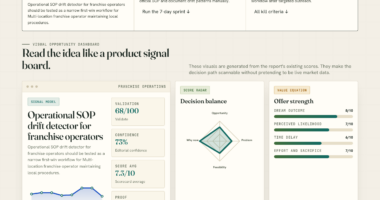
📊 Full opportunity report: Should You Use Mistral Forge? A Buyer’s Decision Guide on ThorstenMeyerAI.com — validation score, market gap, and execution plan.
TL;DR
Mistral Forge is a powerful, sovereign AI platform suited for high-stakes, specialized use cases with strict data control needs. Most organizations, however, should consider simpler, cheaper alternatives unless all specific conditions are met.
Mistral Forge is a capable, full-lifecycle AI model development platform designed for organizations with strict sovereignty, data sensitivity, and specialized knowledge requirements. However, most enterprises should not use Forge unless they meet specific conditions, as it is a scalpel best suited for high-consequence, well-structured use cases. This guide clarifies when Forge is appropriate and when alternative solutions are better.
The core of this guidance is that Forge is only suitable for organizations with four key conditions: data too sensitive for third-party APIs, strict sovereignty requirements (on-premises, non-US vendors, data residency), the need for models to reason with proprietary knowledge, and sufficient data maturity and technical capacity to manage training and operations. If any of these are missing, cheaper and simpler options—such as retrieval-augmented generation (RAG), fine-tuning, or open-weight models—are generally more appropriate.
Experts emphasize that Forge’s strength lies in specialized, high-stakes environments like government, regulated finance, industrial manufacturing, telecommunications, and deep-code tech firms. Its use cases involve complex legal, linguistic, or operational constraints, and organizations must have mature data management capabilities. For most other organizations, the cost and complexity of Forge outweigh the benefits, especially when a more flexible, less expensive alternative can address their needs.
Should you use Mistral Forge? A buyer’s decision guide
Forge isn’t overrated — it’s over-reached-for. A scalpel for a specific, high-value incision, wrong for most jobs. Here’s the honest filter: who it fits, what to use instead, and the red flags that mean “not this, not now.”
- Gov / defense — language, law, process; air-gapped
- Regulated finance — compliance internalized
- Industrial / mfg — specialist constraints & data
- Telecom · deep-code tech — proprietary specs / codebase
- …but only the data-mature, high-consequence, sovereign ones
- You want an assistant / doc-search / support bot → RAG
- Knowledge changes often or must be cited/deleted → RAG
- Low data maturity — fix the data first
- You need cheap, fast, easily updatable
- Small org · no ML capacity · no sovereignty need
- Can’t answer IP / portability / lock-in questions
- No PoC beating a RAG + fine-tune baseline
Forge is a precise instrument for deep domain reasoning + sovereignty + lifecycle control, for orgs mature enough to wield it. For the vast majority the honest answer is not Forge, not yet, maybe never — and that’s fit, not failure. Even the sovereignty-driven buyer has a lighter, reversible choice in self-hosted open weights. The discipline isn’t picking the most powerful tool — it’s matching the tool to the job, the data, and the maturity you actually have, and demanding proof before you commit. Sequence for almost everyone: 1 prompt + RAG → 2 targeted fine-tune → 3 Forge only if a measured gap remains. Climb, don’t leap.
Why Forge Matters for High-Stakes AI Deployment
This guidance is important because choosing the wrong AI platform can lead to costly mistakes—wasted investment, data breaches, or ineffective models. Understanding Forge’s niche helps organizations avoid over-engineering solutions and ensures they select tools aligned with their data, sovereignty, and operational maturity. For high-consequence use cases, Forge’s tailored approach can deliver compliance and control, but for most, simpler solutions are sufficient and more efficient.

ENTERPRISE AI ARCHITECTURE: Volume I – Models, Protocols, Agents, Retrieval, and Application Development
As an affiliate, we earn on qualifying purchases.
As an affiliate, we earn on qualifying purchases.
Key Factors Shaping the Decision to Use Forge
Organizations are increasingly adopting AI for specialized tasks, but many lack the data maturity or sovereignty needs that justify Forge’s complexity. Historically, enterprises have spent significant resources maintaining and organizing data, often before they are ready to leverage advanced models. Forge’s core appeal is for entities with high-value, proprietary data, strict legal or regulatory constraints, and the technical capacity to run and maintain custom models. Its adoption remains limited to sectors like government, defense, regulated finance, and certain industrial sectors, where control and compliance are paramount.
“For most enterprises, cheaper, simpler tools like retrieval-based systems or open-weight models can deliver the needed AI capabilities without the overhead of Forge.”
— Industry expert
on-premises AI sovereignty solutions
As an affiliate, we earn on qualifying purchases.
As an affiliate, we earn on qualifying purchases.
Uncertainties and Limitations in Forge’s Adoption Criteria
It remains unclear how many organizations currently meet all four conditions necessary for Forge’s optimal use, and how flexible Forge can be when organizations have partial needs. Additionally, the evolving landscape of open-weight models and managed services may influence the cost-benefit analysis over time. Details about Forge’s performance, cost structure, and integration complexity are still emerging, making it difficult to provide a definitive recommendation for every scenario.

Beamo Hard Drive Eraser USB – Securely Wipe HDD, SSD, Flash Drive & SD Card Data Before Selling or Recycling, Permanent Data Destruction Tool for PC & Laptop, Plug-and-Play, No Subscription
PERMANENTLY ERASE YOUR DATA: Deleting and formatting only hide your files, leaving them easy to recover. This tool…
As an affiliate, we earn on qualifying purchases.
As an affiliate, we earn on qualifying purchases.
Next Steps for Organizations Considering Forge
Organizations should conduct a thorough assessment of their data maturity, sovereignty requirements, and technical capacity before considering Forge. For those meeting all four conditions, engaging with Mistral or trusted partners for pilot projects can clarify fit and performance. Meanwhile, most organizations should evaluate alternative approaches like RAG, fine-tuning, or open-weight models, which are generally more accessible and adaptable. Industry developments and vendor offerings will continue to evolve, influencing the optimal choice in the coming months.

Finance Reimagined: Digital Tools and AI for Planning, M&A, and Investing: Advanced evaluation and roadmap for seasoned practitioners
As an affiliate, we earn on qualifying purchases.
As an affiliate, we earn on qualifying purchases.
Key Questions
Is Mistral Forge suitable for small or medium-sized businesses?
Generally, no. Forge is designed for organizations with high-stakes, specialized needs and the technical capacity to manage complex AI projects. Smaller organizations typically lack the data maturity and sovereignty constraints that justify Forge’s use.
What are the main alternatives to Forge for enterprise AI?
Common alternatives include retrieval-augmented generation (RAG) systems, conventional fine-tuning of existing models, and open-weight models hosted on-premises or in the cloud. These options are usually more cost-effective and easier to manage.
Can organizations switch from Forge to simpler solutions later?
Yes. Organizations can start with simpler tools and migrate to Forge if their needs become more complex, or if regulatory requirements change. The decision should be based on a clear assessment of data maturity and operational capacity.
What risks are associated with using Forge inappropriately?
Using Forge without meeting the necessary conditions can lead to wasted resources, increased complexity, and potential compliance issues. It may also result in over-engineering solutions that could be achieved more simply.
Source: ThorstenMeyerAI.com