
📊 Full opportunity report: Why Parents Are Turning To IEP Negotiation Practice Simulators on IdeaNavigator AI — validation score, market gap, and execution plan.

Get hardware and tech essentials delivered free with Prime
- Fast, free delivery on millions of items
- Prime Video, Amazon Music and more included
- Member-only deals all year
TL;DR
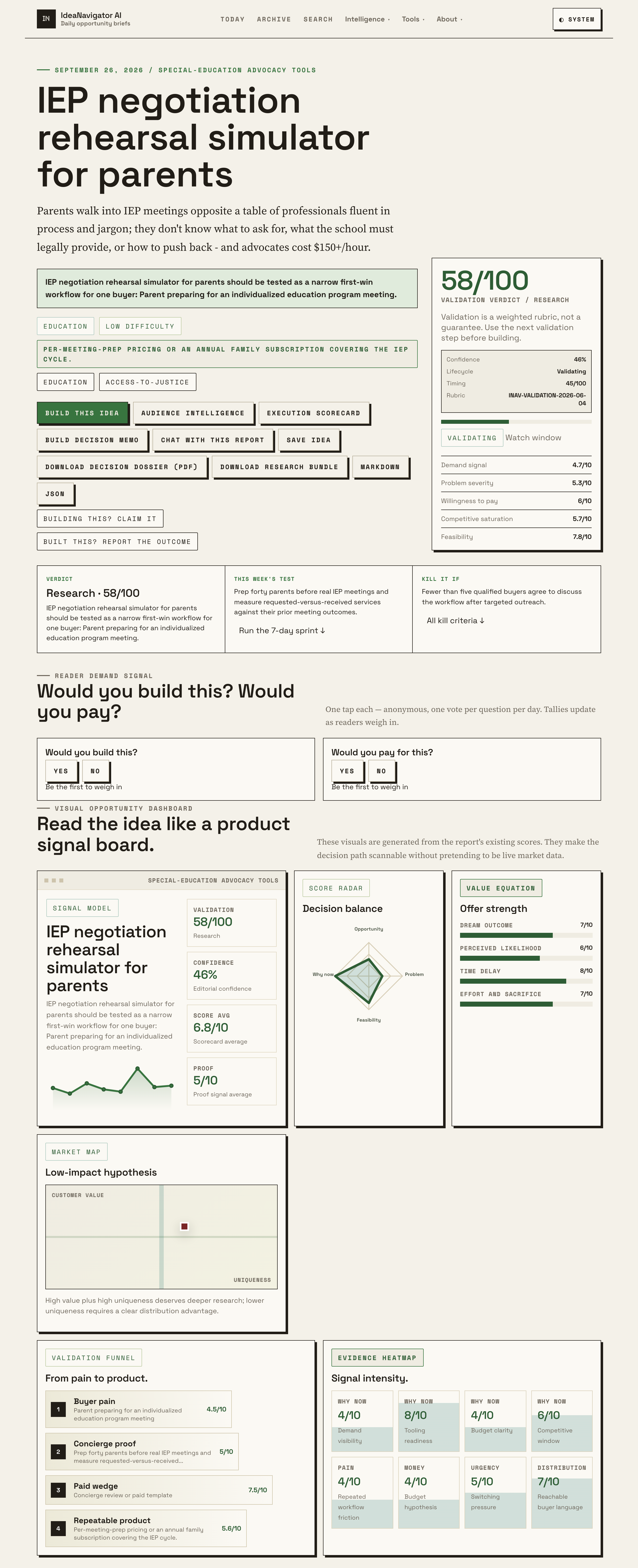
IdeaNavigator AI has outlined a proposed simulator for parents preparing for individualized education program meetings. The concept would explain uploaded records, help draft requests and let parents rehearse conversations, but it has not been tested with families or shown to change meeting outcomes.
IdeaNavigator AI’s proposal describes a practice simulator for parents preparing for individualized education program (IEP) meetings, where families discuss a student’s special-education needs and services with school staff. According to the proposal, the concept would help parents review documents, prepare requests and rehearse responses to likely pushback. The proposal reports no product testing or results showing whether it improves meeting outcomes.
In its proposal, IdeaNavigator AI targets one user: a parent preparing for an IEP meeting. Families would upload a current IEP and evaluation reports. The concept would explain relevant material in plain language, generate possible requests with legal grounding and stage a role-play meeting with realistic objections. The proposal envisions repeated practice to help a parent become more comfortable stating and defending their positions.
IdeaNavigator AI says parents may face school professionals who know meeting procedures and terminology better, and may be unsure what to request, what schools are legally required to provide or how to respond to disagreement. The proposal also cites advocate fees of $150 or more per hour, but provides no geographic scope, fee survey or information about how often families encounter those costs.
For an initial business model, IdeaNavigator AI suggests charging for preparation for each meeting or offering an annual family subscription covering an IEP cycle. Its proposed validation plan is to prepare 40 parents before real meetings and compare the services they request and receive with their outcomes from earlier meetings. The proposal reports no enrolled participants or comparison results.
Testing Support Before IEP Meetings
IdeaNavigator AI’s proposal says a rehearsal tool could help parents organize questions and practice explaining concerns before meeting with school staff. Its plain-language explanations could also help families identify record details they want to discuss. These are potential benefits described in the proposal; no outcomes have been reported.
The proposal concerns preparation for discussions about a student’s educational supports. It suggests that helping parents express requests clearly could affect their participation, but provides no evidence that the simulator would change meeting decisions. An AI-generated request list would not establish what services a student needs or what a school is legally required to provide. The proposal does not say how the tool would handle differing state rules, incomplete records or disagreements about a student’s needs.
IdeaNavigator AI cites advocate fees as part of its rationale for exploring a preparation tool. The proposal provides no planned price, comparison with advocacy services or evidence that families who need help could use the simulator without additional professional advice.
Products Worth Considering

Logitech MX Keypad Programmable LCD Macro Pad for Developers, Pale Grey

Trezor Safe 7 Crypto Hardware Wallet with Bluetooth and Color Touchscreen

LG 27G810A-B 27-inch UltraGear 4K UHD IPS Gaming Monitor
As an affiliate, we earn on qualifying purchases.
From Meeting Prep to Product Test
IEP meetings bring a student’s family and school staff together to discuss the student’s education and special-education services. IdeaNavigator AI’s proposal focuses on preparation for those meetings rather than ongoing advocacy or direct representation. It would use materials a family already has, such as the current IEP and evaluation reports, and role-play to help the parent practice a conversation.
IdeaNavigator AI cites the ability of large language models to simulate role-play as part of its rationale. The proposal also points to rising special-education identification rates and tightening district resources as factors that could make meetings more adversarial. It supplies no figures, dates or independent evidence establishing those trends, and no data showing that they have made meetings more adversarial.
The proposed 40-parent exercise has not been reported as a completed study. Comparing participants’ requested and received services with their earlier meeting outcomes could provide an initial indication of how preparation relates to results. That comparison alone would not show that the simulator caused any difference, since students’ needs, school decisions and meeting details can vary.
Outcomes and Safeguards Remain Unknown
IdeaNavigator AI’s proposal describes no working product, launch date or test findings. It does not specify how legal explanations would be checked, which jurisdictions the tool would cover, or how it would flag cases where a family needs qualified legal or educational advice. It also does not explain how uploaded records would be stored, protected or removed.
The proposed measure—services requested compared with services received—does not specify how services would be evaluated or how previous meeting outcomes would be collected. The proposal also leaves open how many parents would participate, what comparison would be used and whether families with different circumstances would have similar access to the tool. Without those details, the proposed test’s ability to distinguish a product effect from other meeting factors cannot be assessed.
The proposal cites advocate costs, rising identification rates and strained district resources without providing figures or cited research. These claims are presented as rationale for exploring the idea, not as independently established findings.
A Forty-Parent Trial Is Proposed
IdeaNavigator AI proposes preparing 40 parents before actual IEP meetings and comparing their requested and received services with their own previous outcomes. The proposal does not report that the trial has started, set a timetable or describe participant recruitment. Until a test is conducted and results are made available, the simulator’s usefulness, accuracy and effect on services remain unknown.
Source: IdeaNavigator AI proposal
Key Questions
Has the IEP meeting simulator launched?
No launch is reported. IdeaNavigator AI has outlined a proposed product and a way to test it with parents.
What would the proposed simulator do?
Parents would upload a current IEP and evaluation reports. The concept would explain the records in plain language, suggest requests with legal grounding and let parents rehearse a meeting through role-play.
Has the tool been shown to improve services?
No results are available. The proposal suggests preparing 40 parents and comparing their requested and received services with outcomes from earlier meetings.
How might families pay for it?
The proposed options are payment for preparation before an individual meeting or an annual subscription covering an IEP cycle. No prices have been provided.
Source: IdeaNavigator AI