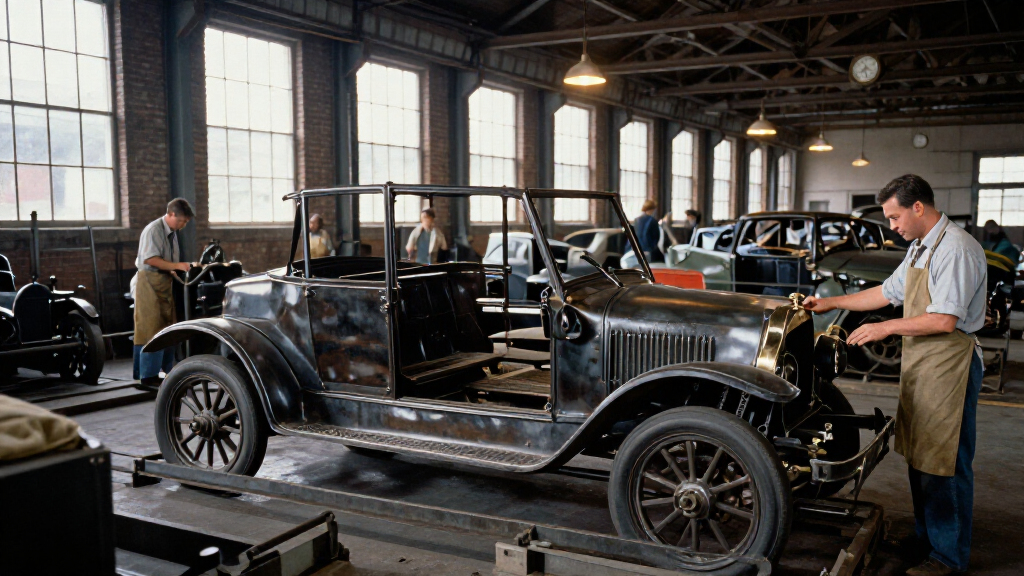
🔍 Read the full analysis: Why The Assembly Line And Five-Dollar Day Belong Together on ThorstenMeyerAI.com

Get hardware and tech essentials delivered free with Prime
- Fast, free delivery on millions of items
- Prime Video, Amazon Music and more included
- Member-only deals all year
TL;DR
Ford’s January 1914 five-dollar day came after the moving assembly line sharply reduced the labor time needed to build a car but left the company struggling to retain workers. Historical figures cited in Thorsten Meyer’s account show Ford’s turnover reached 370% in 1913; the available source excerpt does not include the full account of the pay plan’s results or conditions.
Ford’s own production figures, as presented in Meyer’s account and attributed to Henry Ford’s 1922 book My Life and Work, show the scale of the change. Building a Model T chassis took 12 hours and 28 minutes of labor when workers assembled it in one place. By early 1914, the moving line had cut the reported labor time to 1 hour and 33 minutes, a reduction of about 88%. The figures come from Ford’s account, rather than an independent production audit.
The company first tested the moving-line approach on a small component, the flywheel magneto, in 1913. Ford’s account says workers divided the job into separate operations and moved the part past them. The reported assembly time fell from about 20 minutes per magneto to 13 minutes and 10 seconds, then to five minutes after further changes. Ford said the general idea drew on overhead rails used in Chicago meatpacking plants.
As production methods changed, Ford faced the difficulty of keeping enough people on the job. The turnover figure of 370% in 1913 comes from Daniel Raff and Lawrence Summers’ 1987 study, which drew on earlier labor research and company surveys. Meyer’s account says Ford cut the working day from nine hours to eight and raised minimum daily pay from $2.34 to $5 on January 5, 1914, under a conditional profit-sharing plan. The supplied source says turnover fell to 54% in 1914, but does not give the underlying calculation or the plan’s full eligibility rules.
Productivity Met a Retention Problem
The episode links two developments often discussed separately: faster factory production and the pay policy introduced at Ford in 1914. A line that sharply reduced labor time per chassis did not, by itself, keep workers at their stations. The reported hiring totals suggest that the company faced a major staffing challenge as it tried to maintain production.
Meyer’s account presents the five-dollar day as a response to turnover and absence, rather than accepting the familiar claim that Ford raised pay mainly so workers could afford the cars they built. That interpretation matters because it frames the policy as a decision about running a factory as well as a wage increase. The source does not establish that this was Ford’s sole motive, so the distinction should not be treated as settled fact.
The case also illustrates a broader tension in industrial work: efficiency gains can make production more predictable while making individual tasks narrower and more repetitive. Ford’s own description of reducing workers’ movements and the need for thought underscores that the new system changed the character of work as well as its pace.
Products Worth Considering

Logitech MX Keys Combo for Business Keyboard and Mouse – Graphite

Apple MacBook Air 13-inch Laptop with M5 Chip, 16GB Memory, 512GB SSD, 12MP Center Stage Camera, Touch ID, Wi-Fi 7, Midnight

Logitech MX Anywhere 3S for Mac Compact Wireless Mouse, Space Gray
As an affiliate, we earn on qualifying purchases.
From Stationary Work to Moving Line
Before the moving line, workers assembled a car around a stationary chassis, bringing parts to it. Ford’s Highland Park factory in Detroit tested a different method in 1913, first on the magneto and then on the chassis. In an early chassis experiment, workers pulled the frame along a line with a rope and windlass. The source says this reduced labor time to five hours and 50 minutes, before later changes brought the reported figure lower.
Ford’s 1922 account is the basis for many of the production details in Meyer’s article and should be read as the company’s version of events. The turnover figures have a different cited basis: Raff and Summers’ 1987 study, drawing on earlier sources. Meyer also notes that Ford employed about 14,000 people and produced roughly 250,000 cars a year around 1914, figures used to argue that retention—not a lack of customers—was the immediate issue described.
““the reduction of the necessity for thought on the part of the worker and the reduction of his movements to a minimum.””
— Henry Ford, quoted in My Life and Work (1922)
Limits of the Historical Record
The production-time figures are attributed to Ford’s retrospective account, while the turnover estimate is attributed to a later scholarly study using historical sources. The figures therefore come from different records and methods. The account does not provide enough detail to independently check every number, including the 54% turnover figure reported for 1914.
The full rules for receiving the five-dollar payment are not included in the supplied material, which describes it as conditional profit sharing. It is also unclear from this excerpt how much of the wage change, the shorter workday, or other factors contributed to the reported drop in turnover. The source challenges the claim that Ford acted so workers could buy his cars, but it does not establish that consumer demand played no role in his thinking.
What the Source Establishes
The article is a historical account, not a report of a new policy or a developing event. Its next step for readers is to distinguish Ford’s own production claims from the labor figures cited through later research, and to treat the five-dollar day’s effects as a historical interpretation where the supporting detail is incomplete.
Meyer’s larger series places the factory changes in a longer story about work and production. The supplied excerpt says factory employment in the United States rose between 1910 and 1920 and that robots now perform more tasks on production lines, but it does not provide supporting data or a detailed discussion of those later developments. No further historical milestone or follow-up is specified.
Key Questions
What was Ford’s five-dollar day?
On January 5, 1914, Ford raised minimum daily pay from $2.34 to $5 and shortened the workday from nine hours to eight, according to the supplied account. The higher payment was described as conditional profit sharing.
Why does the account connect the pay increase to turnover?
It reports that Ford hired 50,448 people in 1913 to maintain an average workforce of 13,623, and says turnover reached 370%. Meyer presents the 1914 pay and hours changes as a response to the difficulty of retaining workers.
How much faster did the moving line make chassis assembly?
Ford’s own figures, as cited in the account, put labor time at 12 hours and 28 minutes per chassis before the moving line and 1 hour and 33 minutes by early 1914. The figures are from Ford’s retrospective company account.
Did Ford raise wages so workers could buy his cars?
Meyer describes that explanation as a legend and argues that the immediate problem was worker turnover. The supplied material does not establish Ford’s complete motives, so it cannot rule out other considerations.
Source: ThorstenMeyerAI.com