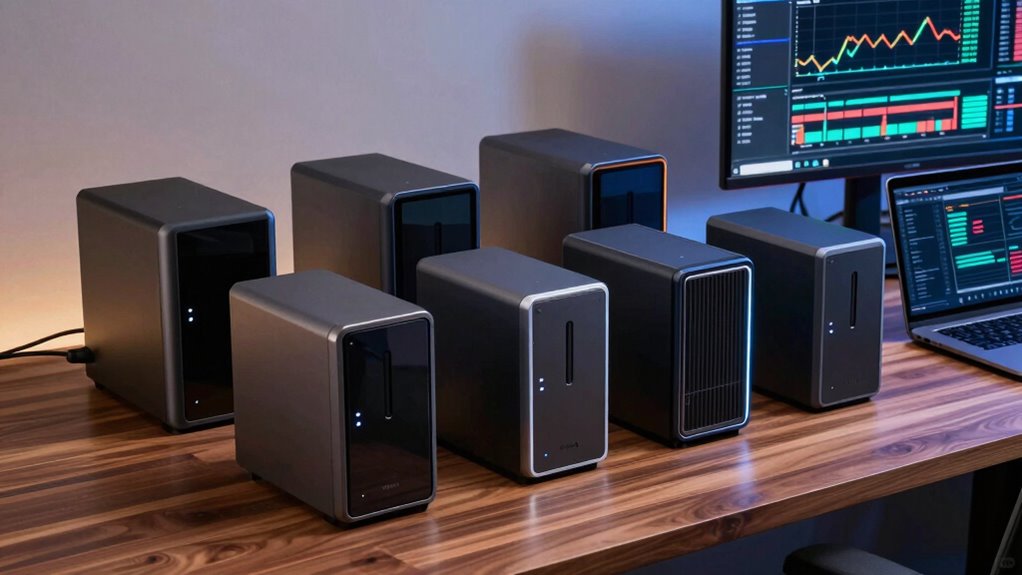

Crypto traders require reliable, high-capacity storage to safeguard their digital assets and transaction histories. An 8-bay NAS provides ample room for multiple drives, redundancy, and fast data access—crucial for active trading environments. The QNAP TS-855X-8G-US stands out as the best overall choice due to its versatile hardware and expandability. Meanwhile, the Asustor Lockerstor 8 Gen3 offers a great balance of performance and cost, perfect for those on a budget or starting out. The main tradeoffs include cost versus features, ease of setup, and scalability. Keep reading for a detailed comparison of these options to find the ideal fit for your crypto trading setup.

Get hardware and tech essentials delivered free with Prime
- Fast, free delivery on millions of items
- Prime Video, Amazon Music and more included
- Member-only deals all year
Key Takeaways
- The top-performing models balance high-speed network ports with robust hardware for seamless crypto trading workflows.
- Scalability and future-proofing are critical—look for NAS that support expansion and latest connectivity standards.
- Cost varies widely; the best value options deliver solid features at a lower price point, but may lack some premium capabilities.
- Ease of setup and management is often overlooked but vital for traders who need quick, reliable access without technical hassle.
- Build quality and warranty support can significantly influence long-term reliability, especially in a 24/7 trading environment.
| QNAP TS-855X-8G-US 8-Bay NAS |  | Best Overall for Power Users and Advanced Crypto Traders | Processor: Intel Atom C5125 8-core 2.8GHz | RAM: 8GB DDR4 (expandable to 128GB) | Drive Bays: 6 x 3.5-inch + 2 x 2.5-inch SATA | VIEW ON AMAZON | See Our Full Breakdown |
| QNAP TS-832PX-4G 8-Bay NAS |  | Best for Small to Medium Crypto Operations with High-Speed Networking | Processor: AnnapurnaLabs Alpine AL324 ARM Cortex-A57 1.7GHz | RAM: 4GB DDR4 (max 16GB) | Storage Bays: 8 x 3.5-inch SATA | VIEW ON AMAZON | See Our Full Breakdown |
| QNAP TS-932PX-4G 5+4 Bay High-Speed NAS with Dual 10GbE and 2.5GbE Ports |  | Best for Flexible High-Speed Storage and Moderate Virtualization | Processor: AnnapurnaLabs Alpine AL324 ARM Cortex-A57 1.7GHz | RAM: 4GB DDR4 (expandable to 16GB) | Storage Bays: 5 x 3.5-inch + 4 x 2.5-inch SATA | VIEW ON AMAZON | See Our Full Breakdown |
| Asustor Lockerstor 8 Gen3 AS6808T 8-Bay NAS (Diskless) |  | Best for Heavy-Duty Virtualization and Media Workloads | Processor: AMD Ryzen Embedded V3C14 quad-core | Memory: 16GB DDR5 ECC (up to 64GB) | Drive Bays: 8 | VIEW ON AMAZON | See Our Full Breakdown |
| UGREEN NAS DXP8800 Plus 8-Bay Business NAS |  | Best for Large-Scale Crypto Data Management and Enterprise Use | Processor: 12th Gen Intel Core i5 | Maximum Storage: 272TB | Network Ports: 2 x 10GbE | VIEW ON AMAZON | See Our Full Breakdown |
| BUFFALO LinkStation 220 8TB 2-Bay NAS Network Attached Storage with Hard Drives Included |  | Best Value for Simple Home Crypto Storage | Capacity: 8TB | Number of Bays: 2 | RAID Support: Yes (RAID 1 by default, configurable to RAID 0) | VIEW ON AMAZON | See Our Full Breakdown |
| bay nas for crypto trader | Processor | RAM | Drive Bays | Network Ports |
|---|---|---|---|---|
| QNAP TS-855X-8G-US 8-Bay NAS | Intel Atom C5125 8-core 2.8GHz | 8GB DDR4 (expandable to 128GB) | 6 x 3.5-inch + 2 x 2.5-inch SATA | 1 x 10GbE, 2 x 2.5GbE |
| QNAP TS-832PX-4G 8-Bay NAS | AnnapurnaLabs Alpine AL324 ARM Cortex-A57 1.7GHz | 4GB DDR4 (max 16GB) | — | — |
| QNAP TS-932PX-4G 5+4 Bay High- | AnnapurnaLabs Alpine AL324 ARM Cortex-A57 1.7GHz | 4GB DDR4 (expandable to 16GB) | — | 2 x 10GbE SFP+, 2 x 2.5GbE |
| Asustor Lockerstor 8 Gen3 AS68 | AMD Ryzen Embedded V3C14 quad-core | — | 8 | — |
| UGREEN NAS DXP8800 Plus 8-Bay | 12th Gen Intel Core i5 | — | 8 | 2 x 10GbE |
| BUFFALO LinkStation 220 8TB 2- | — | — | — | — |
More Details on Our Top Picks
QNAP TS-855X-8G-US 8-Bay NAS
The QNAP TS-855X stands out for its high capacity and extensive expandability, making it ideal for traders managing large crypto datasets or running complex virtualization environments. Compared to the Asustor Lockerstor 8 Gen3, it offers more flexible PCIe expansion options and faster network ports, but at the expense of a steeper learning curve and potentially higher cost. Its 10GbE and 2.5GbE ports ensure rapid data transfers essential for crypto mining or trading applications, while the ability to upgrade RAM up to 128GB provides future-proofing. However, setup complexity and unclear included accessories might challenge less technical users. This NAS suits experienced traders who need maximum customization and performance.
Pros:- Massive storage capacity with 8 bays and PCIe expansion slots
- High-speed 10GbE connectivity supports rapid data transfers
- Upgradeable RAM up to 128GB for demanding workloads
- Supports SSD caching for optimized performance
Cons:- Complex setup process may require technical expertise
- Price and accessories details are not specified, potentially increasing total cost
Best for: Crypto traders who require high-capacity storage, advanced network options, and extensive customization for virtualization or data analysis.
Not ideal for: Beginners or traders with limited technical skills, as setup and configuration can be daunting without prior experience.
- Processor:Intel Atom C5125 8-core 2.8GHz
- RAM:8GB DDR4 (expandable to 128GB)
- Drive Bays:6 x 3.5-inch + 2 x 2.5-inch SATA
- Network Ports:1 x 10GbE, 2 x 2.5GbE
- SSD Slots:2 x M.2 PCIe Gen 3 x4
- Expansion Slots:2 x PCIe Gen 3 x4
Our verdict“This is a highly capable choice for advanced crypto traders and data professionals who need maximum expandability and performance.”
QNAP TS-832PX-4G 8-Bay NAS
The QNAP TS-832PX-4G offers a solid balance of performance and affordability for traders needing scalable storage with fast network connectivity. Its ARM Cortex-A57 processor is less powerful than Intel-based options like the UGREEN NAS DXP8800 Plus, but it provides reliable 10GbE transfers essential for crypto data syncs. Its 4GB RAM, expandable to 16GB, fits smaller-scale setups but limits heavy multitasking. Unlike the Asustor Lockerstor 8, it is less suited for intense virtualization or AI tasks, yet it remains a good choice for traders prioritizing high-speed networking over raw power. The diskless design means additional setup steps, which can be a barrier for newcomers.
Pros:- High-speed 10GbE network ports for quick data transfers
- Expandable RAM up to 16GB for modest multitasking needs
- 8-bay storage capacity supports large datasets
- Cost-effective for scalable crypto storage
Cons:- Requires purchase of drives separately, increasing initial investment
- Limited processing power for intensive workloads
Best for: Crypto traders running small to medium operations who need fast network speeds and scalable storage without requiring top-tier processing power.
Not ideal for: Power users or those needing extensive virtualization capabilities, due to its limited RAM and processor performance.
- Processor:AnnapurnaLabs Alpine AL324 ARM Cortex-A57 1.7GHz
- RAM:4GB DDR4 (max 16GB)
- Storage Bays:8 x 3.5-inch SATA
- Ethernet Ports:2 x 2.5GbE, 2 x 10GbE
- Supported OS:QTS
- Drive Compatibility:SATA drives
Our verdict“This NAS offers a balanced mix of speed and scalability for smaller crypto operations but may fall short for heavy virtualization needs.”
QNAP TS-932PX-4G 5+4 Bay High-Speed NAS with Dual 10GbE and 2.5GbE Ports
The QNAP TS-932PX-4G delivers a flexible storage option with its mixed 5+4 bay configuration, pairing well with traders who need a combination of capacity and speed. Its dual 10GbE SFP+ ports outperform single-port solutions like the Ugreen NAS DXP8800 Plus in data transfer rates, especially when combined with multiple drives. The ARM Cortex-A57 processor keeps costs reasonable but limits heavy virtualization or AI workloads. The setup complexity and the need for additional drives make it less attractive for complete beginners, but it’s a valuable option for traders who want speed with moderate system demands.
Pros:- Dual 10GbE ports enable fast, redundant network connectivity
- Flexible 5+4 bay configuration for storage customization
- Expandable RAM up to 16GB for multitasking
- Supports multiple USB 3.2 ports for peripherals
Cons:- Requires additional drives for operation, increasing overall setup steps
- Limited processing power for intensive workloads
Best for: Crypto traders needing versatile storage with high-speed network access without the complexity of high-end enterprise setups.
Not ideal for: Heavy virtualization or AI tasks, due to processing limitations and diskless configuration requiring extra drives.
- Processor:AnnapurnaLabs Alpine AL324 ARM Cortex-A57 1.7GHz
- RAM:4GB DDR4 (expandable to 16GB)
- Storage Bays:5 x 3.5-inch + 4 x 2.5-inch SATA
- Network Ports:2 x 10GbE SFP+, 2 x 2.5GbE
- Memory Max:16GB
- Supported OS:QTS
Our verdict“Ideal for traders needing fast networking with flexible storage, but less suited for intensive virtual environments.”
Asustor Lockerstor 8 Gen3 AS6808T 8-Bay NAS (Diskless)
The Asustor Lockerstor 8 Gen3 distinguishes itself with a powerful AMD Ryzen embedded processor, making it suitable for traders who run virtualization, media editing, or AI applications alongside crypto storage. Its dual 10GbE and 5GbE ports deliver exceptional network speeds, while four NVMe slots allow for caching and all-flash configurations, a feature not found in most competitors like the QNAP TS-855X. However, its large size and weight demand significant space, and the absence of included drives means additional investment upfront. This NAS is best suited for those who prioritize raw processing power and multitasking capabilities over compactness or simplicity.
Pros:- Powerful AMD Ryzen quad-core processor handles demanding workloads
- Dual 10GbE and 5GbE ports for high-speed networking
- Supports four NVMe SSDs for caching or all-flash setups
- Expandable up to 64GB DDR5 ECC RAM for reliability
Cons:- Large, heavy design requiring ample space and setup effort
- No included drives, increasing initial cost
Best for: Advanced crypto traders and data professionals needing high processing power and fast networking for virtualization or AI tasks.
Not ideal for: Traders seeking a lightweight, plug-and-play solution or those with limited space, due to its size and complexity.
- Processor:AMD Ryzen Embedded V3C14 quad-core
- Memory:16GB DDR5 ECC (up to 64GB)
- Drive Bays:8
- NVMe SSD Slots:4
- Networking:Dual 10GbE, Dual 5GbE
- Dimensions:16.14 x 14.57 x 13.78 inches
Our verdict“Best for professionals who need robust processing and networking capabilities for virtualization and AI tasks alongside crypto management.”
UGREEN NAS DXP8800 Plus 8-Bay Business NAS
The UGREEN NAS DXP8800 Plus sets itself apart with an enterprise-grade design and a powerful 12th Gen Intel Core i5 processor, making it suitable for large-scale crypto operations and business environments. Its support for up to 272TB of storage and multiple RAID options offers unmatched capacity, outpacing the storage potential of the QNAP TS-855X. Dual 10GbE ports enable rapid data transfers critical for crypto farms and collaborative setups. However, the device’s high price and need for separate drive purchases could be barriers for smaller traders. Its wired-only connectivity limits flexibility in certain environments but ensures stable and secure network performance for demanding workloads.
Pros:- Massive storage capacity up to 272TB supports large datasets
- Powerful 12th Gen Intel Core i5 processor for demanding tasks
- Dual 10GbE ports for rapid, redundant network connectivity
- Supports a wide array of RAID configurations for data security
Cons:- Drives are not included, adding to initial costs
- Wired Ethernet only limits deployment options in some environments
Best for: Large-scale crypto storage operations and enterprises needing high capacity, fast network speeds, and robust data security.
Not ideal for: Small traders or those seeking a plug-and-play or wireless solution, due to large size, cost, and wired-only connectivity.
- Processor:12th Gen Intel Core i5
- Maximum Storage:272TB
- Network Ports:2 x 10GbE
- RAID Support:JBOD, RAID0, RAID1, RAID5, RAID6, RAID10
- Drive Compatibility:Third-party drives
- Drive Bays:8
Our verdict“This NAS is tailored for large data farms and enterprise crypto operations that demand maximum storage and network performance.”
BUFFALO LinkStation 220 8TB 2-Bay NAS Network Attached Storage with Hard Drives Included
The BUFFALO LinkStation 220 stands out for its straightforward setup and included drives, making it an attractive choice for crypto traders who want a hassle-free, budget-friendly NAS. Compared to higher-end options like the QNAP TS-855X, it offers less advanced networking features but excels in ease of use and affordability. Its RAID support ensures basic data redundancy, which is vital for protecting crypto wallets and transaction histories. However, the limited capacity—reduced to 4TB in RAID 1—may be restrictive for traders handling large datasets or multiple wallets. Compatibility issues with newer macOS versions and basic feature set make it less suitable for power users needing advanced management tools. This model is best suited for crypto traders who prioritize simplicity, security, and cost over raw performance or expandability.
Pros:- Includes hard drives, reducing initial setup cost
- Supports RAID for data redundancy
- Easy to set up and manage
Cons:- Reduced usable capacity in RAID 1 (4TB total)
- Limited support for the latest macOS versions
- Basic feature set compared to more advanced NAS models
Best for: Crypto traders seeking a plug-and-play NAS with included drives for simple backup and storage.
Not ideal for: High-volume traders or those needing advanced networking features and future-proof expandability.
- Capacity:8TB
- Number of Bays:2
- RAID Support:Yes (RAID 1 by default, configurable to RAID 0)
- Compatibility:Windows, macOS
- Support:24/7 US-based support
- Warranty:2 years
- Made in:Japan
Our verdict“This NAS makes sense for traders who want a straightforward, cost-effective solution for secure storage without complex features.”

How We Picked
These products were selected based on their hardware specifications, connectivity options, scalability, and user reviews relevant to crypto traders. Priority was given to models offering high-speed network interfaces like 10GbE, reliable data redundancy features, and ease of use. We also considered price-to-performance ratio and expandability options for future growth. The ranking reflects a balance between top-tier features and value, ensuring each pick serves a specific trader profile—from budget-conscious beginners to advanced professionals.Factors to Consider When Choosing 8 Bay Nas For Crypto Traders
When choosing an 8-bay NAS for crypto trading, it’s vital to consider factors that ensure data security, speed, and future-proofing. The right device should support your current needs while accommodating potential growth. Beyond hardware specs, focus on network connectivity, reliability, and ease of management. Making the wrong choice can lead to slower transaction times, data loss, or costly upgrades down the line. Here are key considerations to help guide your decision.Network Connectivity and Speed
For crypto trading, fast and reliable network connections are non-negotiable. Look for NAS that offer dual 10GbE ports or higher, which reduce latency and support simultaneous connections. This ensures quick access to your data and minimizes downtime during critical trading periods. Investing in higher network speeds often comes with increased upfront costs, but it pays off in trading efficiency and data transfer rates.
Scalability and Storage Expansion
Crypto data can grow rapidly, so consider NAS that support easy expansion—whether through additional drives or external modules. Future-proof models with PCIe slots or support for NVMe SSD caching can keep your system agile as your storage needs evolve. Overlooking scalability might mean costly replacements or complex migrations later, which can disrupt your trading activities.
Hardware Redundancy and Data Security
Crypto traders must prioritize data integrity. Features like RAID support, hot-swappable drives, and UPS compatibility help prevent data loss during hardware failures or power outages. While these add to initial costs, they protect your trading history and digital assets over the long term. Failing to invest in redundancy can result in costly downtime and data recovery efforts.
Ease of Use and Management
An intuitive interface and straightforward setup process minimize technical frustrations and downtime. Look for models with comprehensive management software, mobile apps, and clear documentation. For traders who prefer focusing on their assets rather than IT troubleshooting, ease of use is a crucial factor that can save time and reduce mistakes.
Cost and Total Value
Price varies widely, but the best value balances cost with features like network speed, scalability, and support. Cheaper options may lack essential capabilities or require frequent upgrades, ultimately costing more in the long run. Conversely, premium models offer advanced features but may be unnecessary for casual traders. Clarify your needs to avoid overpaying or under-equipping your setup.
Frequently Asked Questions
Is a 10GbE port necessary for crypto trading?
While not strictly necessary, a 10GbE port significantly enhances data transfer speeds, reducing lag during high-volume trading activities. If you frequently access large datasets or run multiple simultaneous processes, investing in a NAS with 10GbE support can improve overall responsiveness. For casual traders, a 1GbE port might suffice, but it’s worth considering future needs as your data grows.
Should I choose a diskless NAS or one with drives included?
Opting for a diskless NAS provides flexibility to select drives based on your performance and capacity needs, often at a lower initial cost. However, it requires additional time for setup and compatibility checks. Preloaded models with drives included are more convenient and ready to use immediately but may come at a premium. Consider your comfort with hardware installation and budget constraints.
How important is hardware redundancy for crypto storage?
Hardware redundancy is vital for protecting your crypto data against hardware failures. Features like RAID configurations, hot-swappable drives, and UPS support ensure your data remains accessible and secure during unexpected issues. While redundancy can increase upfront costs, the peace of mind it offers is well worth the investment, especially if your crypto holdings are substantial.
Can I upgrade my NAS later if I need more storage?
Many modern 8-bay NAS units support expansion through additional drives or external modules, but the ease of upgrading varies. Some models offer hot-swappable bays and PCIe slots for SSD caching, which simplify future upgrades. It’s important to verify upgrade paths before purchasing, as incompatible hardware or limited expansion options can restrict your ability to grow your storage capacity.
Is a dedicated NAS better than cloud storage for crypto traders?
A dedicated NAS offers complete control over your data, faster local access, and lower ongoing costs compared to cloud solutions. However, it requires technical knowledge for setup and ongoing maintenance. Cloud storage provides off-site backups and easy access from anywhere but involves subscription costs and potential latency issues. The best choice depends on your security preferences, technical skills, and trading volume.