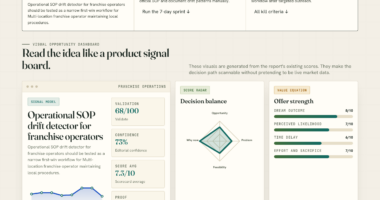

📊 Full opportunity report: The Coding Singularity Is Real — and Steeper Than Clark Presented on ThorstenMeyerAI.com — validation score, market gap, and execution plan.
TL;DR
Recent updates confirm AI models now code at near-human levels on routine tasks, accelerating the coding singularity. Deployment is advancing, but challenges remain in complex, unfamiliar codebases. The timeline for widespread impact is faster than earlier forecasts.
New data confirms that AI systems are now capable of coding at near-human levels for routine tasks, accelerating the onset of the coding singularity faster than previous estimates suggested. This development is reshaping expectations about AI’s role in software engineering and industry automation.
Recent updates to the SWE-Bench leaderboard show that models like Mythos Preview now achieve 93.9% accuracy on routine coding benchmarks, up from around 2% at the end of 2023. This indicates that frontier AI systems are handling a majority of standard software engineering tasks at near-human or super-human performance levels, particularly in familiar codebases.
Additionally, the METR time horizon, which measures how quickly AI can generate usable code, has been revised downward. The median estimate for end-2026 now suggests AI can produce functional code within approximately 24 hours, a significant acceleration from earlier projections of 100 hours. This shift results from updated methodologies and more rapid observed progress, indicating the trajectory of AI capability growth is steeper than previously thought.
These developments confirm that we are witnessing a recursive loop of AI self-improvement in coding, which Clark describes as the ‘coding singularity.’ However, deployment realities reveal a more bifurcated landscape, where advanced models excel in routine tasks but still face challenges with complex, unfamiliar, or architectural problems, especially outside frontier labs.
The coding singularity is real —
and steeper than Clark presented.
Clark’s data is accurate. The trajectory is plausibly steeper. The deployment is bifurcated. The labor consequence is empirical. The substance is recursive self-improvement.
Jack Clark’s Import AI #455 has a section called “The coding singularity – capabilities over time” that does the heavy lifting for his automated AI R&D thesis. This is the read on Clark’s section from outside the frontier lab. The headline finding: the capability data is real and possibly understated, the deployment reality is more bifurcated than “everyone codes through AI” suggests, and the substantive event is not the coding part — it’s the opening of the recursive self-improvement loop the coding capability makes operational.
Clark’s numbers check out. Post-publication data is sharper.
Both benchmark trajectories Clark cites are publicly verifiable. Both have moved meaningfully in the week since Import AI #455 was published. The trajectory is plausibly steeper than the essay presents.

AI VoiceWriter – Smart Dictation & AI Writing Assistant for Windows & Mac | USB Dongle & Mobile App for Voice Input, Proofreading, Rewriting & Multilingual Support
🎙️ Hands-Free Voice Typing for Windows & Mac – Powered by iOS & Android dictation technology, AI VoiceWriter…
As an affiliate, we earn on qualifying purchases.
As an affiliate, we earn on qualifying purchases.
Five-tool consolidated stack. Bifurcated by segment.
Clark: “frontier-lab researchers code entirely through AI systems.” Correct for frontier labs. Partially correct across the broader market — with substantial segment-level variance. The Cambrian explosion of 2024 has consolidated to five production-grade tools.
24% US/CA
50%+ F500
40% large ent
Cursor usage
professional
Python Programming for Automation and AI Apps: Build Scripts, Dashboards, APIs, and Smart Tools That Save Time, Automate Repetitive Work, and Solve Real … Problems (AI agents Made Easy from Scratch)
As an affiliate, we earn on qualifying purchases.
As an affiliate, we earn on qualifying purchases.
Stanford data confirms what Clark’s data implies.
Junior software engineering postings down 40-50% since 2024. Age-inverted hiring relative to historical software engineering patterns. The data is unambiguous on the entry-level segment. The longer-term consequences are unresolved.
AI code generation IDE plugins
As an affiliate, we earn on qualifying purchases.
As an affiliate, we earn on qualifying purchases.
“Coding singularity” is the right name.
Clark calls it “the coding singularity.” The phrase is correct. The framing implies the significance is about coding. The actual significance is what the coding capability enables. Coding is the wedge. The thing on the other side is the singularity.
SWE-Bench saturating means the broader AI engineering capability has reached saturation. AI R&D is engineering with model training as the target output. The coding singularity is what you see. The recursive self-improvement loop is what you are looking at.

Spec-Driven Software Development with AI: A Practical Handbook for Turning Requirements into Designs, Tests, Tasks, and Production-Ready Code with AI Coding Agents
As an affiliate, we earn on qualifying purchases.
As an affiliate, we earn on qualifying purchases.
Five audiences. Five different obligations.
The coding singularity has specific implications by stakeholder. The institutional response cycle in most democracies is longer than the cadence the data implies.
ENGINEERS
BUSINESSES
PROFESSIONALS
INVESTORS
EVERYONE ELSE
The coding singularity is the canary. The mine is what matters. Software engineers and developer-tool investors are paying attention. Alignment researchers and policymakers are paying less attention than the math suggests they should.
Implications for Industry and AI Development
The rapid advancement in AI coding capabilities suggests a near-term shift in software engineering, with automation replacing large portions of routine tasks. This could lead to increased productivity, reduced costs, and a potential reshaping of the labor market for engineers. However, it also raises questions about job displacement, the quality of AI-generated code in complex scenarios, and the readiness of organizations to adopt these tools at scale.
Moreover, the acceleration of the coding singularity underscores the importance of policy and ethical considerations, as the pace of AI self-improvement outstrips current regulatory frameworks. Stakeholders must consider how to manage deployment, safety, and accountability in this rapidly evolving landscape.
Recent Data and Theoretical Foundations of AI Coding Progress
Thorsten Meyer’s analysis synthesizes data from Clark’s ‘Import AI’ newsletter and recent benchmark updates, confirming that AI models like Mythos Preview now perform at near-human levels on routine coding tasks. Clark’s initial assertion of a ‘coding singularity’ was based on the exponential growth in AI capabilities and deployment within frontier labs, where most work involves tasks well within current AI competence.
Progression in METR time horizons, which measure how quickly AI can produce usable code, has been faster than earlier forecasts. Cotra’s recent revisions show the median time horizon decreasing from 100 hours to approximately 24 hours by the end of 2026, indicating a steeper growth curve than previously estimated.
While these benchmarks confirm rapid capability growth, they primarily measure routine, familiar coding tasks. The challenge remains in scaling these capabilities to complex, unfamiliar, or architectural codebases, which are more representative of real-world software engineering outside frontier labs.
“The data shows that AI coding capabilities are advancing faster than Clark’s initial estimates, confirming a near-term singularity in routine software tasks.”
— Thorsten Meyer
Unresolved Challenges in Complex and Unfamiliar Code
While capabilities in routine coding tasks are confirmed to be near-human or better, it remains unclear how well current models can handle complex, unfamiliar, or architectural codebases outside the scope of benchmark tasks. The practical deployment of AI in real-world software engineering faces hurdles related to code quality, reliability, and context understanding, especially in non-frontier environments.
Additionally, the exact timing and scale of widespread adoption across industries remain uncertain, as organizational, regulatory, and technical barriers could slow deployment despite rapid capability improvements.
Monitoring Deployment and Capability Expansion in 2026-2027
In the coming months, focus will be on tracking how quickly AI tools are adopted in broader software markets, especially in complex projects. Researchers and industry leaders will likely release further benchmarks and real-world performance data, clarifying the extent of AI’s impact on software engineering.
Expect ongoing updates from Cotra and Clark as they refine their forecasts, alongside policy discussions on managing the societal implications of accelerated AI self-improvement in coding. The next 12-24 months will be critical in determining whether the coding singularity becomes a pervasive industry reality or remains confined to specific use cases.
Key Questions
What exactly is the coding singularity?
The coding singularity refers to the point where AI systems can autonomously handle most software engineering tasks at or above human proficiency, leading to rapid self-improvement and automation in coding.
How confident are experts about this acceleration?
Recent benchmark data and updated forecasts suggest high confidence that AI capabilities are accelerating faster than earlier predictions, but practical deployment at scale still faces challenges in complex scenarios.
Will AI replace human software engineers?
AI is expected to automate routine coding tasks, potentially reducing demand for some roles, but complex, architectural, and innovative work will still require human expertise for the foreseeable future.
When might AI coding capabilities reach industry-wide adoption?
Predictions vary, but current trends suggest significant adoption could occur within the next 1-2 years, especially for routine tasks, while complex projects may take longer to fully integrate AI tools.
What are the risks of this rapid AI progress?
Risks include potential quality issues in AI-generated code, security vulnerabilities, job displacement, and the challenge of establishing appropriate regulations and safety measures amid fast-paced technological change.
Source: ThorstenMeyerAI.com