

Bitcoin’s next difficulty adjustment happens roughly every two weeks to keep mining blocks close to ten minutes apart. It looks at how long it took to mine the last 2,016 blocks and then adjusts the difficulty up or down to maintain network stability. If blocks are mined too fast, the difficulty rises; if too slow, it lowers. Continuing this process helps ensure security and smooth operations—if you want to understand how this balancing works, keep exploring further.
Key Takeaways
- The next adjustment is scheduled for July 26, 2025, after 2,016 blocks are mined approximately every two weeks.
- It adjusts the difficulty based on how quickly the last 2,016 blocks were mined to keep block times around 10 minutes.
- Recent changes have increased difficulty, but upcoming adjustments may decrease it to maintain network stability.
- Difficulty affects how hard it is for miners to find new blocks, impacting their profitability and hardware needs.
- The adjustment process uses a built-in algorithm to ensure the network remains secure and operates smoothly over time.

Bitcoin’s next difficulty adjustment is set for July 26, 2025, and it could decrease by roughly 4.61%. This event happens approximately every two weeks, after 2,016 blocks are mined. The system aims for a consistent block time of about 10 minutes. When the network detects that blocks are being mined faster or slower than this target, it adjusts the difficulty accordingly. The goal is to keep the network stable and secure by making mining easier or harder based on recent performance.
Next Bitcoin difficulty adjustment on July 26, 2025, may decrease by around 4.61% to maintain network stability.
The difficulty is recalculated by analyzing how long it took to mine the last 2,016 blocks. If miners are finding blocks too quickly, the difficulty increases; if it takes longer, the difficulty drops. Currently, the difficulty stands at 126.27 trillion, but it’s expected to decrease to around 120.45 trillion after the upcoming adjustment. This decrease is part of a natural cycle to balance out fluctuations in hash rate—the total computational power dedicated to mining. A recent adjustment in April 2025 increased difficulty by 1.42%, reaching a peak of about 123.23 trillion, reflecting a surge in hash rate to around 888.37 exahashes per second. The hash rate is a key indicator of network strength, and it influences how difficulty is set. The hash rate directly impacts the network’s security and efficiency.
The process of adjusting difficulty is built into Bitcoin’s core algorithm, which uses the SHA-256 hashing function. The difficulty calculation involves dividing the difficulty target by the current target, ensuring that mining remains consistent over time. Interestingly, there’s a known bug in the calculation that ignores the first block in each difficulty epoch, but this bug doesn’t impact the network’s overall stability. The code accounts for this peculiarity, so the network continues functioning smoothly despite the quirk.
As difficulty shifts, it directly affects miners’ profitability because it makes solving blocks either easier or more challenging. When difficulty increases, miners need more powerful hardware and consume more energy to stay competitive. Conversely, a decrease in difficulty can make mining more profitable for smaller operators. The adjustment helps maintain Bitcoin’s predictable supply schedule and ensures the network remains secure against attacks. Miners must stay alert and adapt quickly to these changes to keep their operations profitable. Overall, the upcoming adjustment is a natural part of Bitcoin’s self-regulating system, designed to keep the network stable, secure, and aligned with its long-term goals. This process also helps prevent sudden surges or drops in network security, maintaining overall robustness.
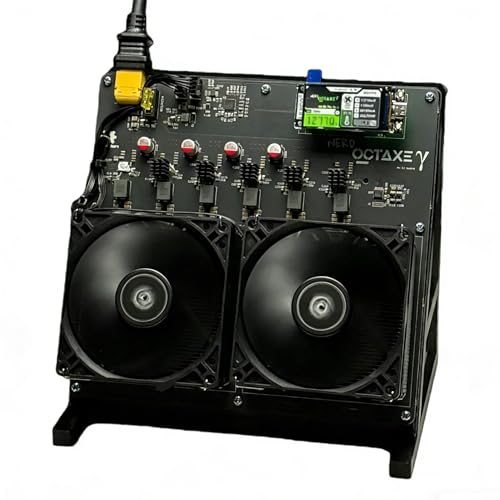
Bitcoin Home Miner Nerdqaxe++12TH/s 240W with Four Fans and Eight BM1370 ASIC Chips Dual-Fan Plug-and-Play 2.4G WiFi and Quiet for Crypto Machine Bitcoin Miner for Beginners
Powerful 12TH/s Performance at 240W:Powered by eight advanced BM1370 ASIC chips, this Bitcoin miner delivers a strong 12TH/s...
As an affiliate, we earn on qualifying purchases.
Frequently Asked Questions
How Often Does Bitcoin’S Difficulty Adjustment Occur?
You ask how often Bitcoin adjusts its difficulty. The network recalculates this roughly every two weeks, after 2,016 blocks are mined. Since each block takes about 10 minutes, this interval keeps block production steady. The adjustment responds to changes in mining power, increasing difficulty when blocks are mined too quickly and decreasing it when they’re too slow. This keeps the system secure and predictable over time.
What Factors Influence the Difficulty Change?
You should know that several factors influence difficulty change. When more miners join, increasing your network’s hash rate, blocks are found faster, prompting a difficulty increase. Conversely, if miners leave, the hash rate drops, and difficulty decreases. Market conditions, like rising or falling Bitcoin prices, also impact miner participation. Additionally, network events or upgrades can temporarily affect hash rates, all working together to keep block times around 10 minutes.
How Does Difficulty Adjustment Impact Miners’ Profitability?
Imagine a balancing act that keeps your mining efforts just right—you’ll notice that when difficulty rises, you need more computing power, which can eat into your profits. Conversely, when difficulty drops, your chances of earning increase, making mining more rewarding. This adjustment guarantees the network stays stable, but it also means your profitability varies with the difficulty changes, making it essential to stay informed about these shifts.
Can Difficulty Adjustments Prevent Bitcoin From Being Hacked?
You might wonder if difficulty adjustments can stop Bitcoin from being hacked. They can’t prevent all types of attacks, like software exploits or wallet breaches. However, difficulty increases make it harder for attackers to rewrite the blockchain or execute a 51% attack, since they’d need enormous computing power. While they bolster network security, they aren’t foolproof—other vulnerabilities still require attention to keep Bitcoin safe.
What Happens if the Difficulty Adjusts Too Much?
Imagine trying to keep a boat steady in choppy waters; too much adjustment can rock the boat violently. When difficulty adjusts too much, it can cause chaos—speeding up or slowing down block times unpredictably, making transactions less reliable. Miners might get discouraged or over-enthusiastic, risking network stability. It’s like overcorrecting a steering wheel, leading to a shaky ride instead of a smooth voyage, threatening Bitcoin’s security and consistency.

Bitaxe Gamma 601 Bitcoin Miner, Open Source Solo BTC Mining Machine, BM1370 ASIC Chip, 1TH/s - 1.2TH/s SHA-256, 2.4G WiFi, Home Crypto Miner, incl. 5V Power Supply & Stand, AxeOS, Black
1-1.2TH/s Efficient Mining with BM1370 ASIC Chip: Powered by a single high-performance BM1370 ASIC chip—optimized for SHA-256 Bitcoin...
As an affiliate, we earn on qualifying purchases.
Conclusion
As you follow Bitcoin’s upcoming difficulty adjustment, think of it as a balancing act, much like a tightrope walker maintaining perfect tension. This adjustment helps keep mining rewards stable and the network secure, regardless of how many miners join or leave. By understanding this process, you gain insight into Bitcoin’s resilience and adaptability—like a ship adjusting its sails to stay on course amid changing winds. Staying informed guarantees you grasp how Bitcoin continues to evolve smoothly over time.

NerdOctaxe Gamma 9.6 TH/s Bitcoin ASIC Miner – Open-Source Home Miner with BM1370, Wi-Fi & USB-C, Complete Kit, Power Supply & Stand
⚡ Up to 9.6 TH/s total hash rate with ~180 W power consumption (~15 J/TH), delivering powerful and...
As an affiliate, we earn on qualifying purchases.

DTV ₿ ELECTRONICS Bitaxe Ultra Open Source Bitcoin ASIC Miner - BTC Miner with 500 GH/s Hash Rate, Low Power Consumption - Quiet Solo Bitcoin Miner for Home Use with Multi-Regional PSU
Open-Source Bitcoin Miner Machine: The Bitaxe Ultra features a fully open-source design, enabling users to customize and optimize...
As an affiliate, we earn on qualifying purchases.