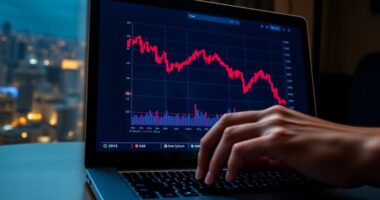

When Bitcoin seems to stand still, it’s usually not weakness but a sign of traders hesitating, waiting for clearer signals or catalysts. This inactivity can stem from psychological pauses and liquidity traps, where traders hold back and create narrow ranges before a big move. Instead of seeing these as signs of failure, recognize they’re strategic moments. If you want to understand how to spot these quiet phases and what they mean, keep going—you’ll find important insights ahead.
Key Takeaways
- Extended inactivity often reflects market participants’ strategic hesitation rather than weakness or indecision.
- Liquidity traps cause price stagnation, signaling traders are waiting for clearer signals before acting.
- Calm periods may be psychological pauses for information digestion, not necessarily indicating an impending breakout.
- Traders frequently misinterpret inactivity as trend failure; instead, it can be a preparation phase for significant moves.
- Recognizing these dormant phases helps avoid false signals and provides insight into underlying market sentiment.

Many traders assume that Bitcoin’s lack of movement signals weakness or indecision, but often they miss the deeper reasons behind these periods of inactivity. One key factor is market psychology. When traders collectively feel uncertain or cautious, they tend to hold their positions rather than push prices in either direction. This collective hesitation creates a calm, stagnant phase where buy and sell orders practically cancel each other out. It’s not necessarily a sign of strength or impending breakout; instead, it reflects a pause driven by traders’ emotional states. During these times, the market’s psychology is skewed toward caution, often fueled by external news, macroeconomic factors, or recent volatility, prompting traders to adopt a wait-and-see approach. Recognizing these patterns can help traders avoid misreading market signals and stay focused on the underlying dynamics. Additionally, understanding liquidity traps is essential because they can be mistaken for market strength or weakness, leading traders to make premature decisions. These traps often involve a temporary absence of trading volume, which can be misinterpreted as a sign of a potential breakout or breakdown, but instead, it indicates a standoff where traders are waiting for more clarity.
Another vital element is liquidity traps. These are situations where traders are hesitant to enter new positions because they fear unfavorable price movements or high volatility. When liquidity dries up, even minor sell or buy orders can cause disproportionate price swings, making traders reluctant to participate. As a result, the market becomes stuck in a narrow range, with traders waiting for a clear signal before committing. This creates a liquidity trap where the volume is insufficient to push the market in either direction, trapping Bitcoin in a state of apparent inactivity. Many traders misread this as a sign of consolidation or impending breakout, but in reality, it often signifies a standoff where the market is waiting for a catalyst to break free. Moreover, these pauses can sometimes be a prelude to significant moves, as the market gathers momentum before a breakout. Recognizing the market psychology behind these pauses can help traders better anticipate whether the market will remain dormant or suddenly surge.
Understanding these psychological and liquidity-driven dynamics helps you see that Bitcoin’s inactivity isn’t always a sign of weakness. Instead, it may be a strategic pause, a moment where market participants digest information, reassess their positions, or await more favorable conditions. Recognizing these signs of market psychology and liquidity traps allows you to avoid jumping to conclusions about a trend’s strength or weakness. Instead, you can better interpret these periods of silence as opportunities to observe market sentiment and prepare for the next move. Often, the most significant moves follow these quiet phases, once traders gain confidence or new information shifts the collective mood. Additionally, market sentiment plays a crucial role in these pauses, influencing whether traders stay cautious or become more aggressive. By understanding these underlying forces, you can stay ahead of the crowd and make smarter trading decisions during Bitcoin’s dormant periods.

Crypto Trading: Volume 3 – Bitcoin Trading Indicators
As an affiliate, we earn on qualifying purchases.
As an affiliate, we earn on qualifying purchases.
Frequently Asked Questions
How Can I Identify Dormant Bitcoin Holdings?
To identify dormant Bitcoin holdings, you should analyze wallet clustering and look for large addresses that haven’t moved assets in years. Use blockchain explorers to track long-term addresses associated with Bitcoin hoarding. These wallets often show little activity, indicating dormant holdings. Recognize patterns where multiple addresses cluster under a single owner, suggesting significant dormant Bitcoin that’s been held for a long time, which could influence market trends.
What Are the Risks of Holding Bitcoin Long-Term?
Holding Bitcoin long-term involves risks like market psychology swings that can trigger sudden price drops, making your investment vulnerable to panic selling. Additionally, regulatory challenges can impact Bitcoin’s legality and liquidity, causing unexpected losses. You need to stay informed about evolving laws and market sentiment to protect your holdings. While long-term holding can be profitable, understanding these risks helps you prepare for volatility and regulatory uncertainties.
Do Large Bitcoin Wallets Influence Market Prices?
Imagine a whale gently piloting a massive ship through calm waters—that’s how large Bitcoin wallets can influence market prices. Their activity often triggers market manipulation, causing sudden price swings or stability. When these wallets move or hold significant amounts, traders tend to react, assuming market shifts. So, yes, whale activity and large wallets can subtly sway prices, impacting market dynamics much like a captain steering a vessel through unpredictable seas.
How Does Bitcoin’s Supply Impact Its Price Stability?
Bitcoin’s supply impacts its price stability mainly through supply scarcity, which influences market liquidity. When supply is limited, fewer coins are available for trading, making the market less liquid and more volatile. Conversely, increased supply can stabilize prices by enabling smoother trading. As a trader, you should watch how supply changes affect liquidity, as scarcity tends to push prices higher, while ample supply can lead to more stable but potentially lower prices.
Are There Legal Reasons for Bitcoin’s Inactivity?
Yes, there are legal reasons for Bitcoin’s inactivity. Regulatory restrictions in certain countries limit trading or transferring Bitcoin, causing periods of inactivity. Additionally, traders and investors often hold onto their Bitcoin due to legal safeguards that protect their assets or prevent unauthorized transactions. These legal factors influence market behavior, making some Bitcoin remain dormant for extended periods, which traders sometimes misinterpret as a lack of interest or movement.

Cryptocurrency Market Psychology: Mastering Investor Emotions and Market Sentiment in Crypto Trading (THE ULTIMATE CRYPTO WEALTH BLUEPRINT)
As an affiliate, we earn on qualifying purchases.
As an affiliate, we earn on qualifying purchases.
Conclusion
So, next time you see Bitcoin sitting still, ask yourself—what unseen reason keeps it locked in place? Maybe it’s not about market chaos or uncertainty, but a strategic pause, waiting for the right moment. Don’t rush to judge the silence; sometimes, the most powerful moves happen behind the scenes. Can you imagine what secrets that quiet Bitcoin might be holding, just waiting for its moment to break free?
Bitcoin liquidity trap analysis tool
As an affiliate, we earn on qualifying purchases.
As an affiliate, we earn on qualifying purchases.

Crypto Market Sentiment Analysis: How to Read the Crowd: Decode Fear, Greed & Whale Moves — Build Smarter Crypto Trades with Proven Sentiment Strategies
As an affiliate, we earn on qualifying purchases.
As an affiliate, we earn on qualifying purchases.