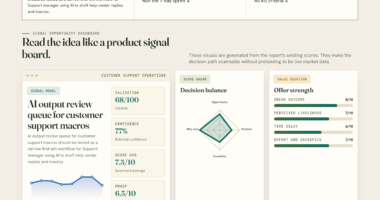

📊 Full opportunity report: Glasspane: One Dataset, Three Views on ThorstenMeyerAI.com — validation score, market gap, and execution plan.
TL;DR
Glasspane has demonstrated a new approach to infrastructure monitoring: one dataset presented through three tailored views for different roles. This emphasizes transparency and trust, though it remains a prototype on mock data.
Glasspane has introduced a prototype that presents a single dataset through three distinct, role-specific views, aiming to enhance transparency and trust in infrastructure monitoring. This approach allows different stakeholders—executives, managers, and engineers—to see only the relevant information they need, without sacrificing data integrity or transparency.
The core innovation is that the same underlying data is re-presented for different audiences, each with a tailored view. For example, a CFO might see SLA compliance and costs, a business manager sees client health and team status, and an engineer views technical metrics like latency and incidents. This role-aware lens is designed to show only what each user needs, rather than overwhelming them with unnecessary data.
Currently, the demo is built on mock data and is positioned as a minimum viable product (MVP). It is open-source under the AGPL-3.0 license and can be self-hosted, including options to run local models to keep sensitive telemetry within a network. The emphasis is on transparency, with the system openly displaying its own gaps and failures to build trust.
Glasspane — one dataset, three views
Most tools answer “is it up?” Glasspane answers a harder one: how do you prove it’s fine to someone who isn’t you? Transparency itself, made the product.
Independent commentary, produced with AI assistance under human editorial oversight. The views are the author’s own and may change. Glasspane is open source under AGPL-3.0, provided “as is” without warranty; see the repository LICENSE. It is a demo / MVP — the views and figures shown run on illustrative, mock data and do not represent a live production deployment. AI interpretation of telemetry may contain errors and should be independently verified. Product and company names are trademarks of their respective owners; mention does not imply endorsement.
Implications of Transparent, Role-Specific Data Views
This development shifts the traditional focus of monitoring tools from simply indicating system uptime to demonstrating trustworthiness to external stakeholders. By providing role-specific, real-time views, organizations can reduce the need for repetitive reassurance, streamline audits, and foster a culture of transparency. It also emphasizes that trust is layered—built on credible data, transparent AI models, and honest failure reporting—potentially transforming how infrastructure reliability is communicated and verified.

Datadog Cloud Monitoring Quick Start Guide: Proactively create dashboards, write scripts, manage alerts, and monitor containers using Datadog
As an affiliate, we earn on qualifying purchases.
As an affiliate, we earn on qualifying purchases.
Positioning Within the Transparency and Open-Source Movement
Glasspane’s approach aligns with a broader movement toward transparency and open-source tools in infrastructure management. Unlike typical monitoring solutions that are inward-facing, Glasspane aims to make data outward-facing, serving clients and auditors directly. Its open-source nature and local deployment options reinforce its commitment to verifiability and data sovereignty, contrasting with proprietary, hosted platforms.
As a demo, it currently lacks production-level robustness but aims to illustrate a conceptual shift—making trust a measurable, demonstrable asset rather than a matter of faith.
“Transparency as the product is a fundamental shift—showing the same data differently for each role, and making trust verifiable from the source.”
— Thorsten Meyer, founder of ThorstenMeyerAI.com
role-based data visualization tools
As an affiliate, we earn on qualifying purchases.
As an affiliate, we earn on qualifying purchases.
Limitations and Open Questions for Glasspane’s Approach
Since the current implementation is a demo based on mock data, it remains unclear how well the approach will perform in real-world, production environments. Questions also persist about whether organizations will adopt a trust-as-product model, and how AI model transparency will be maintained at scale. The effectiveness of user-specific views in reducing complexity and increasing trust needs further validation.
Additionally, it’s uncertain how the system will handle inaccuracies or failures in AI interpretation, and whether users will accept the open-source, self-hosted model as a viable alternative to proprietary solutions.

Modern Network Observability: A hands-on approach using open source tools such as Telegraf, Prometheus, and Grafana
As an affiliate, we earn on qualifying purchases.
As an affiliate, we earn on qualifying purchases.
Next Steps for Developing and Validating Glasspane’s Concept
Glasspane plans to refine its prototype, potentially integrating more robust data sources and testing in real-world scenarios. Future developments may include expanding role-specific views, improving AI model transparency, and conducting user studies to assess trust and usability. The team also aims to engage with early adopters to gather feedback and demonstrate the system’s practical benefits in enterprise settings.
Data Analyst Dashboarding Data Analytics Data Power BI Tote Bag
- Unique gift for data professionals: Ideal for Data Analysts and Developers
- Showcase your data passion: For SQL, Power BI, Python, and more
- Spacious tote bag: 16” x 16” with durable handles
As an affiliate, we earn on qualifying purchases.
As an affiliate, we earn on qualifying purchases.
Key Questions
Is Glasspane currently a production-ready tool?
No, it is currently a demo and MVP built on mock data. Its goal is to demonstrate the concept of role-specific transparency rather than provide a ready-to-deploy solution.
Can I self-host Glasspane?
Yes, it is open-source under AGPL-3.0 and designed to be self-hosted, including options to run local models for sensitive data.
How does Glasspane ensure trust in AI interpretations?
It emphasizes model transparency by showing what the AI is interpreting and why, making the AI’s decisions part of the trust chain.
Will this approach scale to complex, real-world systems?
That remains to be seen; the current prototype is illustrative. Future validation in production environments is necessary to determine scalability and effectiveness.
How does role-specific viewing improve trust?
By showing each stakeholder only the data relevant to their role, it reduces information overload and enhances confidence in the data’s relevance and accuracy.
Source: ThorstenMeyerAI.com