

AI-generated smart contracts aren’t just hype—they represent the next wave of productivity. By combining blockchain’s security with AI’s ability to learn, adapt, and process natural language, these contracts can automate complex tasks, reduce errors, and respond dynamically to external data. They promise faster decisions, lower costs, and greater transparency across industries. As technology advances, you’ll discover how these innovative tools could reshape digital agreements and open new opportunities—continuing to explore their potential might surprise you.
Key Takeaways
- AI-generated smart contracts combine blockchain security with adaptable, self-learning capabilities, potentially transforming digital agreements.
- They can dynamically respond to real-time data, enabling more complex and context-aware decision-making than traditional contracts.
- While promising efficiencies and cost reductions, challenges like unpredictability, system complexity, and regulatory issues remain.
- Growing market adoption and investments suggest AI smart contracts are moving from hype to a significant productivity enhancement.
- Their ability to automate, personalize, and evolve contracts positions them as a key innovation in future digital ecosystems.
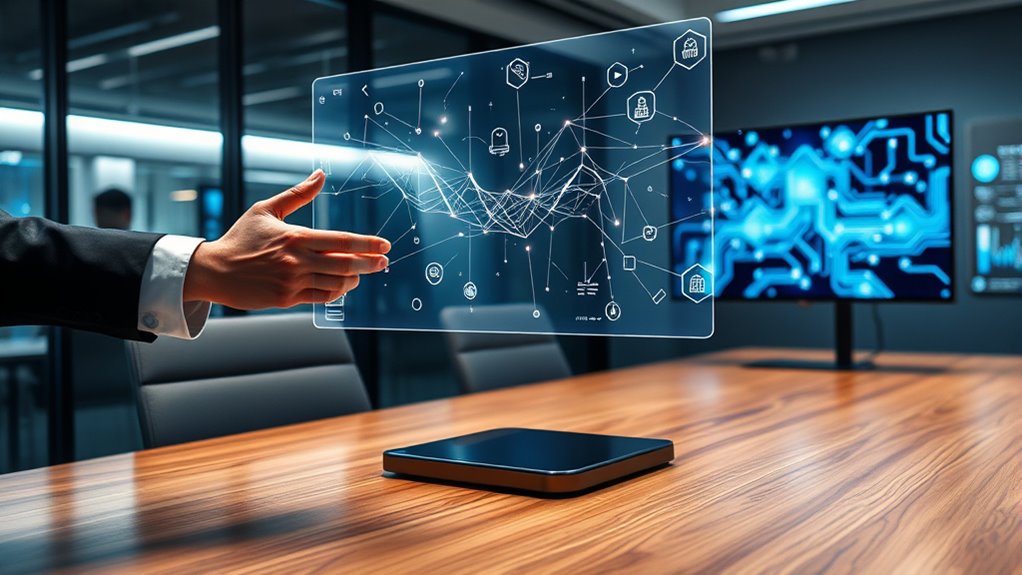
Are AI-generated smart contracts revolutionizing the way we execute digital agreements? These innovative tools combine the security and transparency of blockchain with the intelligence and adaptability of AI. Instead of relying solely on static rules, they are self-executing digital agreements enforced by code that can learn from past transactions and real-time data inputs. This means you can create contracts that aren’t just pre-programmed but can evolve based on changing circumstances, making them far more flexible than traditional legal agreements. They also process natural language, making them accessible to users who aren’t tech experts, so you don’t need to understand complex coding to leverage their benefits. By interpreting legal terms and translating them into executable code, AI-generated smart contracts bridge the gap between legal language and digital automation. They’re designed to handle complex, data-driven decisions, going beyond simple rule enforcement, which allows them to adapt dynamically to new data streams and external events.
AI smart contracts are transforming digital agreements with adaptability, natural language processing, and real-time data integration.
Technologically, these contracts harness machine learning to predict outcomes and adjust behavior accordingly. They incorporate natural language processing to interpret legal and contractual language, making the creation and management of agreements more user-friendly. Furthermore, they can integrate external data sources—like market trends or weather reports—to modify contract terms in real time, enabling automatic responses to changing conditions. This capacity supports non-deterministic outcomes, meaning the results can vary based on the current environment rather than fixed rules. Their ability to analyze large datasets supports more informed decision-making, helping you optimize processes and reduce errors. For example, in supply chains, they can adjust orders based on real-time market or weather data; in finance, they can update interest rates dynamically; and in insurance, they can modify premiums based on ongoing health or driving data. Additionally, vetted blockchain technology enhances trustworthiness and reduces the risk of fraud, making these contracts even more reliable.
Compared to traditional contracts, AI-generated smart contracts offer notable advantages. They cut out intermediaries, reducing costs and human error, while increasing transparency and security thanks to blockchain’s immutable record. They automate repetitive tasks, boosting efficiency and freeing up your time for more strategic activities. Plus, their adaptability means they learn from past transactions, improving over time. Their accessibility improves as natural language processing makes contract creation more straightforward for non-technical users. However, challenges remain, including unpredictable outcomes, system complexity, potential bugs, and regulatory uncertainties. Data privacy remains a concern, especially with sensitive information. Despite these hurdles, the impact on productivity is significant. These contracts automate many manual tasks, enhance data management, enable faster decision-making, and support cross-chain interoperability. They also facilitate better risk assessment and open new business opportunities, transforming industries and liberating innovative revenue streams.
Market adoption is accelerating, with estimates suggesting that up to 10% of global GDP could be stored on blockchain by 2024. Platforms like Ethereum already support smart contract automation, and interest is growing across finance, supply chain, and insurance sectors. Investments in AI and blockchain integration continue to rise, fostering the development of tools that streamline contract generation and validation. While some see AI-generated smart contracts as hype, many believe they represent the next wave of productivity—offering smarter, more efficient ways to execute digital agreements and reshape how businesses operate in the digital age.

Lubvlook 47 inch Corner Standing Desk Converter, Height Adjustable Sit Stand Desk Riser, Black, GSD06T
Experience smooth height adjustment with our advanced dual-pneumatic spring lifting system, height adjusting from 5.9 to 17.3 inches...
As an affiliate, we earn on qualifying purchases.
Frequently Asked Questions
How Do Ai-Generated Smart Contracts Handle Legal Compliance?
You might wonder how AI-generated smart contracts handle legal compliance. AI uses machine learning and NLP to draft contracts that follow local laws and industry standards. It applies pre-built templates, offers customizable clauses, and performs compliance checks to guarantee legality. However, you still need human oversight because AI can’t fully interpret complex legal issues or adapt quickly to evolving regulations, especially across different jurisdictions.
What Are the Security Risks of Ai-Generated Smart Contracts?
Think of AI-generated smart contracts as a double-edged sword. They can identify vulnerabilities like reentrancy, overflows, and improper permissions, but also pose risks if they generate exploitable code or miss subtle flaws. You might face security breaches, oracle manipulations, or flash loan attacks. Relying solely on AI without proper review can leave gaps, so combining AI tools with thorough audits guarantees your contracts stay secure and resilient.
Can AI Create Fully Autonomous Smart Contract Systems?
You wonder if AI can create fully autonomous smart contract systems. While AI’s capabilities have advanced to allow smart contracts to make complex decisions, most are still semi-autonomous, requiring human oversight. Fully autonomous systems are emerging, with AI agents executing transactions independently in areas like finance and logistics. However, security concerns and technological limitations mean complete independence isn’t widespread yet, but it’s likely to grow over the next few years.
How Cost-Effective Are Ai-Generated Smart Contracts Compared to Traditional Ones?
You wonder how cost-effective AI-generated smart contracts are compared to traditional ones. They lower costs by automating creation, execution, and reducing manual effort. Faster transactions, fewer intermediaries, and scalability boost savings. Although initial development and computational expenses are high, long-term savings from efficiency, error reduction, and lower legal fees make AI smart contracts a smart investment. Over time, they can profoundly improve your financial outcomes and operational productivity.
What Industries Are Most Likely to Benefit From Ai-Driven Smart Contracts?
You’ll find that industries like real estate, healthcare, finance, supply chain, and gaming stand to benefit most from AI-driven smart contracts. These sectors can automate complex processes, increase transparency, reduce costs, and improve security. By eliminating middlemen and streamlining operations, AI smart contracts make transactions faster, safer, and more reliable, helping you work more efficiently and confidently across various fields.

Casaottima 63 Inch Electric L-Shaped Standing Desk, Reversible Corner Desk with Height Adjustment, Large Ergonomic Workstation for Home Office, Reception Room, White
Designed for home office and corner setups, this electric L-shaped standing desk supports both sitting and standing work,...
As an affiliate, we earn on qualifying purchases.
Conclusion
You might think AI-generated smart contracts are just a fleeting trend, but they’re actually the game-changer that will revolutionize productivity forever! Imagine a world where contracts write themselves in seconds, mistakes vanish, and entire industries leap forward overnight. This isn’t hype—it’s the dawn of an unstoppable technological tsunami. If you’re not paying attention now, you’ll be left in the dust as AI transforms the very fabric of how we do business. The future’s here, and it’s mind-blowingly powerful!

X-Elite Pro 40" Corner Standing Desk Converter with Pneumatic Lift | Adjustable Sit to Stand Riser, L-Shaped Desks & Cubicles | Fully Assembled Computer Workstation (Matte Black)
Smooth Sit to Stand Transitions: Easily move from sitting to standing in seconds. The built-in pneumatic lift raises...
As an affiliate, we earn on qualifying purchases.

Claiks L Shaped Standing Desk Adjustable Height, Dual Motor Electric Corner Standing Desk, 75 x 63 inch with Splice Board, White
Height adjustable from 28.5" to 47.2" - Enjoy different working positions with this adjustable standing desk, which allows...
As an affiliate, we earn on qualifying purchases.