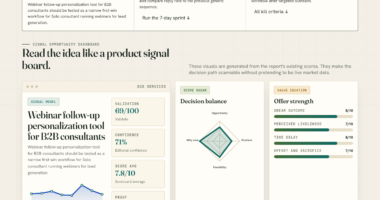
📊 Full opportunity report: Discover How Meta's Muse Spark 1.2 Is Revolutionizing AI Programming on ThorstenMeyerAI.com — validation score, market gap, and execution plan.

Get hardware and tech essentials delivered free — and shop member deals
- Fast, free delivery on millions of items
- Access to Prime Big Deal Days deals on October 6–7
- Prime Video, Amazon Music and more included
TL;DR
Meta has launched Muse Spark 1.2 and Muse Code, a co-trained AI model and coding agent designed for advanced, long-term programming tasks. The release emphasizes improved tool use, safety features, and competitive performance, positioning Meta against industry leaders.
Meta has officially released Muse Spark 1.2 and Muse Code, a pair of AI models designed specifically for programming tasks, with the goal of advancing autonomous coding capabilities. The release, announced by Meta CEO Mark Zuckerberg in a beta post, marks a strategic move into the competitive space of AI coding assistants used by professional developers. This pairing introduces a new approach to AI training and deployment, emphasizing co-training for better tool use and long-horizon task management, which could impact how software is developed in the future.
Muse Spark 1.2 is a frontier model optimized for coding, built with a focus on long-term, complex projects. Its key innovation is the co-training with Muse Code, a dedicated coding agent, which Meta claims results in fewer retries, higher-quality outputs, and improved tool use. The models were trained together on extensive repositories, enabling the AI to handle entire projects with planning, goal conditioning, and context management. This architectural approach aims to produce more reliable and autonomous coding assistance.
Muse Code is designed as a persistent, restart-safe agent that maintains a local event log, allowing it to resume work precisely after interruptions. It features three default skills—/plan, /grill, and /goal—and supports parallel background agents. The system is capable of handling long-horizon tasks with a 1 million token context window, although the effectiveness of context compaction across extended sessions remains to be independently verified. Benchmark tests show significant improvements in agentic work, with Muse Spark 1.2 scoring highly on multiple industry-standard evaluations such as Artificial Analysis’s Intelligence Index and GDPval-AA v2.
Pricing remains competitive, with Meta positioning Muse Spark 1.2 as a cost-efficient option at approximately $0.40 per benchmark task, undercutting comparable models like Kimi K3 and GPT-5.5. However, some trade-offs are evident: the model’s hallucination rate has decreased mainly because it answers fewer questions, not necessarily because it has improved its knowledge base, raising questions about its actual capabilities versus safety.
Meta shipped a coding model and its first coding agent on the same day, co-trained together. The pairing is the story — and it puts Meta straight into competition with Claude Code and Codex. Parts are genuinely strong; one part cuts against how I build.
▲ Capability claims are Meta’s own · benchmarks independentMuse Code and Muse Spark 1.2 were co-trained — harness and model together — for better tool use and fewer retries than a generic wrapper. Three default skills ship with it.
Vendor benchmarks are worth nothing until someone independent runs the model. Artificial Analysis already has, on a coding- and agent-heavy index.
One finding a launch post will never tell you — and it matters more than the headline score.
The pricing has a tell. Below the standard tier sits a contributor tier at a tenth of the price — in exchange for one thing. (The two-panel pattern below mirrors §03 by design.)
The choice here isn’t “sovereign or not” — it’s which frontier vendor’s pipeline your code flows into.
- Frontier-adjacent coding model, co-trained with a crash-safe agent
- Priced below the competition; one-command install on macOS + Linux
- The event-log runtime is a genuinely good idea
- Closed, API-only, from a company whose model is data harvesting
- Same hosted tradeoff as Claude Code / Codex — pick your pipeline
- Thin track record: replaced Llama months ago; 1.2 is a fast follow on a weeks-old 1.1
The cheapest number on the pricing page is the one that costs the most.
Implications for AI-Driven Software Development
The release of Muse Spark 1.2 and Muse Code signals a notable shift in AI-assisted programming, emphasizing co-trained models with long-horizon capabilities. This approach could lead to more autonomous, reliable coding agents that reduce developer workload and improve efficiency. Meta's focus on safety features like restart safety and abstention from uncertain outputs addresses critical concerns about AI reliability in professional settings. The competitive performance and pricing also suggest Meta aims to gain a significant share in the enterprise AI coding market, challenging established players like OpenAI and Anthropic.
For developers and organizations, this development could mean access to more capable and cost-effective tools, potentially accelerating software development cycles. However, the trade-offs in hallucination rates and the true long-term performance of context management remain under observation, making it important to follow independent testing and real-world adoption.
As an affiliate, we earn on qualifying purchases.
Background of Meta’s AI Coding Initiatives
Meta has been investing in AI models tailored for coding and complex reasoning, releasing Muse Spark versions since early 2024. Prior models focused on general tasks, but recent developments have shifted toward specialized, agentic systems capable of handling extended projects. The concept of co-training models with dedicated agents is new for Meta, inspired by industry trends toward modular, safety-aware AI systems. This move follows a pattern of rapid model releases, with Muse Spark 1.2 being Meta’s third major update within four months, aiming to close the gap with industry leaders like OpenAI and Anthropic.
Earlier benchmarks showed promising results, but the focus has been on improving agentic performance, tool use, and long-horizon task management. Meta’s emphasis on cost efficiency and safety features aligns with broader industry concerns about AI reliability and practical deployment in real-world scenarios.
"Meta’s co-training approach and emphasis on long-horizon, restart-safe agents could reshape how AI assists in software development, making autonomous coding more reliable."
— Thorsten Meyer
As an affiliate, we earn on qualifying purchases.
Unverified Long-Term Effectiveness of Context Management
It remains unclear how well Muse Spark 1.2’s context compaction and long-horizon capabilities will perform in real-world, extended sessions. Independent testing is needed to verify if the model maintains accuracy and tool use over time, especially across multiple sessions and complex projects. Additionally, the impact of increased abstention on overall productivity and capability is still uncertain, as lower hallucination rates may come at the cost of fewer attempted answers.
As an affiliate, we earn on qualifying purchases.
Upcoming Independent Evaluations and Industry Adoption
Expect independent researchers and industry users to conduct real-world tests of Muse Spark 1.2’s long-term performance and safety features in the coming months. Meta is likely to release further updates based on feedback, and integration into developer workflows will be a key milestone. Monitoring how competitors respond with their own models and features will also be crucial, as the AI coding landscape continues to evolve rapidly.
As an affiliate, we earn on qualifying purchases.
Key Questions
How does Meta’s co-training improve AI coding agents?
Co-training involves training the model and its dedicated coding agent together, which Meta claims results in better tool use, fewer retries, and higher-quality outputs, especially for complex, long-term projects.
What are the main safety features of Muse Spark 1.2?
Muse Spark 1.2 includes restart safety through a local event log, enabling the agent to resume work precisely after interruptions. It also features abstention, where the model declines to answer when uncertain, reducing hallucinations.
Will Muse Spark 1.2 replace human developers?
There is no indication it will replace humans; instead, it aims to augment developer productivity by automating routine or complex coding tasks, with safety measures to prevent errors.
How does the model’s performance compare to competitors?
Independent benchmarks place Muse Spark 1.2 near GPT-5.5 and Grok 4.5, with strong agentic work scores and cost efficiency, though it still trails behind the very top models like Claude Opus 5 in some areas.
What are the potential risks of this new AI coding model?
The main risks include over-reliance on AI for critical tasks, possible limitations in long-term context management, and the trade-off between safety (abstention) and capability (attempt rate).
Source: ThorstenMeyerAI.com
Fall Picks
fall essentials
As an affiliate, we earn on qualifying purchases.