
TL;DR

Get hardware and tech essentials delivered free with Prime
- Fast, free delivery on millions of items
- Prime Video, Amazon Music and more included
- Member-only deals all year
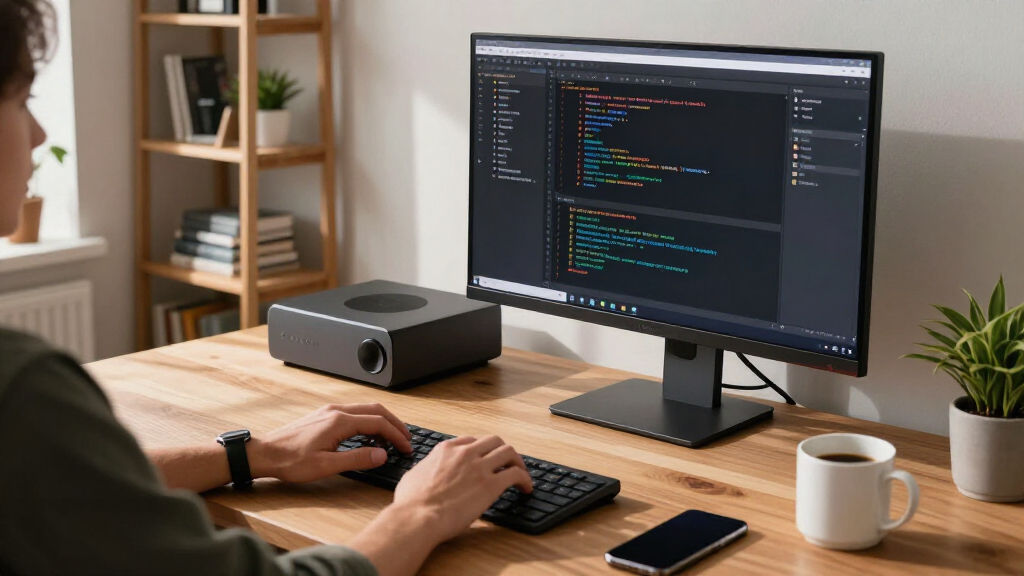
Apple announced a Mac Studio capable of holding 512GB of unified memory, enabling local inference of large AI models. While it can load these models, performance and practical use depend on bandwidth and compute limits. Details on real-world speed and scalability are still emerging.
Apple has announced a new Mac Studio capable of holding up to 512GB of unified memory, claiming it can run frontier-scale AI models locally without cloud reliance. This marks a significant development for AI researchers and small teams seeking local inference capabilities, but the actual speed and scalability depend on more than just memory capacity.
On August 25, 2026, Apple introduced the Mac Studio in two configurations: the M5 Max and the M5 Ultra. The latter, designed for AI workloads, features a 36-core CPU, an 80-core GPU, and up to 512GB of unified memory with a bandwidth of 1.2 terabytes per second. The 512GB model will be available in late October, with prices starting well above $10,000, due to Apple’s memory pricing.
The M5 Ultra is built from two M5 Max chips connected via Apple’s UltraFusion interconnect, creating a single, powerful processor with integrated neural accelerators. Apple claims up to 4.3x faster AI performance than the previous generation, though these benchmarks are based on select workloads and may vary in real-world scenarios.
The key advantage of this machine is its ability to load large models directly into memory. Unlike traditional GPUs with limited dedicated VRAM, Apple’s unified memory allows the GPU to access the entire 512GB pool, enabling local inference of models that previously required datacenter resources. This capability is especially relevant for research, privacy-sensitive applications, and small-scale deployment.
Implications of a Desktop Capable of Running Frontier-Scale AI Models Locally
This development signals a shift toward more accessible AI experimentation and deployment outside of datacenter environments. For individual researchers and small teams, the ability to load and run large models locally reduces dependence on cloud infrastructure, enhances data privacy, and accelerates development cycles. However, it does not replace high-throughput, large-scale serving environments, as the hardware’s bandwidth and compute capabilities are still limited compared to datacenter clusters.
While the capacity to load large models is a breakthrough, performance in terms of inference speed and throughput will vary depending on workload complexity and software maturity. The announcement underscores a move toward democratizing AI hardware but also highlights the ongoing gap between capacity and practical, scalable deployment at scale.
Apple Mac Studio with 512GB memory
As an affiliate, we earn on qualifying purchases.
As an affiliate, we earn on qualifying purchases.
Background on AI Hardware and Apple’s Position
Prior to this release, running frontier-scale models locally was largely confined to specialized datacenter GPUs and custom hardware, often inaccessible to individual users. Apple’s transition to silicon with unified memory architecture has long promised more integrated and efficient hardware, but practical AI deployment has lagged behind marketing claims. The new Mac Studio’s 512GB memory is a notable milestone, representing the largest capacity for a desktop device aimed at AI workloads.
This announcement follows a trend of hardware vendors emphasizing memory capacity as a critical factor for AI, but it also raises questions about the real-world utility of such capacity without matching bandwidth and compute power. Historically, high memory alone does not guarantee fast inference, as throughput depends heavily on bandwidth and processing speed. Apple’s design, which integrates neural accelerators and high bandwidth, aims to bridge this gap, but independent benchmarks are still forthcoming.
AI inference workstation Apple Silicon
As an affiliate, we earn on qualifying purchases.
As an affiliate, we earn on qualifying purchases.
Uncertainties About Real-World AI Performance on the New Mac Studio
It is not yet clear how well the Mac Studio performs in practice when running large models, especially in terms of inference speed and throughput. Independent benchmarks and real-world testing are awaited to confirm whether it truly meets the needs of researchers and developers for scalable, efficient local inference. Additionally, the software ecosystem for AI on Apple silicon is still evolving, which could impact usability and workflow integration.
high memory AI development computer
As an affiliate, we earn on qualifying purchases.
As an affiliate, we earn on qualifying purchases.
Upcoming Benchmarks and Software Compatibility Tests
In the coming weeks, independent researchers and early adopters will evaluate the Mac Studio’s performance with frontier-scale models. Benchmark results on inference speed, latency, and stability will clarify its practical utility. Apple is also expected to release updates to its ML tooling, which will influence how effectively users can develop and deploy AI models on this hardware. The late October release of the 512GB model will be a key milestone to watch.
Apple Mac Studio for machine learning
As an affiliate, we earn on qualifying purchases.
As an affiliate, we earn on qualifying purchases.
Key Questions
Can the new Mac Studio replace a GPU cluster for AI inference?
While the Mac Studio can load large models and perform local inference, its bandwidth and compute limitations mean it is not a direct replacement for high-end GPU clusters used for large-scale deployment or serving many users simultaneously.
What types of AI workloads are best suited for this machine?
It is best suited for research, experimentation, privacy-sensitive inference, and small-scale deployment where loading large models locally is beneficial. High-throughput, multi-user serving remains beyond its scope.
Will software support be sufficient for running frontier-scale models?
Software ecosystems on Apple silicon are improving but are not yet as mature as those on traditional GPU platforms. Some workflows may require porting or alternative tools, and real-world performance will depend on ongoing software updates.
How does the price compare to traditional AI hardware?
The 512GB model will cost over $10,000, which is significantly less than datacenter GPU setups but still a substantial investment for small teams or individual researchers.
Is this hardware suitable for production deployment?
It is primarily designed for experimentation and small-scale inference. For large-scale, production-level deployment, dedicated server hardware with higher bandwidth and compute capacity remains preferable.
Source: ThorstenMeyerAI.com
Fall Picks
fall essentials
As an affiliate, we earn on qualifying purchases.