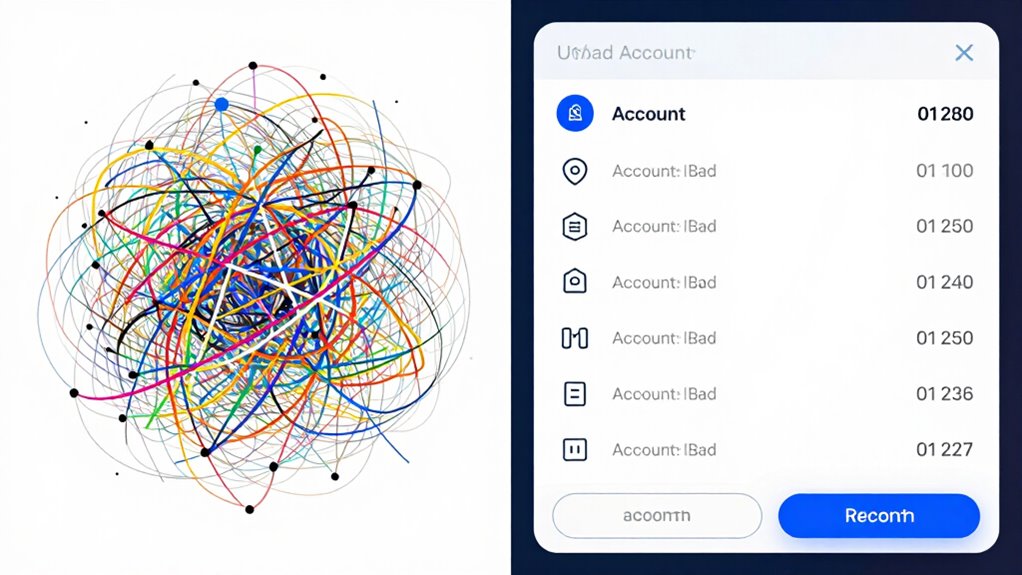

In UTXO models, you might mistake managing multiple unspent outputs, risking transaction bloat and errors, while in account models, you could underestimate private key security, risking theft. UTXO systems require careful handling of each coin’s signature, increasing complexity, whereas account models simplify balances but may obscure transaction history. Both systems have unique privacy, security, and management risks. Understanding these differences can help you avoid costly mistakes—continue exploring to learn more about safeguarding your assets effectively.

Get hardware and tech essentials delivered free with Prime
- Fast, free delivery on millions of items
- Prime Video, Amazon Music and more included
- Member-only deals all year
Key Takeaways
- UTXO management errors, like not consolidating small outputs, can cause transaction bloat and higher costs.
- Account models simplify balances but may lead to underestimating private key security risks.
- UTXO transparency can reveal transaction history, impacting user privacy more than account models.
- Mistakes in signing or private key storage pose significant security risks in both models.
- Understanding each model’s specific vulnerabilities is crucial to prevent costly security and privacy errors.

When choosing between UTXO and account models, users often make mistakes that can lead to lost funds or security vulnerabilities. Understanding these differences is key to maintaining good cryptocurrency security and protecting your blockchain privacy. The UTXO (Unspent Transaction Output) model, used by Bitcoin, requires you to manage multiple unspent outputs, each representing a separate coin. If you’re not careful, you might accidentally reuse an output or lose track of your coins, putting your funds at risk. On the other hand, the account model, common in Ethereum, simplifies this by maintaining a balance, making transactions more straightforward but less transparent in terms of UTXO management.
Choosing the right model impacts your security, privacy, and management of funds—understand the differences to avoid costly mistakes.
A common mistake in UTXO-based systems is not properly consolidating small unspent outputs, which can cause transaction bloat. When you hold many tiny UTXOs, your wallet size increases, and transactions become larger and more costly. This can also compromise your blockchain privacy, as larger transaction footprints can make it easier for someone to trace your activity. Conversely, in account-based systems, users sometimes overlook the importance of securing their private keys, thinking that the simplified process means less risk. This oversight can lead to vulnerabilities if private keys are stored insecurely or if security practices aren’t followed. Additionally, many users underestimate the importance of proper key management in safeguarding their digital assets.
Another mistake arises around transaction signing. In UTXO systems, you must sign each input separately, which can be complex and prone to errors if you’re not attentive. A mistake here might result in a failed transaction or, worse, exposing your private keys. With account models, signing is more straightforward, reducing this particular risk, but it still demands strong security habits. Users often underestimate how important it is to keep their private keys or seed phrases confidential, regardless of the model. Failing to do so can lead to theft and loss of funds. Properly understanding digital signature processes can help prevent these issues and enhance security.
Additionally, understanding the role of color accuracy in projectors can help you better secure and manage your digital assets by ensuring clear and precise transaction details, reducing mistakes. Many users also overlook the implications for blockchain privacy. UTXO systems reveal your transaction history through unspent outputs, making it easier for observers to trace your activity. In contrast, account models tend to be more opaque but can still leak information if you don’t use privacy-preserving techniques. Misunderstanding these nuances can lead to unintentional exposure of your financial habits.
Finally, educating yourself about the differences between models and their respective security considerations is crucial to avoid costly errors and keep your cryptocurrency secure. Whether you choose UTXO or account models, the key is to understand their unique risks and manage your security and privacy carefully. Mistakes like mismanaging UTXOs or neglecting private key security can jeopardize your funds and your anonymity. Educating yourself about how each model works helps you avoid costly errors and keeps your cryptocurrency secure.
As an affiliate, we earn on qualifying purchases.
Frequently Asked Questions
How Do UTXO and Account Models Impact Transaction Speed?
You’ll notice that UTXO and account models impact transaction speed differently, affecting transaction confirmation times and network scalability. UTXO models process transactions faster during high traffic because they can handle multiple unspent outputs simultaneously. Meanwhile, account models are simpler but may slow down with increased network activity, reducing scalability. Your experience with transaction speeds depends on these underlying structures, influencing how quickly your transactions get confirmed on the network.
Can Users Switch Between UTXO and Account Models Easily?
Switching between UTXO and account models isn’t always seamless, so your user experience may vary. Compatibility issues can arise, making shifts a bit tricky. You might need to adjust your approach or tools to fit each model’s nuances. While some platforms offer guidance, it’s crucial to stay informed and prepared. Understanding these differences helps you navigate smoothly, ensuring your transactions stay efficient and secure regardless of the model you choose.
What Security Risks Are Unique to Each Model?
You face distinct security risks with each model. In the UTXO model, you must guarantee your private keys are protected, as losing them can mean losing access to unspent outputs. For the Account model, smart contracts introduce vulnerabilities if poorly coded, risking exploits. Additionally, the consensus mechanism‘s robustness affects security; a compromised mechanism can lead to double-spending or network attacks. Always stay vigilant about these specific risks to safeguard your assets.
How Do These Models Affect Privacy Features?
You’ll find your privacy features dramatically affected, with the UTXO model offering near-impenetrable privacy through better data traceability, while the account model’s transparency makes it almost impossible to hide your transactions. UTXO’s privacy enhancement keeps your data more secure, preventing easy tracing, whereas accounts make your transaction history more exposed. Your choice dramatically influences how much privacy you can maintain in your crypto activities, shaping your digital footprint.
Are There Specific User Demographics Better Suited for One Model?
You might find that users with more technical familiarity prefer the UTXO model because it offers granular control and transparency. Conversely, those with less experience or different demographic preferences may favor the Account model, which simplifies transactions and resembles traditional banking. Your familiarity with blockchain concepts influences which model suits you best, so understanding your demographic preferences can help you choose the option that aligns with your comfort level and usage habits.
private key storage security device
As an affiliate, we earn on qualifying purchases.
As an affiliate, we earn on qualifying purchases.
Conclusion
Understanding the differences between UTXO and account models isn’t just technical; it’s personal. Your choices shape your experience, much like a captain steering a ship through unpredictable waters. By grasping these models, you avoid costly mistakes and navigate confidently. Don’t let confusion be your anchor—embrace knowledge, and steer your crypto journey with clarity and purpose. After all, isn’t control over your digital assets worth every effort? The choice is yours—make it wisely.
cryptocurrency transaction signing tool
As an affiliate, we earn on qualifying purchases.
As an affiliate, we earn on qualifying purchases.
As an affiliate, we earn on qualifying purchases.
Halloween Picks
halloween
As an affiliate, we earn on qualifying purchases.