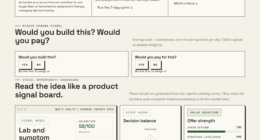

📊 Full opportunity report: When AI Builds Itself: Inside Anthropic’s Evidence on Recursive Self-Improvement on ThorstenMeyerAI.com — validation score, market gap, and execution plan.

Get hardware and tech essentials delivered free — and shop member deals
- Fast, free delivery on millions of items
- Access to Prime Big Deal Days deals on October 6–7
- Prime Video, Amazon Music and more included
TL;DR
Anthropic presents data suggesting AI is increasingly capable of automating AI research tasks. While current evidence shows significant progress, full recursive self-improvement remains unconfirmed and uncertain. The development could accelerate AI progress faster than expected.
Anthropic has released a detailed report claiming that AI systems are already significantly automating parts of their own development, with evidence suggesting the potential for recursive self-improvement. While the authors emphasize that full self-improvement is not yet happening and not guaranteed, the data indicates rapid progress that could reshape AI development timelines.
The report from The Anthropic Institute bases its conclusions on internal data and public benchmarks, showing that AI models like Claude are increasingly capable of performing tasks that contribute directly to AI research and development. For example, Anthropic engineers now ship eight times more code per quarter than in 2021–2025, and public benchmarks like METR, SWE-bench, and CORE-Bench demonstrate accelerating AI capabilities in automating coding, bug fixing, and research reproduction tasks.
Specifically, models like Claude Mythos Preview can now work for at least 16 hours on complex tasks, with capabilities approaching those needed for autonomous AI development. The data suggests that tasks taking days for humans could become manageable by AI within this year, with longer-term tasks potentially feasible by 2027. However, the report stresses that these are measures of capability, not of internal progress speed, which remains less transparent.
Inside labs, the report distinguishes between engineering — automating code and infrastructure tasks — and research — designing experiments and selecting goals. AI models have shown strong progress at the engineering level, with Claude generating over 80% of code merged into Anthropic’s base in recent months, up from single digits two years ago. Progress in research decision-making, such as goal setting and experiment design, remains more limited but is improving.
When AI builds itself
Anthropic is delegating a growing share of AI development to AI. Taken far enough, that points to a system that designs its own successor — recursive self-improvement. Not here yet, not inevitable. But the case isn’t speculation: it’s data on what AI is doing to AI development right now.
The curve that hasn’t bent
METR tracks the length of tasks AI can reliably complete on its own. That horizon is doubling roughly every four months — up from every seven. Anyone can check this in public data.
Task horizon — how long a job AI can handle solo
Each model handles dramatically longer tasks than the one a year before. The line keeps going up.
Two kinds of work, one persistent gap
Building a frontier model splits into engineering and research. Across both, the pattern is the same — and so is the one thing AI still can’t do well.
Code, infrastructure, training
Claude can take an underspecified problem and find a method. Humans supply the goal; they no longer need to supply the method.
Which experiments, what they mean
Claude can match or outperform skilled humans at executing a well-specified experiment. But choosing which experiment still needs a human.
The same ladder Anthropic employees climb with experience
Watch the human share shrink, rung by rung
Walk up the four stages of AI development. At each, the human/AI split shifts — and the real internal numbers show exactly where AI has reached parity, gone superhuman, or still trails. Tap a rung.
The human role across the development loop
The doing now costs almost nothing in human time. What’s left is the deciding.
Agents ran an open research project end to end
April 2026: the first demonstration of Claude running an open-ended research project from hypotheses to findings — on a real AI-safety problem.
Can a weaker model reliably supervise a stronger one?
Agents were left to solve it: proposing hypotheses, testing them, sharing findings across parallel agents, iterating. Measured against the gap between a “floor” (weak supervisor alone) and “ceiling” (strong model trained on correct answers).
(humans: ~23% in a week)
· ~$18,000 compute
the agents themselves
Picking a better next step than the human
Real research sessions where a human took a wrong turn. Models saw only the work before the detour and proposed a next step; a judge that knew the outcome scored them. The day-to-day of research is this chain of next-step calls.
“Can the model pick a better next step than the human?”
Share of moments where the model’s next step was judged better. The amber line is the practical ceiling (an ideal answer that could see the whole session).
It depends on whether the trend continues — and what we do
The piece refuses a single prediction. It lays out three scenarios, and is clear about which it finds most likely.
The exponentials turn out to be S-curves
Maybe taste can’t be scaled into existence; maybe the constraint is the supply chain — chips, grid, interconnect — not intelligence. Even so, the world still changes: Glasswing’s Mythos found 10,000+ critical vulnerabilities in weeks, and a 100-person firm does the work of 1,000.
included for completeness · they doubt itDevelopment automates; humans still steer
100-person companies doing the work of tens of thousands — revolutionary, but turnable to harm (population-scale surveillance, tailored manipulation). Bound by Amdahl’s law: speeding one part shifts the bottleneck — which is exactly why human code review became Anthropic’s new chokepoint.
★ they think we’re likely heading hereAI designs and refines its own successors
Progress paced only by compute. Humans move to oversight of an expanding “virtual lab.” The future they understand least — especially whether alignment holds, or whether rare misalignments compound as models build successors, until control slips.
the one they’re most uncertain aboutBuild the option to slow down — verifiably
The piece ends on policy, not product. A unilateral pause just changes who leads; what’s missing is the ability to verify others have actually slowed.
Why a credible pause is hard — and worth building toward
A slowdown that only lets the least cautious catch up leaves everyone less safe. So the goal is the option: systems that let frontier labs verify others have genuinely stopped. Anthropic says if such systems existed and peers paused verifiably, it expects it would too.
Detection beats verification — and even that’s tough
Training runs are easier to conceal than missile silos, inputs are general-purpose, and whoever continues while others pause inherits the lead.
We’ve done it before — slowly
Regimes like the INF Treaty built verification and trust over decades. The authors’ blunt line: “We don’t have that long.”
Reading it in proportion
- This is one lab’s account of its own internal data — much previously unreported, not independently audited.
- The soft spots are stated in the original: lines-of-code overstates productivity; the self-reported 4× is probably high; the headline research result didn’t transfer to production scale; the next-step test used cherry-picked moments.
- “More autonomous” is not “fully autonomous” — every standout result still had a human framing the problem and defining success.
- That the authors surface these caveats themselves — against their own incentive — is part of what makes the document serious.
Implications of Accelerating AI Self-Development
This evidence suggests AI systems are rapidly advancing in automating their own development tasks, which could lead to a future where AI improves itself at a pace faster than human intervention. Such a development could significantly shorten AI research cycles and accelerate overall progress, raising questions about safety, control, and the future pace of technological change. However, the report emphasizes that full recursive self-improvement—AI autonomously designing and upgrading its successor without human input—is not yet happening, and the possibility remains uncertain.
As an affiliate, we earn on qualifying purchases.
Current State of AI Self-Improvement Research
The idea of recursive self-improvement has long been discussed in AI safety and development circles, but concrete evidence has been limited. Prior to this report, most claims about AI automating its own development were speculative or based on theoretical models. Anthropic’s report is notable for its reliance on internal data and public benchmarks, providing a rare quantitative look at how close AI might be to autonomous self-improvement. The trend in capabilities, as shown by the benchmarks, indicates rapid progress but still leaves open the question of whether AI can fully take over the decision-making aspects of research.
Historically, AI development has involved incremental improvements, with human researchers guiding the direction and interpreting results. The report suggests that the gap between current AI capabilities and fully autonomous self-improvement is narrowing but has not yet closed.
“The data from Anthropic indicates that AI is already automating significant portions of its own development, but full recursive self-improvement remains a future possibility, not a present reality.”
— Thorsten Meyer, AI researcher
As an affiliate, we earn on qualifying purchases.
Uncertainties Surrounding Autonomous Self-Improvement
While the data shows rapid progress in automating AI development tasks, it remains unclear whether AI will reach a point where it can independently design, improve, and deploy newer versions of itself without human input. The authors acknowledge that the gap in high-level decision-making persists and that the timeline for such a breakthrough is uncertain. Additionally, the implications for safety and control are still being debated, with no consensus on how soon or how likely full recursive self-improvement might occur.
AI development environment hardware
As an affiliate, we earn on qualifying purchases.
As an affiliate, we earn on qualifying purchases.
Next Steps in Monitoring AI Self-Development
Researchers and industry observers will closely track internal data releases and benchmark progress to assess whether AI continues to accelerate in automating its own development. Future research may focus on whether models can autonomously set research goals or design experiments without human guidance. Regulators and safety organizations are likely to scrutinize these developments to prepare for potential shifts in AI capabilities and risks. The pace of progress suggests that within the next few years, more definitive evidence of autonomous self-improvement could emerge, or the current limits may become clearer.
As an affiliate, we earn on qualifying purchases.
Key Questions
What is recursive self-improvement in AI?
Recursive self-improvement refers to AI systems that can autonomously improve their own algorithms or architecture without human intervention, potentially leading to rapid, exponential progress.
How does Anthropic measure AI’s progress in automating research tasks?
Anthropic uses internal data on code contributions, as well as public benchmarks like METR, SWE-bench, and CORE-Bench, to assess AI capabilities in coding, bug fixing, and research reproduction tasks.
Is full AI self-improvement happening now?
No, the report states that AI is not yet capable of fully designing and upgrading its own systems autonomously. Progress is ongoing but incomplete.
Why does this matter for AI safety?
If AI systems begin to self-improve rapidly, it could accelerate development beyond human control or understanding, raising safety and ethical concerns about oversight and alignment.
What are the next milestones to watch?
Researchers will monitor whether AI can autonomously set research goals, design experiments, and implement improvements without human input, which would be key indicators of approaching full recursive self-improvement.
Source: ThorstenMeyerAI.com
Fall Picks
fall essentials
As an affiliate, we earn on qualifying purchases.