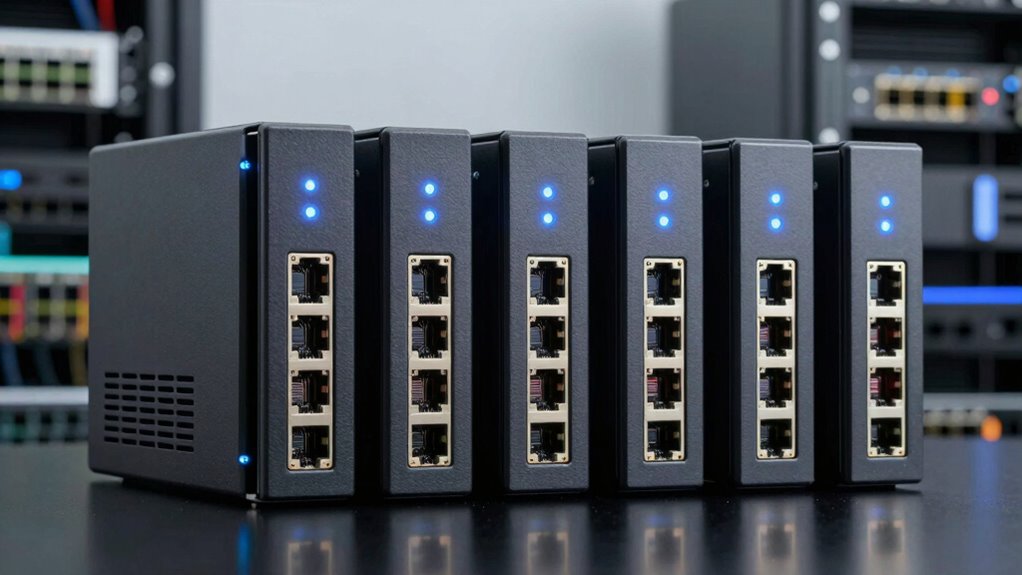
The best 10GbE switch with SFP+ depends on whether your network needs many fiber uplinks, copper devices, or a balance of both. I’d start with the SODOLA 12-Port for its eight SFP+ ports and four RJ45 ports, while the TP-Link Omada SX3008F suits an all-fiber setup and the TRENDnet TEG-7124WS offers a broader 12-port managed-switch option. The main tradeoff is port mix: more SFP+ connections support fiber and DAC links, while RJ45 ports simplify connections to copper-equipped devices. Management features, network ecosystem, and the number of devices you need to connect also shape the choice. Read on for how these six options compare and which one fits your setup.

Get hardware and tech essentials delivered free with Prime
- Fast, free delivery on millions of items
- Prime Video, Amazon Music and more included
- Member-only deals all year
Key Takeaways
- SODOLA’s 8 SFP+ and 4 RJ45 layout is the most balanced choice here for networks that need both fiber or DAC links and copper connections.
- TP-Link Omada SX3008F has eight SFP+ ports and no RJ45 ports, making it a clearer fit for fiber-heavy networks than mixed copper-and-fiber installations.
- TRENDnet’s TEG-7124WS and TL2-F7120 serve different needs: compare their port types and management requirements rather than assuming two 12-port switches are interchangeable.
- The 8-port smart-managed SFP+ switch favors a smaller fiber-first setup, while the YuanLey’s six RJ45 ports suit buyers who need more direct copper connections.
- Port count alone does not settle the choice: transceiver compatibility, cable distances, management needs, and future device plans can change which switch is the better fit.
| TRENDnet TEG-7124WS 12-Port 10G Web Smart Switch |  | Best Overall for Mixed Copper and Fiber | Ports: 8 x 10GBASE-T RJ-45; 4 x 10G SFP+ | Switching capacity: 240 Gbps | Management: Web smart managed | VIEW ON AMAZON | See Our Full Breakdown |
| SODOLA 12-Port 10Gb Managed Ethernet Switch with 8 SFP+ and 4 RJ45 Ports |  | Best for SFP+-Heavy Mixed Networks | Ports: 8 x 10G SFP+; 4 x 10G RJ45 | Backplane capacity: 240G | RJ45 speeds: 10G, 5G, 2.5G, 1G, 100M | VIEW ON AMAZON | See Our Full Breakdown |
| TRENDnet TL2-F7120 12-Port 10G Layer 2 Managed SFP+ Switch |  | Best for Fiber-First Racks | Ports: 12 x SFP+; supports 1Gbps and 10Gbps | Switching capacity: 240 Gbps | Data transfer rate: 120 Gbps | VIEW ON AMAZON | See Our Full Breakdown |
| TP-Link Omada SX3008F 8-Port 10G SFP+ L2+ Managed Switch |  | Best for Omada-Centric Networks | Model: SX3008F | Ports: 8 x 10 Gbps SFP+ | Switch type: Smart managed L2+ | VIEW ON AMAZON | See Our Full Breakdown |
| 8-Port 10Gb SFP+ Smart Managed Network Switch |  | Best Compact, Silent Option | Ports: 8 x SFP+ | Supported modes: 10G/2.5G and 10G/1G | Management: Web managed | VIEW ON AMAZON | See Our Full Breakdown |
| YuanLey 8-Port 10Gb Ethernet Switch with 6 RJ45 and 2 SFP+ Ports |  | Best for Simple RJ45-and-SFP+ Expansion | Port count and type: 8 total: 6 RJ45 and 2 SFP+ | Port speeds: 10G, 5G, 2.5G, 1G, 100Mbps | Switching capacity: 160Gbps | VIEW ON AMAZON | See Our Full Breakdown |
| 10gbe switch with sfp plu | Ports | Management | Switching capacity | Mounting |
|---|---|---|---|---|
| TRENDnet TEG-7124WS 12-Port 10 | 8 x 10GBASE-T RJ-45; 4 x 10G SFP+ | Web smart managed | 240 Gbps | 1U, 19-inch rack-mountable |
| SODOLA 12-Port 10Gb Managed Et | 8 x 10G SFP+; 4 x 10G RJ45 | Web GUI with LACP, QoS, VLAN, and SNMP | — | 1U rack-mount; brackets included |
| TRENDnet TL2-F7120 12-Port 10G | 12 x SFP+; supports 1Gbps and 10Gbps | Web interface and CLI | 240 Gbps | — |
| TP-Link Omada SX3008F 8-Port 1 | 8 x 10 Gbps SFP+ | Omada SDN; cloud, hardware, software, or standalone modes | — | — |
| 8-Port 10Gb SFP+ Smart Managed | 8 x SFP+ | Web managed | — | — |
| YuanLey 8-Port 10Gb Ethernet S | — | — | 160Gbps | Rackmount or desktop |
More Details on Our Top Picks
TRENDnet TEG-7124WS 12-Port 10G Web Smart Switch
I rank the TRENDnet TEG-7124WS first for buyers who need both familiar copper connections and SFP+ uplinks in one rack unit. Its eight 10GBASE-T ports can connect equipment over standard Ethernet cabling, while four SFP+ slots give fiber or DAC connections room to serve servers and other switches. The 240 Gbps switching capacity and VLAN, QoS, LACP, and monitoring features suit an SMB network that needs more control than an unmanaged switch provides. Compared with the SODOLA 12-port model, this TRENDnet has fewer SFP+ slots but adds IPv4/IPv6 static routing. The tradeoff is that the available specs do not state power use or noise, which matters when placing it outside a dedicated equipment room. Its lifetime protection also applies only in the U.S. and Canada.
Pros:- Combines eight 10GBASE-T ports with four 10G SFP+ slots
- Includes VLAN, QoS, LACP, SNMP, and IPv4/IPv6 static routing
- 240 Gbps switching capacity in a rack-mountable metal chassis
- NDAA and TAA compliant
Cons:- Only four of its twelve ports are SFP+
- Power consumption and noise level are not specified
- Lifetime manufacturer protection is limited to the U.S. and Canada
Best for: Small and midsize businesses that need several 10Gb RJ45 connections, a handful of SFP+ links, and managed traffic controls in a rack.
Not ideal for: Fiber-heavy server rooms needing more than four SFP+ connections, or quiet home offices where unspecified fan noise and power draw are concerns.
- Ports:8 x 10GBASE-T RJ-45; 4 x 10G SFP+
- Switching capacity:240 Gbps
- Management:Web smart managed
- Network features:VLAN, QoS, LACP, SNMP, IPv4/IPv6 static routing
- Mounting:1U, 19-inch rack-mountable
- Case:Metal
- Operating temperature:32°F to 122°F
- Compliance:NDAA and TAA compliant
Our verdict“Choose this TRENDnet when your 10Gb network needs a useful balance of copper ports, SFP+ uplinks, and managed features.”
SODOLA 12-Port 10Gb Managed Ethernet Switch with 8 SFP+ and 4 RJ45 Ports
The SODOLA 12-port makes sense when most 10Gb links will use fiber or DAC, but a few devices still need copper. Its eight SFP+ ports and four multigig RJ45 ports reverse the port balance of the TRENDnet TEG-7124WS, giving a fiber-oriented rack more direct high-speed connections. The RJ45 ports accept 10G, 5G, 2.5G, 1G, and 100M, which can help when connecting equipment with different Ethernet speeds. Web management includes VLAN, QoS, LACP, and SNMP, backed by a stated 240G backplane. The tradeoff is active fan cooling, which can be noticeable in a quiet room, and the listed warranty is one year. Unlike TRENDnet’s model, the supplied feature list does not include static routing.
Pros:- Eight SFP+ ports provide more fiber or DAC connections than the TRENDnet TEG-7124WS
- Four RJ45 ports support 10G, 5G, 2.5G, 1G, and 100M
- Web management includes LACP, QoS, VLAN, and SNMP
- Includes 1U rack-mount brackets
Cons:- Built-in fans may be noisy in quiet rooms
- One-year warranty is shorter than the listed coverage for the TRENDnet models
- Rack is not included
Best for: Small server rooms and advanced home labs with several SFP+ servers or switches plus a few copper-connected multigig devices.
Not ideal for: Quiet offices or living spaces where built-in fan noise is unwelcome, and buyers who want a longer stated warranty or static routing.
- Ports:8 x 10G SFP+; 4 x 10G RJ45
- Backplane capacity:240G
- RJ45 speeds:10G, 5G, 2.5G, 1G, 100M
- Management:Web GUI with LACP, QoS, VLAN, and SNMP
- Cooling:Built-in fans
- Mounting:1U rack-mount; brackets included
- Maximum power:96 W
- Warranty:1 year
Our verdict“Pick the SODOLA if you want eight SFP+ connections with flexible multigig copper ports and can accommodate fan cooling.”
TRENDnet TL2-F7120 12-Port 10G Layer 2 Managed SFP+ Switch
For a rack built around SFP+ connections, the TRENDnet TL2-F7120 offers twelve ports without using space on built-in RJ45 interfaces. That gives it more fiber or DAC capacity than the eight-SFP+ TP-Link Omada SX3008F, while retaining VLAN, QoS, link aggregation, and SNMP controls. Web management and a CLI give administrators a choice of configuration approach, and IPv4/IPv6 static routing adds flexibility beyond basic Layer 2 switching. The listed 20W maximum power is a useful planning detail compared with products in this roundup that do not state consumption. The main compromise is clear: there are no RJ45 data ports, so copper devices need compatible SFP+ modules or a separate switch. Dual rack mounting also requires a separately sold bracket.
Pros:- Twelve SFP+ ports offer more direct high-speed links than the TP-Link Omada SX3008F
- Supports VLAN, QoS, link aggregation, SNMP, and IPv4/IPv6 static routing
- Configuration is available through a web interface or CLI
- Specified maximum power draw of 20W and NDAA/TAA compliance
Cons:- No built-in RJ45 data ports
- Dual rack mounting requires a separately sold bracket
- The 48V DC power requirement may not suit every existing setup
Best for: Network administrators building a fiber- or DAC-first SMB rack who need twelve SFP+ ports, CLI access, and managed traffic features.
Not ideal for: Buyers who need direct RJ45 connections, or rack installers who require dual mounting without purchasing an additional bracket.
- Ports:12 x SFP+; supports 1Gbps and 10Gbps
- Switching capacity:240 Gbps
- Data transfer rate:120 Gbps
- Management:Web interface and CLI
- Network features:VLAN, QoS, link aggregation, SNMP, IPv4/IPv6 static routing
- Maximum power:20 W
- Power input:48V DC
- Dimensions:8.26 x 9.06 x 1.73 inches
- Compliance:NDAA and TAA compliant
Our verdict“Choose the TL2-F7120 for a managed, SFP+-only rack that needs twelve ports and does not depend on built-in copper Ethernet.”
TP-Link Omada SX3008F 8-Port 10G SFP+ L2+ Managed Switch
The TP-Link Omada SX3008F is the clearest fit for buyers who already manage their network through Omada SDN. Its eight 10Gb SFP+ ports can be managed through cloud, hardware, software, or standalone modes, letting a network administrator use the management style that matches the rest of the system. VLANs, static routing, QoS, IGMP, LAG, ACL, and 802.1X provide more than simple port connectivity. Compared with the twelve-port TRENDnet TL2-F7120, the SX3008F gives up four SFP+ ports but brings centralized Omada management and a five-year warranty. Its SFP+-only design still means copper devices need suitable modules or another switch, and buyers should check controller arrangements before relying on cloud management.
Pros:- Eight 10Gb SFP+ ports suit fiber or DAC aggregation
- Omada SDN supports cloud, hardware, software, and standalone management
- Includes static routing, VLAN, QoS, ACL, 802.1X, and LAG
- Five-year manufacturer warranty
Cons:- No built-in RJ45 data ports
- Four fewer SFP+ ports than the TRENDnet TL2-F7120
- Cloud controller plan details may require confirmation with TP-Link
Best for: Small-business IT teams and Omada users who want centralized management for an eight-port SFP+ aggregation switch.
Not ideal for: Fiber-heavy racks needing more than eight SFP+ links, or buyers seeking built-in RJ45 ports and a standalone copper connection option.
- Model:SX3008F
- Ports:8 x 10 Gbps SFP+
- Switch type:Smart managed L2+
- Management:Omada SDN; cloud, hardware, software, or standalone modes
- Features:IPv6, static routing, L2/L3/L4 QoS, IGMP, LAG, VLAN, ACL, 802.1X
- Dimensions:17.32 x 7.09 x 1.73 inches
- Weight:1.65 kg
- Maximum operating temperature:45 °C
- Warranty:5 years
Our verdict“Choose the SX3008F when Omada integration and centralized control matter more than having twelve SFP+ ports.”
8-Port 10Gb SFP+ Smart Managed Network Switch
This eight-port switch is the lineup’s straightforward choice for a compact setup where fanless operation matters as much as SFP+ connectivity. It supports compatible copper, fiber, DAC, and AOC modules, and its web management covers VLAN, QoS, spanning tree, MAC address management, DHCP client, and static or dynamic link aggregation. At a stated 18W maximum power, it also gives buyers a clearer power figure than the TRENDnet TEG-7124WS, though the two serve different port needs: this model has no built-in RJ45 ports, while the TRENDnet does. That flexibility depends on choosing compatible modules; the specs warn that 1G modules are not recognized in the default 10G/2.5G mode. Fanless cooling avoids fan noise, but the case may get warm under full load, especially with 10G RJ45 modules.
Pros:- Eight SFP+ ports support compatible copper, fiber, DAC, and AOC modules
- Fanless design avoids fan noise
- Web management includes VLAN, QoS, spanning tree, and link aggregation
- Specified maximum power draw of 18W
Cons:- No built-in RJ45 data ports; copper connections require compatible modules
- 1G modules are not recognized in the default 10G/2.5G mode
- May run warm under full load, especially with 10G RJ45 modules
Best for: Home lab builders and small offices that need eight managed SFP+ links in a quiet, compact switch and are comfortable selecting transceivers.
Not ideal for: Buyers who need built-in RJ45 ports, automatic recognition of 1G modules in the default mode, or sustained heavy use with warm-running copper modules.
- Ports:8 x SFP+
- Supported modes:10G/2.5G and 10G/1G
- Management:Web managed
- Features:VLAN, QoS, spanning tree, MAC address management, DHCP client, link aggregation
- Link aggregation:Static and dynamic (IEEE 802.3ad), up to 8 member ports
- Maximum power:18 W
- Cooling:Fanless
- Housing:Metal
- Operating temperature:0–40 °C
Our verdict“Pick this model for a quiet, compact SFP+ network if you can manage module compatibility and do not need built-in copper ports.”
YuanLey 8-Port 10Gb Ethernet Switch with 6 RJ45 and 2 SFP+ Ports
The YuanLey pairs six 10Gbps RJ45 ports with two 10G SFP+ ports, a useful mix for a small network that needs fast connections for copper devices plus fiber or DAC uplinks. Unlike the TP-Link Omada SX3008F, which uses SFP+ across all eight ports, this model connects ordinary Ethernet devices directly without SFP+ transceivers. Its unmanaged, plug-and-play design keeps setup straightforward, but gives up the VLAN and traffic controls available on managed alternatives such as the TRENDnet TEG-7124WS. Auto-negotiation across speeds down to 100Mbps can also help when linking older equipment. The metal case supports desktop or rack placement, though the built-in fan adds a source of noise, and its 24dB rating may matter in a quiet room. I’d choose it for mixed copper-and-SFP+ expansion, not for networks needing detailed configuration.
Pros:- Six 10Gbps RJ45 ports connect copper devices directly
- Two 10G SFP+ ports support fiber or DAC links
- Auto-negotiation supports speeds from 100Mbps to 10Gbps
- Desktop or rackmount placement gives installation flexibility
Cons:- Unmanaged operation provides no network configuration options
- Cooling fan can be audible in quiet rooms
- Only two SFP+ ports, fewer than SFP+-focused alternatives
Best for: Small offices or home labs adding 10GbE to several RJ45 devices while reserving SFP+ ports for a fiber or DAC connection.
Not ideal for: Network administrators who need VLANs, traffic management, or monitoring, and users who require a fanless switch for a quiet workspace.
- Port count and type:8 total: 6 RJ45 and 2 SFP+
- Port speeds:10G, 5G, 2.5G, 1G, 100Mbps
- Switching capacity:160Gbps
- Switch type:Unmanaged
- Case material:Metal
- Cooling fan noise:24dB
- Mounting:Rackmount or desktop
- Operating temperature:0–45°C
- Warranty:1 year
Our verdict“Choose the YuanLey if you need several 10Gbps copper connections and a pair of SFP+ ports without managed-switch setup.”

How We Picked
I compared the six switches around the decisions that matter in a 10GbE setup: how many SFP+ and RJ45 ports each provides, what kinds of links that layout supports, and how much management capability its product positioning suggests. I also considered whether each model is aimed at a fiber-first network, a mixed-media installation, or a simpler small deployment. Since port count and port type affect both cabling choices and later expansion, I treated them as more meaningful than headline speed alone.
The ranking favors useful flexibility and clear fit, then weighs port capacity and the likely setup burden. The SODOLA leads for its combination of eight SFP+ and four RJ45 ports; the TP-Link and TRENDnet models follow for buyers whose needs align with their respective port and management approaches. Compact and copper-heavy choices rank lower for this broad roundup because they serve narrower layouts, not because they are poor fits for those buyers. Before purchasing, check the manufacturer’s documentation for management features, supported transceivers, and any model-specific requirements.
| 10gbe switch with sfp plu | Management |
|---|---|
| TRENDnet TEG-7124WS 12-Port 10 | Web smart managed |
| SODOLA 12-Port 10Gb Managed Et | Web GUI with LACP, QoS, VLAN, and SNMP |
| TRENDnet TL2-F7120 12-Port 10G | Web interface and CLI |
| TP-Link Omada SX3008F 8-Port 1 | Omada SDN; cloud, hardware, software, or standalone modes |
| 8-Port 10Gb SFP+ Smart Managed | Web managed |
| YuanLey 8-Port 10Gb Ethernet S | — |
Factors to Consider When Choosing 10gbe Switch With Sfp Plus
Before choosing a 10GbE switch with SFP+, map the links you need today and the ones you may add later. The port mix tells you what can connect directly, but cabling, compatibility, management, and network layout determine whether the switch will work smoothly in your installation.
Match SFP+ and RJ45 Ports to Your Devices
Count the devices that can connect over SFP+ and the ones that need copper Ethernet before comparing total port counts. SFP+ ports can serve fiber links or direct-attach copper cables, while RJ45 ports connect to copper Ethernet devices without a separate SFP+ transceiver. A switch with eight SFP+ ports may be a poor match if most of your endpoints only have RJ45 ports. Conversely, paying for many RJ45 ports may leave too few high-speed links for a server, NAS, or core switch. Leave spare capacity for planned additions, but avoid buying ports for a network layout you do not expect to build.
Check Transceiver, DAC, and Cable Compatibility
An SFP+ port is a form factor, not a guarantee that every module or cable will work with every switch. Check the switch maker’s compatibility guidance for fiber transceivers and DAC cables, including supported speeds and cable types. Fiber can be useful when equipment is separated by distance or when electrical isolation matters, while DAC cables are often a straightforward option for nearby devices. Also confirm the fiber type and connector match the transceivers at both ends of a link. A low-cost switch can become a poor fit if your existing optics are unsupported or your cable plan requires a different module.
Decide How Much Management You Need
Unmanaged, smart-managed, and Layer 2 or Layer 2+ switches differ in how much control they give you over traffic and network setup. VLANs can separate devices such as workstations, storage, and guest equipment; link aggregation can combine supported links; and monitoring features can help diagnose problems. These functions are useful only when the rest of your network can use and support them. If you want simple connectivity, a feature-heavy interface may add setup work without helping your day-to-day use. If the switch will sit at the center of a segmented network, confirm the exact management functions in the documentation before choosing based on a label alone.
Plan for Network Speed End to End
A 10GbE switch cannot make a slower network connection deliver 10GbE performance. Check the network adapters, server or NAS ports, cabling, and the other switch at the far end of each link. A single 10GbE uplink can also become a bottleneck when many devices send traffic through it at once. Think about whether your main need is fast communication between local devices or a high-speed connection to the rest of the network. Buying a switch with more 10GbE ports than your devices can use may add cost and cabling complexity without improving the current setup.
Account for Placement, Noise, and Power
Switches intended for network closets may not be a comfortable fit beside a desk or in a quiet home workspace. Check the manufacturer’s specifications for dimensions, mounting options, cooling design, and operating noise rather than assuming all compact-looking models behave alike. Power use can also vary with the switch design and connected modules, so consider how many ports will be active and what hardware will occupy them. If the switch needs to sit in a living area, noise and heat may matter as much as management features. Confirm the physical installation requirements before ordering so the unit has suitable airflow and cable clearance.
Choose for Expansion Without Overbuying
It is easy to focus on the largest port count and overlook whether the layout supports the next devices you actually plan to add. Sketch current connections, likely additions, and uplinks; then compare that list against each switch’s SFP+ and RJ45 allocation. A 12-port model may be a better long-term fit if several high-speed links are planned, while an eight-port model can suit a smaller network with a stable device count. Consider whether additional switches would be practical later, including the number of uplinks they would consume. The best expansion plan leaves room for growth without paying for unused ports or creating unnecessary network layers.
Frequently Asked Questions
Should I choose a switch with more SFP+ ports or more RJ45 ports?
Start with the ports your devices already have and the links that need 10GbE, rather than choosing by total port count. SFP+ is the relevant choice for compatible fiber modules and DAC cables, while RJ45 connects copper Ethernet devices directly. A mixed layout like the SODOLA’s eight SFP+ and four RJ45 ports can reduce the need to compromise when both link types are present. An all-SFP+ model such as the TP-Link Omada SX3008F is more suited to a fiber-first design. Confirm device adapters and cabling before deciding, since changing an endpoint’s connection type can add hardware and setup steps.
Can I use any SFP+ transceiver or DAC cable with these switches?
No; physical fit does not guarantee that a switch will support every transceiver or DAC cable. Compatibility can depend on the switch’s supported module list, link speed, cable type, and the equipment at the other end. Check the manufacturer’s documentation for the exact model and intended module before buying, especially if you already own optics. For fiber links, match the transceivers and fiber type at both ends. For short connections between nearby devices, a supported DAC cable may be a simpler option than separate optics and fiber patch cables.
Do I need managed features for a home NAS and workstation network?
Not always. If your goal is simply to connect a few devices at 10GbE, advanced management may add setup work without changing how those devices communicate. Managed features can be useful when you want VLAN separation, link aggregation, or network monitoring, but the connected devices and other network equipment must support the configuration too. For a growing home lab or a network with separate device groups, a managed model may give you more control. Check which specific features are included rather than relying only on terms such as smart-managed or Layer 2+.
Will a 10GbE switch make every device on my network run at 10GbE?
No. Each device needs a compatible 10GbE network interface, a suitable cable or transceiver, and a connection to a 10GbE-capable port. The speed of a file transfer can also depend on storage performance, computer hardware, and the link to the device receiving the data. A 10GbE switch helps when the connected devices can use that bandwidth, but it does not raise the speed of older adapters or internet service. Check each link in the route instead of treating the switch’s port speed as a network-wide guarantee.
How many spare ports should I leave when choosing a switch?
Leave enough capacity for the devices and uplinks you expect to add, but do not use an arbitrary spare-port target. Count current endpoints, any link aggregation that uses multiple ports, and connections to other switches; then add realistic near-term growth. Remember that an SFP+ uplink uses an SFP+ port that cannot also serve another device at the same time. A larger model can reduce the need to replace the switch later, while a smaller model may suit a stable installation better. Your expected port mix matters as much as the number of open ports.
Conclusion
For the broadest mix of high-speed fiber or DAC links and copper connections, I’d choose the SODOLA 12-Port as the best overall fit. The 8-Port 10Gb SFP+ Smart Managed Switch is the best value-style choice for a smaller fiber-first network, while the TRENDnet TEG-7124WS is the best premium-oriented option for buyers who need a larger managed-switch footprint and should confirm its port layout against their plan. For a beginner building an all-SFP+ setup, the TP-Link Omada SX3008F is the most straightforward match among these picks if eight SFP+ ports cover the need. Choose the YuanLey 8-Port for a specific copper-heavy layout with six RJ45 ports and two SFP+ uplinks; choose the TRENDnet TL2-F7120 when its Layer 2 managed SFP+ design matches your network requirements. Before settling on any model, verify module compatibility, management features, and the exact port mix you need.