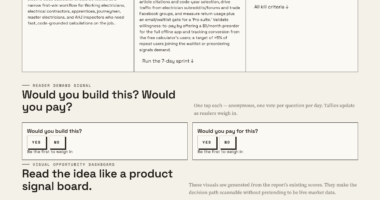
📊 Full opportunity report: How Proptech Is Shaping Backyard Home Construction on IdeaNavigator AI — validation score, market gap, and execution plan.

Get hardware and tech essentials delivered free — and shop member deals
- Fast, free delivery on millions of items
- Access to Prime Big Deal Days deals on October 6–7
- Prime Video, Amazon Music and more included
TL;DR
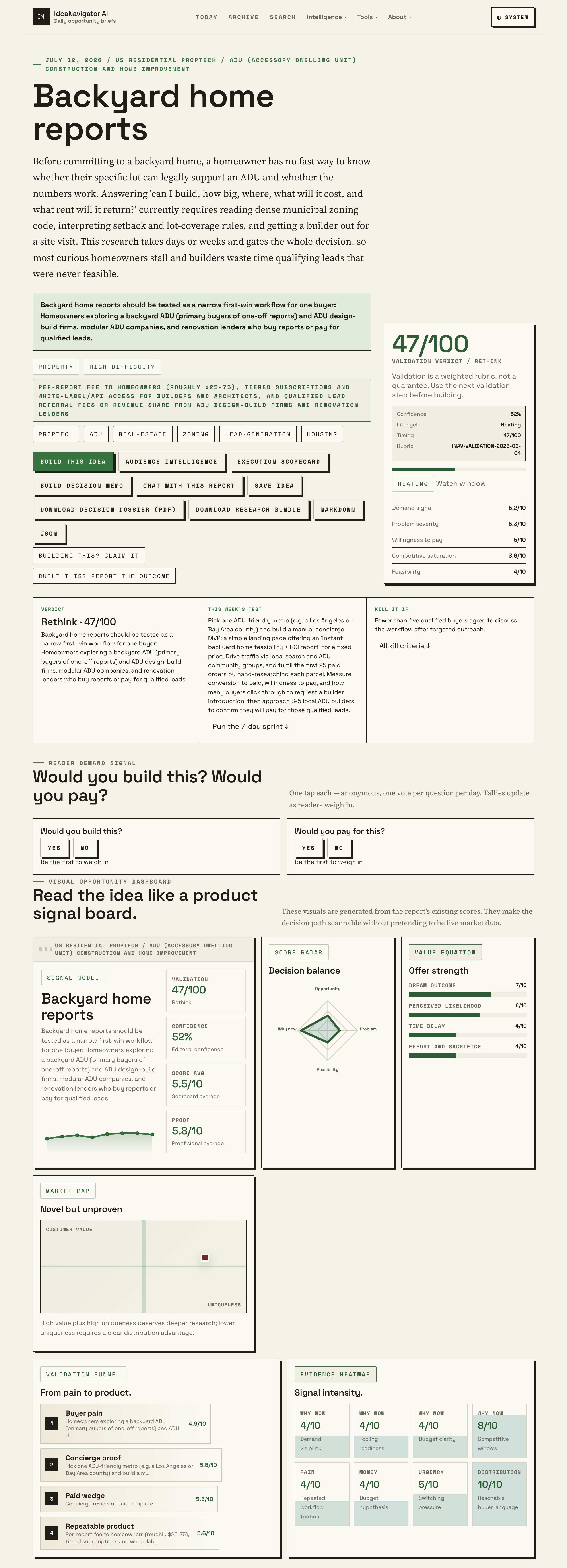
IdeaNavigator AI has proposed testing paid, address-specific reports that estimate whether a property can support an accessory dwelling unit and whether a project’s costs and potential rent may make sense. The proposal describes a market opportunity, not a launched service or validated business; customer demand, report accuracy and builder willingness to pay remain unproven.
IdeaNavigator AI has outlined a proposed service that would sell homeowners address-specific reports on whether their lots might support a backyard accessory dwelling unit, or ADU. The plan targets a common early project question—whether a lot’s rules, size and potential economics justify further work—but it describes an idea to validate, not an operating product or confirmed business.
The proposed report would combine county parcel data, applicable state ADU law and a locally curated set of zoning rules. For a selected launch area, it could estimate permitted ADU types and size, setbacks, lot coverage and a potential buildable area. It would also give a construction cost range and projected rent based on nearby comparisons. Those outputs are estimates; the proposal does not establish that they have been tested against completed projects or reviewed by permitting authorities.
IdeaNavigator AI recommends beginning in one California market, with rules researched manually, rather than attempting nationwide coverage. A homeowner would enter an address and pay a suggested $25 to $75 per report. Possible additional revenue includes subscriptions or white-label and API access for builders and architects, plus referral fees when homeowners request an introduction to an ADU firm or renovation lender. These are proposed prices and revenue channels, not reported sales.
The suggested validation plan is a concierge test: advertise a fixed-price feasibility and return estimate, research the first 25 paid orders by hand, and track purchases and requests for builder introductions. The proposal also recommends approaching three to five local ADU builders to learn whether they would pay for qualified leads. No results from those tests, participating businesses or paying customers are identified in the proposal.
Potential Uses for Early Project Screening
An address-specific report could give homeowners an initial summary of site constraints, estimated project costs and potential rent before they pursue a site visit, design work or permit application. The information could help them identify questions to raise with a designer, builder or local planning office. Its practical value would depend on the accuracy of the information, how clearly the report describes uncertainty and whether users confirm findings with qualified professionals.
Builders could use early site screening to assess inquiries before investing time in project discussions. The proposal does not establish whether this would reduce their workload or lead to more projects. Builder willingness to pay for qualified leads, and whether those leads become projects, are among the points it recommends testing.
Accessory dwelling units can add housing on existing residential lots. The proposed report would provide early information about a property; it would not change zoning, construction costs or permit requirements. Its value would depend on the currency of parcel records and rule interpretations, as well as clear limits on cost and rent estimates.
California ADU Rules Set the Stage
California began statewide ADU law changes in 2016 and has loosened rules in subsequent years, according to the proposal. It cites more than 45,000 ADU permits in Los Angeles County in 2023 and says ADUs accounted for roughly one in five new housing units produced in California. The figures are presented as context for the opportunity; the proposal does not provide underlying datasets or specify the exact measurement method for the statewide share.
Rules still require local interpretation. State law can set broad protections or requirements, while lot conditions and local provisions shape what may be built at a particular address. Homeowners may need to understand setbacks, lot coverage and other constraints alongside site access, utilities, design choices and construction budgets. An automated parcel screening tool could organize some of that early research, but a preliminary estimate is distinct from an official zoning determination or a permit decision.
The proposal links the timing to broader housing demand, more available parcel and zoning data, and language models that may help parse codes. It does not name a specific product, technical method, launch date or market partner. Its recommendation to start with a few counties reflects the challenge of translating varied rules into dependable address-level results.
Demand and Accuracy Remain Untested
The proposal does not show that homeowners have bought reports, that a report can reliably identify what a specific lot may support, or that builders and lenders will pay for referrals. It also does not provide a completed feasibility report, an accuracy assessment or a comparison of its cost and rent estimates with final project outcomes. Those gaps matter because an incorrect interpretation of local rules or an overly confident financial estimate could lead a homeowner to spend money on a project that later changes or cannot proceed as expected.
It is also unclear which California county would be selected, how frequently its rules and parcel data would be refreshed, how exceptions would be handled, and what professional review would be included. Rent comparisons can vary by unit type and local conditions, while construction costs depend on site work, design, materials and other project details. The suggested report price and partner revenue are hypotheses, not evidence of customer willingness to pay or a sustainable business model.
A Paid Local Pilot Would Test It
The next step proposed by IdeaNavigator AI is to choose an ADU-friendly metro or county and offer the report at a fixed price through a simple landing page. The team behind the idea would fulfill an initial batch of 25 orders manually, then review how many visitors pay, how buyers respond to the report and how often they request a builder introduction. Discussions with three to five local firms would test whether builders would pay for the resulting leads. The proposal gives no schedule or evidence that this pilot has begun.
If that test proceeds, its results could show whether a locally researched report attracts paying customers and whether lead referrals provide a second source of revenue. Until results are available, the opportunity remains a business proposal. Homeowners would still need to confirm zoning, project costs and rental assumptions with relevant local authorities and qualified professionals before making construction or financing decisions.
Source: IdeaNavigator AI
Key Questions
Is a backyard ADU feasibility report service already operating?
The proposal describes a service to test. It does not identify a launched product, active pilot or paying customers.
What would the proposed report include?
It could estimate applicable ADU types and size, setbacks, lot coverage, buildable area, construction costs and potential rent using parcel information and local rules. The estimates would need confirmation before a homeowner relied on them for a project decision.
How much might a report cost?
IdeaNavigator AI suggests a one-time price of $25 to $75. That range is a proposal; customer willingness to pay has not been reported.
Would the report confirm that a homeowner can build an ADU?
No such confirmation is established. The proposed report would offer an initial estimate, while the proposal does not describe it as an official zoning determination or permit approval.
How would the idea be tested?
The proposed pilot would manually research the first 25 paid reports in one local market and track purchases and requests for builder introductions. IdeaNavigator AI also recommends asking three to five local builders whether they would pay for qualified leads.
Source: IdeaNavigator AI
Fall Picks
fall essentials
As an affiliate, we earn on qualifying purchases.