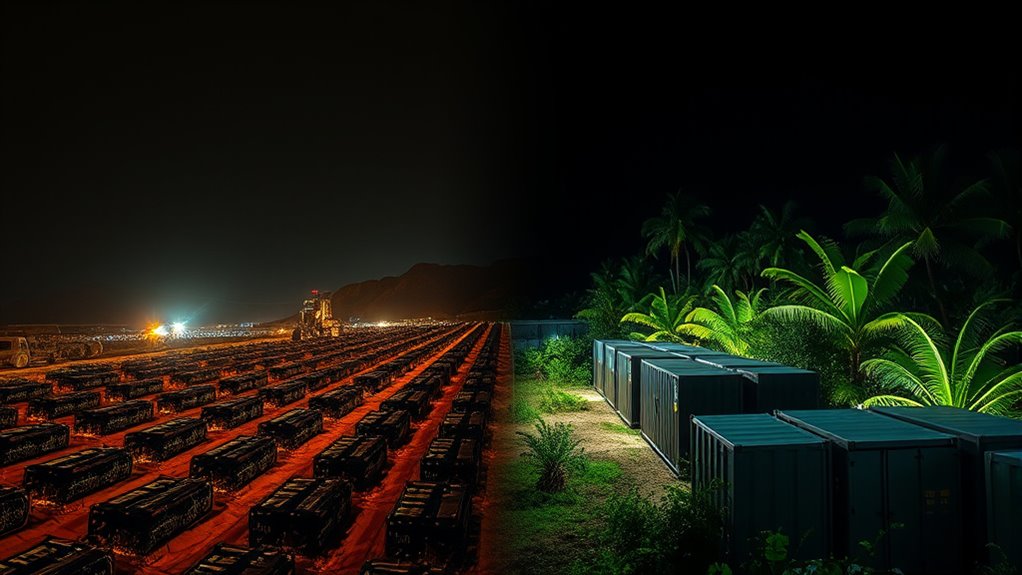

Miners are shifting their operations from Texas to Paraguay due to higher energy costs and regulatory uncertainties in Texas. Paraguay offers low-cost, renewable hydroelectric power, providing a stable and sustainable energy source. Political stability and favorable policies also attract miners seeking long-term reliability. This migration boosts Paraguay’s reputation as a cost-effective, eco-friendly hub for Bitcoin mining. To understand how these factors are shaping the industry and what’s driving the move, keep exploring the details.
Key Takeaways
- Rising energy costs and grid reliability issues in Texas drive miners to seek more stable, affordable energy sources like Paraguay’s hydroelectric power.
- Regulatory uncertainties and political risks in Texas make Paraguay’s stable, pro-investment environment more attractive for large-scale mining operations.
- Paraguay offers low-cost, renewable energy, significantly reducing operational expenses compared to Texas’s energy market.
- Hive Digital Technologies’ expansion in Paraguay demonstrates the region’s growing appeal as a cost-effective, sustainable Bitcoin mining hub.
- The migration enhances miners’ profitability through increased capacity, operational efficiencies, and long-term energy stability.

Hashrate Migration
As miners seek to optimize costs and stability, hashrate migration from Texas to Paraguay has gained momentum. You’re likely aware that Texas has long been a hotspot for Bitcoin mining, thanks to its abundant renewable energy and relatively low electricity prices. However, recent challenges have prompted many to rethink their strategies. Rising energy prices, grid reliability issues, and regulatory uncertainties have made Texas less attractive for large-scale operations. Meanwhile, Paraguay’s rapidly expanding mining sector offers a compelling alternative, drawing miners eager to cut costs and secure long-term stability.
Hive Digital Technologies exemplifies this shift. In early 2025, Hive completed the acquisition of Bitfarms’ 200 MW Yguazú facility for $56 million, marking a significant move into Paraguay’s mining landscape. The company then rapidly expanded its capacity, increasing from 6 exahashes per second (EH/s) to 25 EH/s within the year. Infrastructure development played an essential role—by April 2025, Hive finished its first phase of a 100 MW data center, supporting 5 EH/s of ASIC mining. Throughout 2025, Hive plans to grow its facilities to 300 MW, targeting 12 EH/s by mid-year, 18 EH/s by summer’s end, and reaching 25 EH/s by Thanksgiving. This aggressive expansion demonstrates how Paraguay’s environment is becoming a magnet for miners looking to boost their hashrate efficiently.
Hive’s rapid expansion in Paraguay boosts capacity from 6 to 25 EH/s, showcasing the country’s growing appeal for efficient Bitcoin mining.
The economic impact is significant. Hive’s increased capacity has driven revenue, with the company hitting a $250 million annual run rate by mid-2025, thanks to mining over 6 BTC daily. By the end of the year, projections suggest revenues could approach $400 million annually. Profit margins have improved alongside capacity, rising from 55% at 12 EH/s to an expected 60% at 18 EH/s, reflecting operational efficiencies. Energy costs and sustainability are key advantages, with Paraguay’s hydroelectric power offering a renewable, low-cost energy source that minimizes environmental impact. This clean energy foundation not only reduces operational costs but also aligns with sustainable mining practices, giving miners a competitive edge over Texas, where energy prices and intermittent supply issues persist. Hive’s investment in stable, renewable energy supports long-term growth and regulatory cooperation, reinforcing Paraguay’s reputation as a secure, environmentally conscious mining destination. The country’s abundant hydroelectric resources are a main driver of its appeal for miners seeking sustainable energy solutions.
Geopolitically, Paraguay provides a stable environment with government policies that favor foreign investment. The country’s clear regulatory framework, combined with proactive engagement with policymakers, has eased concerns about potential bans or restrictions. In contrast, Texas has experienced rising electricity prices and regulatory hurdles, prompting miners to consider relocation. The migration of hashrate from Texas to Paraguay reflects a strategic move driven by cost efficiency, energy stability, and political certainty. Hive’s expansion embodies this shift, highlighting Latin America’s untapped potential as a leading Bitcoin mining hub.

Bitaxe Gamma 601 Bitcoin Miner, Open Source Solo BTC Mining Machine, BM1370 ASIC Chip, 1TH/s – 1.2TH/s SHA-256, 2.4G WiFi, Home Crypto Miner, incl. 5V Power Supply & Stand, AxeOS, Orange
1-1.2TH/s Efficient Mining with BM1370 ASIC Chip: Powered by a single high-performance BM1370 ASIC chip—optimized for SHA-256 Bitcoin…
As an affiliate, we earn on qualifying purchases.
As an affiliate, we earn on qualifying purchases.
Frequently Asked Questions
How Does Paraguay’s Electricity Cost Compare to Texas?
You’re wondering how Paraguay’s electricity costs compare to Texas. Initially, Paraguay offered some of the world’s cheapest rates at about $0.033 per kWh, making it attractive for mining. In contrast, Texas’s rates average around 3 to 5 cents per kWh, but can vary with market conditions. Recent tariff hikes in Paraguay might narrow this edge, but Texas’s infrastructure and market stability still make it a competitive option for miners.
What Are the Environmental Impacts of Mining in Paraguay?
You should know that mining in Paraguay impacts the environment through water contamination, soil damage, and electronic waste. Large energy consumption stresses the grid, causing outages and water shortages. Illegal mining and improper waste disposal worsen these issues, while some operators use renewable energy to minimize harm. If regulations tighten and enforcement improves, you could see more sustainable practices that balance economic growth with environmental protection.
Are There Any Legal Restrictions for Miners in Paraguay?
Legal landscape limits like lack of specific laws and licensing laws leave miners with a largely lax, but layered, legal environment. You can mine without formal regulations, but you should stay updated on potential policy shifts. Paraguay taxes crypto profits lightly, especially for individuals, and enforces compliance through oversight agencies. While no concrete constraints exist now, future regulations could impose restrictions, so it’s wise to watch legal developments carefully.
How Does Infrastructure Quality Affect Mining Efficiency in Paraguay?
You should know that infrastructure quality directly impacts your mining efficiency in Paraguay. Overloaded and aging transmission lines can cause power outages and instability, reducing your mining uptime. When the grid struggles, your equipment might face interruptions, lowering productivity. Although Paraguay offers cheap, renewable energy, the infrastructure’s limitations mean you need to plan around potential power disruptions and consider investing in backup solutions to maintain steady mining operations.
What Is the Long-Term Sustainability of Hashrate Migration to Paraguay?
You might wonder if migrating hashrate to Paraguay is sustainable long-term. Given its abundant hydroelectric power, you benefit from clean energy, which supports environmentally friendly operations. However, water stress and infrastructure challenges pose risks. Social concerns like community impact and regulatory changes could affect stability. Overall, if miners actively manage environmental and social issues, Paraguay can offer a sustainable base for growth, but vigilance remains essential for long-term success.

Mining Rig Frame for 12GPU, Steel Open Air Miner Mining Frame Rig Case, Support to Dual Power Supply for Crypto Coin Currency Bitcoin ETH ETC ZEC Mining Tools – Frame Only, Fans & GPU is not Included
SLOT – 6/8/12 GPU slots, support 2 ATX power supplies.
As an affiliate, we earn on qualifying purchases.
As an affiliate, we earn on qualifying purchases.
Conclusion
As you watch miners pack up their rigs, the landscape shifts from Texas’s dusty plains to Paraguay’s lush, green valleys. Streams of data flow across borders, like digital rivers carving new paths. The migration isn’t just about numbers—it’s a dynamic dance across continents, fueling a global race for efficiency and opportunity. Soon, the sound of whirring machines will echo through unfamiliar lands, marking a new chapter in the relentless quest for crypto dominance.

Canaan Avalon Nano 3S Home Bitcoin Miner – 6TH/s 140W SHA-256 ASIC Miner – Quiet & Energy Efficient BTC Mining Machine (White)
Delivering a stable 6TH/s hash rate at only 140W, the Avalon Nano 3S provides powerful Bitcoin mining performance…
As an affiliate, we earn on qualifying purchases.
As an affiliate, we earn on qualifying purchases.
large-scale cryptocurrency mining farm
As an affiliate, we earn on qualifying purchases.
As an affiliate, we earn on qualifying purchases.