
🔍 Read the full analysis: How To Choose Among The 10 Best NVMe SSDs For HPC In 2027 on ThorstenMeyerAI.com

Get hardware and tech essentials delivered free with Prime
- Fast, free delivery on millions of items
- Prime Video, Amazon Music and more included
- Member-only deals all year
TL;DR
A 2027 guide from ThorstenMeyerAI.com compares 10 NVMe SSDs across speed, sustained writes, thermals, endurance and cost. Its source material does not provide HPC benchmarks or complete specifications for every listed model, so the picks should be treated as general buying guidance, not a validated HPC ranking.
ThorstenMeyerAI.com’s 2027 guide compares 10 NVMe SSDs by performance, thermal behavior, endurance and price, while warning readers that peak speeds can obscure drops during sustained writes, as detailed in the original analysis. The supplied material names several models but does not include a full list of 10, detailed test results or HPC-specific benchmarks, leaving its suitability for high-performance computing workloads unverified.
The guide identifies the Samsung 990 PRO 2TB as its overall choice and the Kingston NV3 1TB as a budget option. It also names the Samsung 9100 PRO, SanDisk Optimus 5100 and Bestoss 1TB. The source describes the 990 PRO as combining high sequential speeds with power efficiency, and the NV3 as an entry-level PCIe 4.0 drive, considerations that can also inform mobile workstation choices for AI. Those are the guide’s assessments; the supplied text gives no test figures to independently compare them.
Its main performance warning concerns sustained writes. Entry-level drives may slow after their SLC cache fills, and smaller capacities can be more affected during large transfers than higher-capacity versions. The guide also emphasizes cooling, endurance ratings and warranty terms, especially for compact systems and workloads with frequent writes, alongside the graphics cards used in high-performance builds.
The source says it considered sequential throughput, random IOPS, thermal throttling, terabytes written (TBW), warranty coverage, and whether drives use DRAM or Host Memory Buffer (HMB). However, the supplied material does not state the testing methods, benchmark results, prices, or warranty details for the models. It also does not identify all 10 picks, so this article cannot responsibly reproduce a complete ranked list.
The 10 picks
- 1
 Samsung 990 PRO 4TB PCIe 4.0 NVMe M.2 2280 SSDView on Amazon →
- 2
 Gigastone Game Turbo 4TB M.2 NVMe PCIe 4.0 Internal SSDView on Amazon →
- 3
 Gigastone 1TB Game Turbo PCIe Gen4x4 M.2 NVMe SSD (2-Pack)View on Amazon →
- 4
 Samsung 9100 PRO 2TB Internal SSDView on Amazon →
- 5
 Samsung 990 PRO 2TB PCIe 4.0 M.2 2280 NVMe SSDView on Amazon →
- 6
 Bestoss 1TB PCIe 4.0 NVMe M.2 2280 SSD with HeatsinkView on Amazon →
- 7
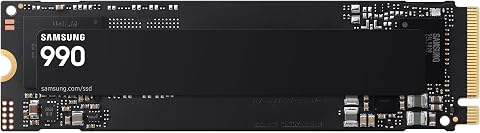 Samsung 990 1TB PCIe 4.0 NVMe Internal SSDView on Amazon →
- 8
 SanDisk Optimus 5100 1TB NVMe SSD, PCIe 4.0, M.2 2280View on Amazon →
- 9
 Kingston NV3 1TB M.2 2280 PCIe 4.0 NVMe SSDView on Amazon →
- 10
 SanDisk Optimus 5100 500GB NVMe SSD, PCIe 4.0, M.2 2280View on Amazon →
Storage Limits in HPC Workloads
For HPC users, storage performance can affect how quickly data reaches compute nodes, how well workloads handle checkpoints, and how efficiently systems process large datasets. The guide’s focus on sustained throughput and thermal control is relevant because long-running transfers can expose limits that short benchmark bursts do not show.
Still, the source discusses a broad mix of consumer use cases, including gaming, creative work and laptops. It does not report results from servers, parallel storage systems, or HPC applications. Buyers should treat the article as a list of factors to investigate rather than evidence that any named consumer SSD meets a particular HPC performance or reliability requirement.
Products Worth Considering

Ledger Flex Crypto Wallet with 2.8-Inch E Ink Touchscreen

Logitech MX Keys S Combo Wireless Keyboard and Mouse, Graphite

Apple MacBook Pro 16.2-inch with M5 Pro, 18-core CPU, 20-core GPU, 24GB Memory, 1TB SSD, Wi-Fi 7, Space Black
As an affiliate, we earn on qualifying purchases.
How the Guide Frames SSD Choice
The source argues that choosing a drive is no longer just a matter of capacity. It highlights the tradeoff between peak speed and consistent performance, along with the effects of drive capacity, cooling, and cost per gigabyte. It says PCIe 4.0 remains a practical choice for many users, while PCIe 5.0 models can demand more cooling; those general claims are not accompanied by a dated market survey or specific comparison data.
It also explains that DRAM-equipped drives store mapping information in onboard memory, while some lower-cost models use HMB to borrow system RAM. According to the guide, HMB can suit lighter workloads, but DRAM may be preferable for heavy multitasking. The source presents TBW and warranty coverage as useful durability indicators, though neither alone establishes suitability for a particular HPC deployment.
“The primary tradeoff in this category often lies between raw peak performance and sustained write consistency.”
— ThorstenMeyerAI.com guide
Missing Tests and Model Details
The material supplied for this report does not name all 10 drives, give a complete ranking, or provide measured throughput, IOPS, temperatures, TBW figures, warranty terms or prices. It does not establish the guide’s publication date or explain its testing setup. Those gaps make it impossible to verify the stated comparisons or determine whether they apply to HPC systems rather than consumer PCs.
It is also unclear which HPC workloads the guide has in mind, including whether the drives are intended for local scratch storage, boot volumes, caching, or another role. No claims about server compatibility, workload endurance, or production reliability can be confirmed from the source material.
What Buyers Should Verify
Readers considering these models should consult the complete guide for its full 10-drive list and testing details, then compare manufacturer specifications with the requirements of their own system. That includes checking interface and slot compatibility, sustained-write behavior, cooling needs, endurance ratings and warranty conditions. For HPC deployments, testing under the intended workload and validating system-level compatibility are needed before making purchasing decisions. The source does not announce a follow-up date or additional test results.
Key Questions
Does the source provide all 10 SSD picks?
No. The supplied text names the Samsung 990 PRO 2TB, Kingston NV3 1TB, Samsung 9100 PRO, SanDisk Optimus 5100 and Bestoss 1TB, but does not identify the other models.
Does this list confirm the best SSD for HPC?
No. The guide discusses general consumer and workstation considerations, but provides no HPC-specific benchmarks or deployment results. Treat it as general selection guidance, not a verified HPC ranking.
Why do sustained writes matter?
Some drives can deliver fast short bursts but slow after their cache fills. For long transfers or repeated writes, sustained performance may matter more than a peak speed printed on a product specification.
What should buyers check before choosing a drive?
Check motherboard or system compatibility, capacity, sustained workload performance, cooling, TBW endurance and warranty terms. For HPC use, validate the drive with the actual application and system configuration.
Source: ThorstenMeyerAI.com