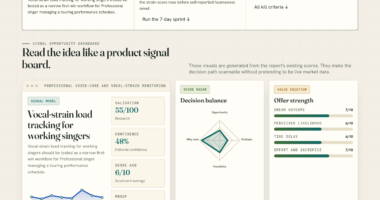
📊 Full opportunity report: Unlocking SaaS Growth Through AI Innovation on ThorstenMeyerAI.com — validation score, market gap, and execution plan.

Get hardware and tech essentials delivered free — and shop member deals
- Fast, free delivery on millions of items
- Access to Prime Big Deal Days deals on October 6–7
- Prime Video, Amazon Music and more included
TL;DR
AI is reshaping SaaS by lowering switching costs and changing the competitive landscape. Companies leveraging AI are achieving higher valuations and faster growth, while traditional SaaS faces new challenges.
AI-driven innovations are transforming the SaaS landscape, shifting the traditional competitive frontier from lock-in and migration pain to capabilities like scalability, iteration speed, and AI-specific features. This change is impacting company valuations, growth strategies, and market dynamics, making it a critical development for industry stakeholders.
Industry analysis from Thorsten Meyer indicates that the old SaaS frontier, defined by high switching costs and migration pain, is eroding due to advances in AI technology. AI agents now enable easier migration by automating complex tasks, effectively reducing the costs and risks associated with switching platforms. As a result, companies that relied on lock-in for revenue stability are facing new competitive pressures.
Market valuations reflect this shift: SaaS companies with strong AI integration are commanding higher multiples, often two to three times that of legacy SaaS firms. Public SaaS valuations have dropped from median multiples of around 18x in 2021 to 6–8x today, emphasizing a market reprice based on the underlying frontier change. High-growth AI-native firms, like Sierra and Legora, are achieving rapid growth and high valuations, while traditional SaaS struggles with declining multiples.
Furthermore, the market is distinguishing between different types of stickiness. While real switching costs like data gravity remain, inertia-based customer retention is diminishing as AI agents eliminate the friction humans previously created. This evolution is prompting investors and acquirers to scrutinize whether low churn rates are genuinely due to switching costs or simply customer inertia.
SaaS’s competitive frontier — the things that actually decide winners — relocated. Companies struggling now are defending the old line while the fight moved elsewhere.
- Own the system of record
- Make switching painful
- Migration as the moat
- Compound at 85% margins
- Lock-in = durability
- Fluency with the jagged edge
- Outcome pricing, not per-seat
- Cost & clean zero-to-infinity scaling
- Proprietary workflow data
- Value of staying, not cost of leaving
Impact of AI-Driven Changes on SaaS Valuations and Competition
This shift matters because it fundamentally alters how SaaS companies compete, grow, and maintain customer retention. Companies that adapt to the new AI-enabled frontier can unlock faster growth, higher valuations, and more flexible customer relationships. Conversely, firms clinging to old lock-in strategies risk obsolescence as the market revalues the importance of migration costs and customer inertia.
As an affiliate, we earn on qualifying purchases.
Evolution of SaaS Market Dynamics and the Role of AI
Historically, SaaS companies thrived on high switching costs, with migration being a complex, risky, and expensive process that created durable margins. This moat was based on data gravity, deep integrations, and regulatory compliance. However, the advent of AI agents capable of automating migration and workflow adaptation is eroding these barriers.
Since 2021, market multiples have contracted significantly, reflecting investor realization that the old frontier no longer applies universally. The emergence of AI-native SaaS firms, which leverage AI to peel off workflow layers and replace point solutions, exemplifies this new landscape. Gartner estimates that by 2030, a third of point-product SaaS tools could be replaced by AI agents, signaling massive disruption.
"The frontier that used to be about lock-in and migration pain is shifting toward capabilities like scalability and iteration speed, driven by AI."
— Thorsten Meyer
As an affiliate, we earn on qualifying purchases.
Unclear Aspects of AI’s Long-Term Impact on SaaS
It remains unclear how quickly traditional SaaS firms will adapt to the new AI-driven frontier or whether new AI-native firms will dominate entirely. The pace at which migration costs remain low across diverse software categories and the long-term durability of AI-enabled lock-in are still developing areas. Additionally, the full extent of how investor and acquirer behavior will evolve remains uncertain.
As an affiliate, we earn on qualifying purchases.
Next Steps for SaaS Companies and Investors
Companies should assess whether their current retention relies on real switching costs or inertia, and adapt their strategies accordingly. Investment focus is likely to shift toward AI-native SaaS solutions that leverage automation and rapid iteration. Market valuations will continue to reprice based on AI capability and market positioning, with high-growth AI firms expected to outperform legacy players. Monitoring how AI capabilities evolve and how customer needs shift will be key in the coming quarters.
As an affiliate, we earn on qualifying purchases.
Key Questions
How is AI changing SaaS customer retention strategies?
AI reduces the friction of migration and integration, making inertia-based retention less effective. Companies now need to focus on real value and capabilities rather than relying solely on switching costs.
Will legacy SaaS firms survive the AI shift?
Legacy SaaS firms can survive if they integrate AI effectively and adapt their strategies. However, those relying solely on traditional lock-in may face declining valuations and market share.
What are AI-native SaaS firms doing differently?
They leverage AI to automate workflows, peel off layers of existing systems, and rapidly iterate, enabling faster growth and higher valuations.
When might we see a full transition to AI-driven SaaS?
The transition is already underway, with Gartner estimating significant replacement of point solutions by AI by 2030. The pace will depend on technological advancements and market adoption.
Source: ThorstenMeyerAI.com
Fall Picks
fall essentials
As an affiliate, we earn on qualifying purchases.