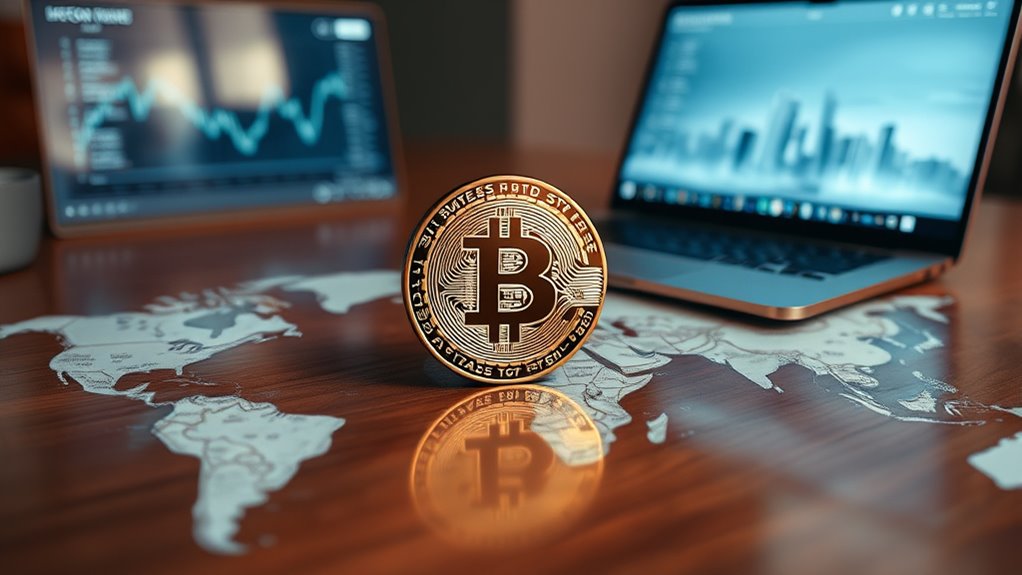

Bitcoin enables you to send cross-border payments quickly and at a lower cost by bypassing traditional banking systems. Transactions are validated on the blockchain within minutes, allowing you to access funds almost instantly regardless of location. Its decentralized nature reduces delays caused by banking procedures and international regulations. As adoption grows and regulations become clearer, Bitcoin could become an even more efficient tool for global money transfers. Keep exploring to discover how this technology is shaping the future of international payments.

Get hardware and tech essentials delivered free — and shop member deals
- Fast, free delivery on millions of items
- Access to Prime Big Deal Days deals on October 6–7
- Prime Video, Amazon Music and more included
Key Takeaways
- Bitcoin enables faster, borderless transactions by bypassing traditional banking systems and completing transfers within minutes.
- Blockchain technology reduces delays and intermediaries, increasing transaction efficiency in cross-border payments.
- Supportive cryptocurrency regulations facilitate smoother, quicker Bitcoin transactions internationally, while restrictive laws may cause delays.
- The decentralized nature of Bitcoin minimizes delays caused by banking procedures and compliance checks.
- Growing adoption and clearer regulations are expected to enhance Bitcoin’s role as an efficient tool for global cross-border payments.

Have you ever wondered how Bitcoin is transforming cross-border payments? The answer lies in its ability to bypass traditional banking systems and leverage blockchain technology to facilitate faster, more efficient transactions. Unlike conventional methods, which often involve multiple intermediaries and lengthy processing times, Bitcoin transactions can be completed in a fraction of the time. This remarkable transaction speed is especially crucial when sending money across borders, where delays can cost you both time and money. When you initiate a Bitcoin transfer, it’s validated and recorded on the blockchain within minutes, regardless of where the recipient is located. This rapid processing is a game-changer for individuals and businesses that need quick access to funds in different countries.
Bitcoin enables fast, cross-border transactions by bypassing traditional banking delays and leveraging blockchain technology.
However, the landscape is not entirely free of hurdles. Cryptocurrency regulation plays a significant role in shaping how seamlessly Bitcoin can be used for cross-border payments. Different countries have varying rules regarding digital currencies, with some embracing them openly and others imposing strict restrictions or bans. These regulations influence how easily you can send or receive Bitcoin across borders, affecting transaction speed and overall usability. For example, in regions with clear, supportive regulations, you might experience fewer delays and smoother transactions. Conversely, in areas with uncertain or restrictive rules, transactions might face additional scrutiny or delays, undermining some of Bitcoin’s advantages. It’s essential to stay informed about local cryptocurrency laws to navigate this evolving regulatory environment effectively.
Additionally, the absence of a centralized authority means that Bitcoin transactions are less susceptible to the delays caused by traditional banking bottlenecks. This decentralization ensures that your cross-border payments aren’t subject to the same constraints as bank wire transfers, which can take days to clear due to compliance checks and international banking procedures. Instead, Bitcoin operates on a peer-to-peer network, allowing direct transfers that are both transparent and quick. This feature not only speeds up the transaction process but also reduces costs associated with currency conversions and banking fees.
Ultimately, Bitcoin’s potential to revolutionize cross-border payments hinges on its transaction speed and the evolving landscape of cryptocurrency regulation. When regulations are clear and supportive, you can capitalize on swift, low-cost transfers that bypass traditional banking delays. As the global financial ecosystem continues to adapt to blockchain technology, it’s likely that Bitcoin will become an increasingly crucial tool for international money movement, offering a faster, more efficient alternative to conventional methods. This transformation promises to empower you with more control over your cross-border transactions and less reliance on slow, costly banking channels.
As an affiliate, we earn on qualifying purchases.
Frequently Asked Questions
How Does Bitcoin Comply With International Financial Regulations?
You need to understand that Bitcoin complies with international financial regulations by implementing anti-money laundering (AML) measures and Know Your Customer (KYC) protocols. While regulatory challenges exist, such as adapting existing laws to crypto, many exchanges and wallets enforce strict compliance to prevent illegal activities. By adhering to these standards, Bitcoin aims to foster trust and ensure its use aligns with global financial regulations, even amid evolving legal landscapes.
What Are the Tax Implications of Using Bitcoin for Cross-Border Payments?
When you use Bitcoin for cross-border payments, you need to think about tax implications like tax reporting and capital gains. You’re required to report any gains from Bitcoin transactions to tax authorities, especially if you profit from price fluctuations. Keep track of your transactions to accurately calculate capital gains or losses. Failing to report these can lead to penalties, so stay informed about your local tax laws and maintain detailed records of your Bitcoin activity.
How Secure Are Bitcoin Transactions Across Different Countries?
You can generally trust Bitcoin transactions’ security, but beware of cryptocurrency fraud and make certain your transaction privacy stays intact. Bitcoin’s blockchain provides a secure, transparent ledger, making hacking difficult. However, scams are common, so stay cautious. Using reputable platforms and private wallets enhances your transaction privacy. Remember, while the system is secure, your own vigilance against fraud is key to safeguarding your cross-border payments.
Can Bitcoin Replace Traditional Banking Systems Globally?
Bitcoin could potentially replace traditional banking systems for peer-to-peer transfers and cross-border remittances because it offers faster, cheaper, and more accessible transactions worldwide. You might find it especially useful if you’re in a region with limited banking infrastructure. However, widespread adoption faces challenges like regulatory hurdles, price volatility, and scalability issues. So, while promising, Bitcoin isn’t ready to fully replace traditional banks yet.
What Are the Environmental Impacts of Bitcoin Mining Worldwide?
You should know that Bitcoin mining markedly impacts the environment due to its high energy consumption, which leads to a substantial carbon footprint. As miners use powerful hardware to solve complex problems, they consume vast amounts of electricity, often from non-renewable sources. This process contributes to greenhouse gas emissions, raising concerns about its sustainability. Reducing energy use and increasing renewable energy adoption can help mitigate Bitcoin’s environmental impacts.
As an affiliate, we earn on qualifying purchases.
Conclusion
You now see how Bitcoin’s decentralized nature simplifies cross-border payments, making transactions faster and cheaper. As the saying goes, “A journey of a thousand miles begins with a single step,” and adopting Bitcoin could be that first step toward more efficient international transfers. Embracing this technology might just transform your financial journeys, breaking down borders and barriers. So, why not explore how Bitcoin can help you navigate the global payment landscape with ease?
cross-border Bitcoin payment platform
As an affiliate, we earn on qualifying purchases.
As an affiliate, we earn on qualifying purchases.
As an affiliate, we earn on qualifying purchases.
Fall Picks
fall essentials
As an affiliate, we earn on qualifying purchases.