

Arthur Hayes warns you about a possible "harrowing dump" in the crypto market around Trump's inauguration on January 20, 2025. As Bitcoin recently surged past $108,000, he believes investor expectations might clash with political realities. Hayes plans to reduce his holdings to brace for potential sell-offs if Trump doesn't meet hopes for swift policy changes. This uncertainty, combined with market volatility and investor psychology, could lead to a significant downturn. Staying alert to these shifts might just reveal more about how to navigate this evolving landscape and what it could mean for your investments.

Get hardware and tech essentials delivered free — and shop member deals
- Fast, free delivery on millions of items
- Access to Prime Big Deal Days deals on October 6–7
- Prime Video, Amazon Music and more included
Key Takeaways
- Arthur Hayes predicts a significant crypto market downturn coinciding with Donald Trump's inauguration on January 20, 2025.
- High expectations for swift policy changes under Trump may clash with political realities, leading to investor disappointment.
- The current political climate and regulatory uncertainty contribute to increased volatility in the crypto market.
- Investors may panic sell if Trump's administration fails to deliver on anticipated reforms, resulting in a potential market crash.
- Hayes advises reducing crypto holdings ahead of the downturn while focusing on long-term investment strategies.
cryptocurrency portfolio diversification
As an affiliate, we earn on qualifying purchases.
As an affiliate, we earn on qualifying purchases.
Background of the Prediction

As we approach Donald Trump's inauguration on January 20, 2025, Arthur Hayes has made a bold prediction about a potential crypto market slump. This forecast comes on the heels of a significant rally in the cryptocurrency market, particularly with Bitcoin hitting record-breaking prices like $108,000. Despite this surge, Hayes believes many investors are overly optimistic about the immediate effects of a Trump administration on the market. Known for his sharp market analysis, Hayes co-founded BitMEX and now leads Maelstrom, where he's preparing to reduce holdings in anticipation of the downturn. Trump's inauguration is set for January 20, 2025, providing only a limited timeframe for significant reforms. Historically, Hayes has been accurate with his predictions, and this situation is no exception. He's previously favored cryptocurrencies like Solana over Bitcoin, indicating his analytical approach to market dynamics.
With the political climate shifting as the 2026 mid-term elections approach, Hayes's prediction underscores the uncertainty many face. While the market is growing and more financial institutions are integrating crypto, public expectations may not align with what Trump can realistically accomplish in his first year. This uncertainty may lead to increased trading activity and volatility in December, as investors react to market trends that are often influenced by political events.
Hayes remains adaptable, ready to pivot if the bull market continues past the inauguration.
As an affiliate, we earn on qualifying purchases.
Reasons for the Predicted Crash

High expectations among crypto investors for immediate policy shifts under Trump's administration clash with the political realities that often slow down change.
You might be eager for rapid reforms, but the truth is that Trump's ability to implement sweeping changes is limited. The political landscape simply doesn't allow for quick fixes to deep-rooted issues, and as focus shifts to the mid-term elections in 2026, any Republican majority could weaken, further complicating matters.
The regulatory environment remains murky, adding another layer of uncertainty. Without comprehensive oversight, market stability falters, and investor confidence wavers. Clear regulatory frameworks can enhance acceptance and trust, but their absence contributes to ongoing volatility. Maintaining emotional alignment during these unpredictable times can be crucial for investor resilience.
Regulatory announcements can shift dynamics dramatically, making the current climate volatile. You'll find that fear and greed drive investor behavior, often leading to panic selling or erratic buying patterns influenced by news and social media.
Moreover, with Trump having only a year to enact significant policies before mid-term campaigning begins, you need to consider the economic realities at play.
Inflation data and Federal Reserve statements can trigger market reactions, leading to anticipated sell-offs as investors realize the limitations of political and economic maneuvers.
These factors collectively create an environment ripe for a potential crypto crash.
Bitcoin long-term holding strategies
As an affiliate, we earn on qualifying purchases.
As an affiliate, we earn on qualifying purchases.
Market Reaction and Expectations
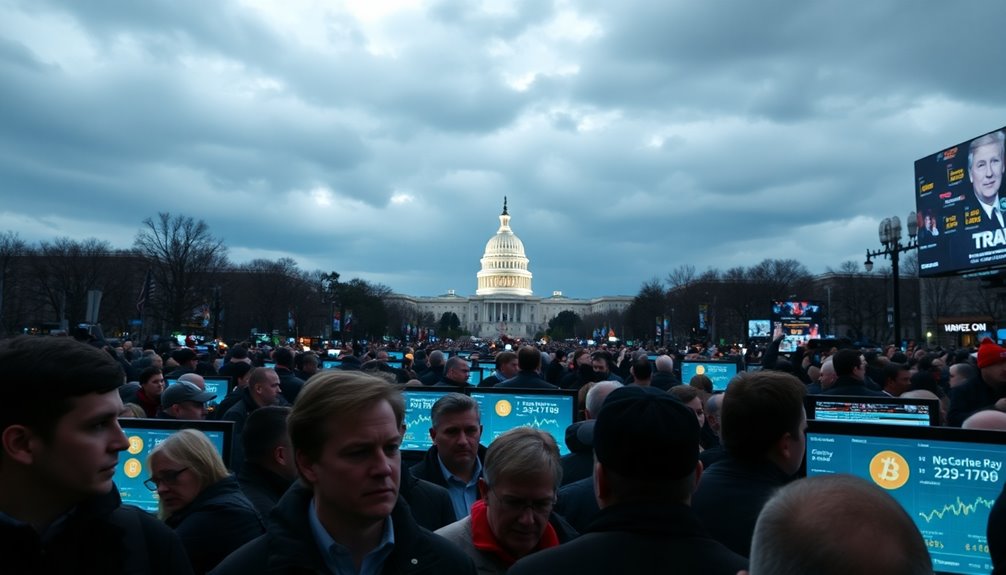
Anticipating a market reaction to the new political landscape, investors are grappling with the implications of Trump's administration on crypto assets.
There's a palpable sense of optimism, especially since Bitcoin has surged past $100,000 for the first time. The total crypto market cap now sits at an impressive $3.81 trillion, fueled by speculation about a potential national strategic Bitcoin reserve. Additionally, the potential for upcoming technological upgrades may further influence market dynamics as investors adjust their portfolios.
However, this euphoria might lead to a significant sell-off if reality doesn't align with expectations. Many investors could find themselves in a panic selling spiral, particularly if they realize Trump's ability to enact swift policy changes is limited. Hayes emphasizes that the market underestimates the time constraints faced by Trump, which could exacerbate selling pressure.
The disconnect between high hopes and actual market movements may create a "harrowing dump." This could impact not just Bitcoin but also other digital assets closely tied to the administration's policies.
Despite these concerns, there's still a prevailing belief in a bullish trend reversal by the second half of 2025. However, it's crucial to temper your expectations and approach the volatile landscape with caution, as the future of crypto adoption remains uncertain in light of ongoing political developments.
As an affiliate, we earn on qualifying purchases.
Strategy of Arthur Hayes
Many investors look to Arthur Hayes for guidance in navigating the crypto landscape, especially during volatile times. His strategy emphasizes solid fundamentals, urging you to invest in crypto assets that have long-term potential rather than reacting emotionally during downturns. Hayes believes in holding onto assets you trust instead of trying to time the market, viewing crypto as a hedge against inflation supported by central banks' monetary policies. Additionally, he suggests considering the benefits of diversification in retirement accounts, which can help manage risk in your overall investment strategy.
Strategically, he plans to reduce holdings before anticipated market downturns, intending to rebuy core positions at lower prices. He suggests lightening up on certain investments ahead of expected sell-offs, while preparing for a potential "crack-up-boom phase" later in 2025. Given that Hayes anticipates a significant market sell-off related to political realities, he emphasizes the importance of staying informed about the broader economic landscape.
Risk management is also crucial to Hayes. He advises against excessive leverage and cautions you to avoid selling during bull runs. Staying calm and maintaining a long-term perspective is vital. Diversifying your investments and adapting strategies based on market conditions can help mitigate risks.
Ultimately, Hayes remains optimistic about crypto's long-term relevance, particularly in light of ongoing economic challenges. By understanding broader trends and preparing for volatility, you can better position yourself in the crypto market.
Impact on Crypto and Equities

In light of the potential crypto dump, the impact on both the crypto market and equities could be significant. If Trump's policies don't meet high expectations, investors may feel disappointed and anxious, leading to a sell-off in the crypto market.
The anticipated crash around January 20, 2025, could trigger panic selling as reality sets in regarding policy implementation delays. With Bitcoin recently trading around $104,002, a drop in prices due to this market reaction could shrink the total crypto market cap significantly. Furthermore, the expectation of a significant reversal in cryptocurrency markets throughout 2025 adds to the uncertainty investors face. This uncertainty is compounded by the fact that user data protection is a growing concern in technology, influencing investor sentiment.
While the equity markets mightn't be directly affected by crypto policy changes, they could still react to the overall market sentiment. If investor confidence wanes due to crypto volatility, you might see risk aversion creep into equity investments as well.
Trump's broader economic policies could also introduce unpredictability, further amplifying volatility across financial markets. Overall, while the direct effects on equities may be less clear, the psychological interplay between crypto and equity markets means you should stay alert to these potential shifts.
Long-Term Predictions

The potential for a significant crypto dump raises questions about the long-term outlook for the market. While short-term fluctuations might cause concern, many projections remain optimistic.
Bitcoin, for instance, is anticipated to reach $100,000 by the end of 2024, with potential highs of $250,000 by late 2025. By 2026, targets soar to between $750,000 and $1 million, driven largely by institutional interest and capital inflows.
Factors like monetary expansion under Trump's policies could create an inflationary environment favorable for Bitcoin. As decentralized assets gain traction amid nationalist economic policies worldwide, the demand for Bitcoin is likely to grow. Moreover, increased regulatory scrutiny could play a significant role in shaping market dynamics post-inauguration.
You should also consider the expected market corrections; four significant dips could occur before a robust recovery in the latter half of 2025. Even with these corrections, the long-term outlook stays bullish, as market dynamics often favor recovery after downturns.
Moreover, a potential financial crisis with negative real rates may further drive diversification into crypto. While the road ahead may include volatility, the broader trends suggest a promising future for Bitcoin and other cryptocurrencies.
Diverging Opinions and Predictions

Diverging opinions and predictions are shaping the crypto landscape as market participants grapple with the implications of potential policy shifts under Trump's administration.
While many expect immediate changes, the reality is that sweeping reforms won't happen overnight. Trump has a limited window to enact significant policy before the 2026 mid-term elections shift focus, making any quick fixes unlikely.
As the inauguration approaches, some traders anticipate a notable sell-off, prompting strategies to trim positions now and re-enter at lower prices in 2025.
Arthur Hayes expresses caution, warning of a potential "harrowing dump," but other analysts like Matrixport predict a strong start for Bitcoin in 2025. Recent predictions suggest a potential "crack-up-boom" phase in the market, indicating a significant shift in [market dynamics by late 2025.]
Standard Chartered even suggests BTC could soar to $200,000, while Bitwise's Matt Hougan advises buying before it hits $500,000.
Market sentiment is mixed, with some fearing immediate downturns while others forecast long-term gains.
Political and economic factors add complexity, but one thing is clear: expectations are high, yet the path ahead remains uncertain.
Your decisions will have to navigate this volatile landscape shaped by diverging predictions and strategies.
Investor Psychology and Behavior

Market sentiment is heavily influenced by investor psychology and behavior, playing a significant role in how individuals react to news and market shifts. You might find yourself driven by emotions like fear and greed, which can lead to FOMO during bull markets and panic selling in bear markets.
Confirmation bias may cause you to interpret information selectively, reinforcing your existing beliefs while ignoring conflicting data. Overconfidence can tempt you to overestimate your predictive abilities, encouraging excessive risk-taking. Cognitive biases can further cloud your judgment, leading to decisions that may not align with market realities. Understanding the importance of emotional manipulation can also help you recognize how your feelings may be swayed by external factors.
Loss aversion often keeps you clinging to losing positions, hoping for a turnaround instead of cutting your losses. You may also anchor your decisions to past price movements, leading to unrealistic expectations about future performance.
The herd mentality can sway your actions, making you follow the crowd rather than think independently. This behavior can amplify market volatility and momentum, driven by social influences from online communities.
Your motivations, whether intrinsic or extrinsic, shape your investment choices, while your self-efficacy and risk preference affect the strategies you adopt. Ultimately, understanding these psychological factors can help you navigate the turbulent waters of the crypto market more effectively.
Political Landscape and Market Dynamics
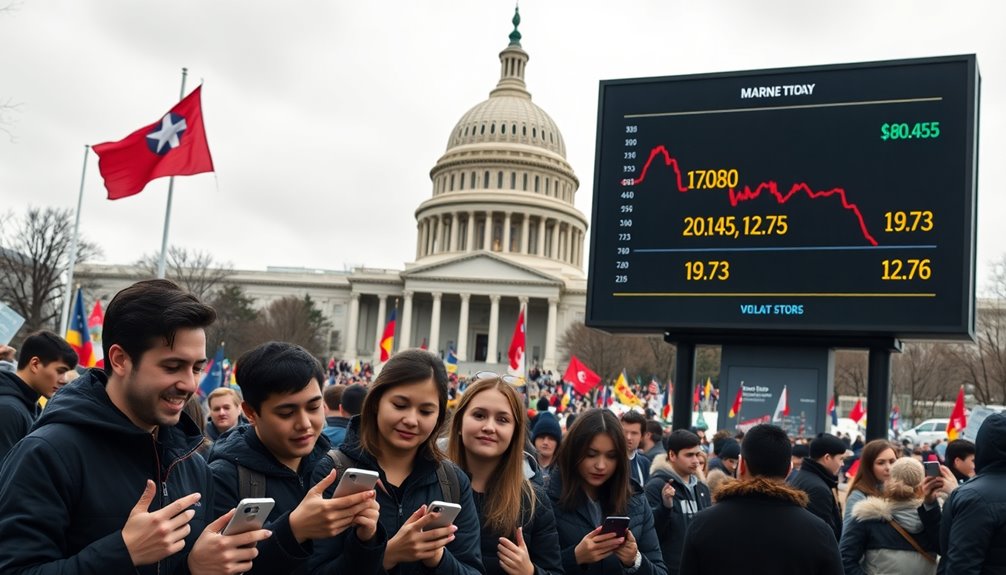
Navigating the political landscape is crucial for understanding how regulatory changes can shape the crypto market dynamics. Changes in government leadership, like the SEC or CFTC, can lead to shifts in crypto regulations that directly impact your investments.
For instance, while the Trump administration favored a conservative approach, the Biden administration prioritizes consumer protection and combating financial crimes. If Republicans gain ground, you might see a more favorable regulatory environment that encourages market-driven innovation. This potential shift indicates that bipartisan support for clear regulatory frameworks could lead to more stable market conditions. Additionally, the evolving landscape of Bitcoin mining regulations may also play a role in shaping market sentiment and investment strategies.
Presidential elections also play a significant role in market sentiment. A pro-crypto president can spark optimism, while anti-crypto candidates often lead to sell-offs. In this context, candidate statements matter; for example, Trump's vision of making the U.S. the "Bitcoin capital" can influence market behavior, even if his policies may not fully materialize.
Moreover, the growing bipartisan support for clear regulatory frameworks suggests a push for innovation while ensuring investor protection. Both parties recognize blockchain's potential, though they differ on implementation.
As the crypto industry becomes more politically engaged, your investment choices might increasingly reflect the evolving political dynamics. Understanding these influences can help you anticipate market trends and navigate potential volatility.
Frequently Asked Questions
How Can Investors Protect Their Assets During a Market Crash?
To protect your assets during a market crash, diversify your investments across various asset classes like stocks, bonds, and cryptocurrencies.
Use stop-loss orders to limit losses and consider dollar-cost averaging to mitigate the impact of volatility.
Keep some cash on hand for opportunistic buying.
Investing in safe-haven assets, such as gold or U.S. Treasury securities, can provide stability.
Regularly reassess your portfolio to align with your risk tolerance and long-term goals.
What Historical Events Correlate With Crypto Market Dumps?
Historical events like the 2008 financial crisis, 2022's inflation, and the FTX collapse directly correlate with crypto market dumps.
During these times, you've seen significant declines in Bitcoin's value, often driven by external pressures like regulatory changes or economic instability.
Additionally, market manipulations such as pump and dump schemes can create rapid sell-offs.
Understanding these correlations helps you navigate the volatile landscape and make more informed investment decisions.
How Does Political Sentiment Affect Cryptocurrency Investments?
Political sentiment significantly impacts your cryptocurrency investments. When candidates express pro-crypto views, it often generates optimism, leading to price increases and attracting new investors.
Conversely, negative narratives, such as environmental concerns or regulatory crackdowns, can trigger market fear, resulting in price drops.
You'll notice that election outcomes shape regulatory landscapes, directly influencing market volatility and your investment strategies.
Staying informed about political developments can help you navigate these market shifts effectively.
Are There Any Indicators to Predict Market Volatility?
To predict market volatility, you can use several indicators. The Average True Range (ATR) gives you insight into price movement ranges, highlighting periods of high volatility.
Bollinger Bands help you identify overbought or oversold conditions by expanding or contracting around a moving average. Additionally, observing divergences between volume and price can signal potential reversals.
Keep an eye on these indicators to better manage your risk and make informed trading decisions.
What Role Do Social Media Trends Play in Crypto Valuations?
Social media trends play a crucial role in crypto valuations. When you notice positive sentiments, it often signals rising prices, while negative vibes can lead to declines.
Influential figures can sway the market significantly with their posts. You’ll find that memes and engaging content foster community trust, which drives demand. As more people engage with these influential figures and their content, a rising meme token gains momentum. This can lead to a surge in demand for the token, resulting in significant market fluctuations. It’s important for investors to carefully consider the impact of influential figures and social media content on their trading decisions.
Conclusion
In light of Arthur Hayes' warning about a potential 'harrowing dump' in crypto during Trump's inauguration, it's crucial to stay vigilant. While his insights highlight possible risks, remember that markets can be unpredictable. Maintain a balanced perspective, weigh the differing opinions, and adapt your strategy accordingly. Keep an eye on the political landscape and its impact on both crypto and equities. Ultimately, informed decisions and a clear understanding of investor psychology can guide you through volatile times.
Fall Picks
fall essentials
As an affiliate, we earn on qualifying purchases.